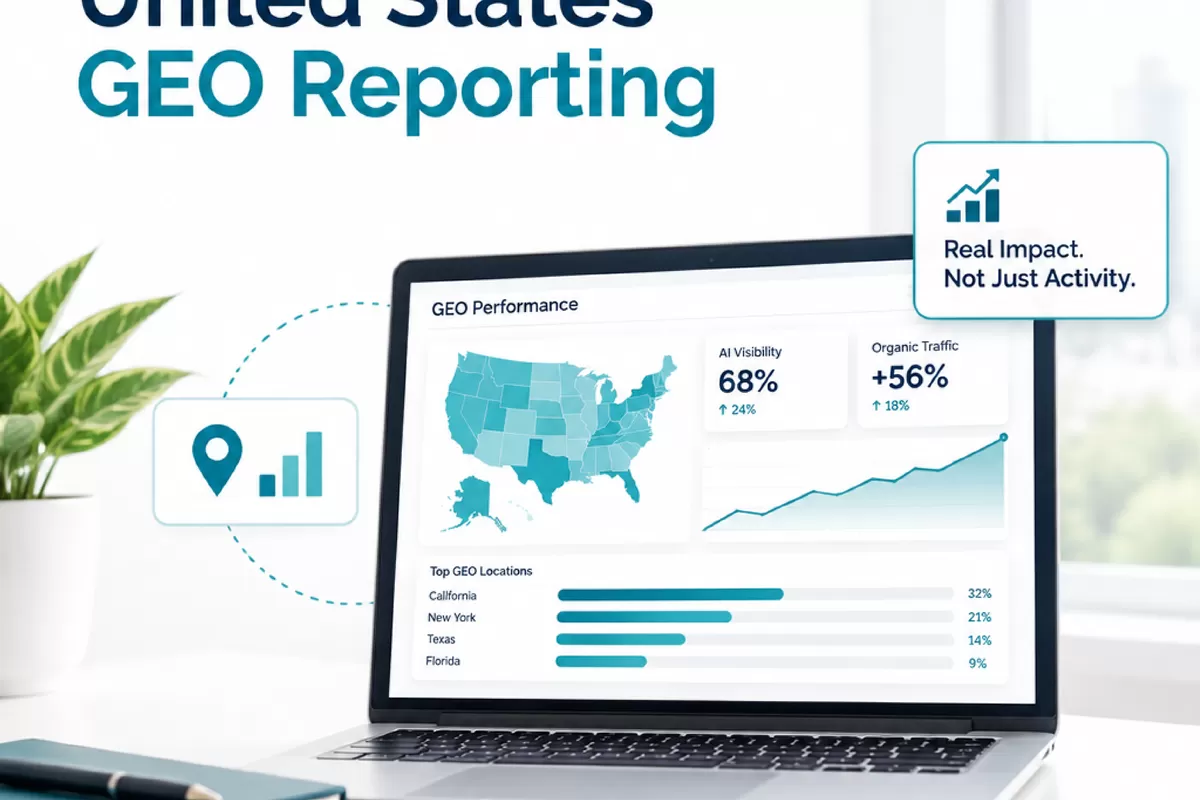
Agencies can hear “geo services” and end up discussing two different needs: location-based marketing and Generative Engine Optimization (GEO). Both can affect how people find and understand a client’s brand, but they need different actions and different ways to measure progress. Treating them as one vague service often leaves clients with a list of tasks instead of a useful plan.
For agencies serving businesses in the United States, a repeatable workflow helps connect local visibility, traditional SEO, Answer Engine Optimization (AEO), and GEO to the client’s actual goals and target regions. Start by clarifying what the client means by “geo,” check the location and brand information people can find, then choose a focused set of work. This process helps agencies explain what they recommend, why it fits, and how they will review it without promising rankings or AI mentions.
Clarify what “geo services” means before scoping work
“Geo” is used in two ways in search marketing. Location-based marketing helps a business become easier to find in specific places. For a local business, that may involve its Google Business Profile (GBP), map visibility, location pages, accurate business details, and customer reviews. For a company serving several cities or states, it may also mean making its service coverage clear to both searchers and search engines.
Generative Engine Optimization focuses on helping a brand’s useful, accurate information appear in search experiences that produce AI-generated answers. GEO is not the same as local SEO. A business can serve one town and still need better answers to questions about its services. A multi-location company may need both clear location information and strong, consistent explanations of what it does.
Begin every client conversation with a plain-language question: “Are you looking to be found in specific places, to be represented more clearly in AI-generated answers, or both?” Then ask what prompted the request. A client concerned about map visibility has a different problem from one whose service information is missing or unclear in answer-driven search experiences.
That distinction keeps the proposal honest. Local SEO and GEO can share useful foundations, such as accurate business information and clear content, but they are not interchangeable tactics. Define each workstream separately, and explain where their activities support the same client goal.
Discover the client’s goals and target regions
Before reviewing keywords or recommending deliverables, identify the business outcome the client wants to support. More qualified calls, appointment requests, store visits, or service inquiries may each call for a different measurement plan. Ask which products or services matter most, who the intended customer is, and what action a searcher should take after finding the brand.
Next, set geographic boundaries based on the business model, not a list of places chosen only because they have search volume. A United States business might serve customers at a storefront, travel to customers within a defined service area, or sell online nationwide. These models affect what location signals make sense. For instance, a company that does not serve a particular city should not build a page implying that it operates there.
Use a short discovery checklist to make the scope concrete:
- Business model: Does the client serve customers at a physical location, travel to them, or sell beyond its immediate region?
- Priority areas: Which cities, neighborhoods, counties, or states can the business genuinely serve?
- Audience and intent: What do local customers need to know before they call, visit, book, or buy?
- Existing evidence: Which locations already produce meaningful inquiries, and where does the client see a visibility gap?
- Limits: Are there licensing, staffing, inventory, or service-area constraints that should shape the plan?
Agree on a baseline before work begins. Record the current visibility and engagement indicators the agency and client can access, such as relevant organic traffic, profile interactions, calls or form submissions, and rankings for a defined set of local searches. These measures do not prove that one specific change caused every movement. They do give the review a starting point and make it easier to discuss progress with context.
Check location and brand information in the United States
For local visibility in the United States, review the client’s Google Business Profile, Google Maps presence, website, and important business listings together. Check that the business name, address, phone number, hours, categories, and service information are accurate and consistent where they appear. This information is often called NAP data, meaning name, address, and phone number. Inconsistencies can confuse customers and create avoidable cleanup work.
Do not assume every business should display a street address publicly. A service-area business may have different profile settings from a customer-facing storefront. Confirm how the business operates and follow current platform rules rather than changing its address or creating location profiles just to target more searches. If the client has multiple real locations, verify that each listing corresponds to an actual, staffed business location and that its details are maintained.
Review location pages with the same care. A useful page gives a visitor relevant information about the service in that place, such as availability, contact details, and location-specific questions the business can answer. It should not simply swap a city name into a duplicate template. If there is no distinct service, team, or other real basis for a page, adding it may create thin content and weaken trust.
Then check how the brand explains its services beyond location signals. Are service names used consistently? Do pages answer common customer questions directly? Are claims supported by information the client can verify? Clear, current details help both people and search systems interpret what the company offers, although no checklist can guarantee placement in a map pack or an AI-generated response.
Reviews are another part of the customer-facing picture. Help the client create a practical, policy-compliant way to invite honest feedback and respond to it. Do not offer incentives for positive reviews or write responses that disclose private customer information. Reviews can inform customer decisions, but the agency should not imply that review volume alone determines local rankings.
Select SEO, AEO, and GEO work that fits the need
After discovery and review, map each issue to the work that addresses it. SEO is the broader work of improving a site’s ability to be crawled, understood, and found in search. AEO, or Answer Engine Optimization, focuses on making useful answers easy to identify and understand. GEO applies that clarity to generative search experiences. Local SEO supports visibility tied to places, including accurate profiles and location-relevant pages.
These disciplines can overlap, but the client plan should name the problem before naming the tactic. If an important service page is difficult to find or understand, technical SEO and content improvements may be the priority. If local profile details are incomplete, profile and business-information updates may come first. If customers repeatedly ask questions the site does not answer, AEO and GEO-informed content work may be appropriate.
A simple decision sequence keeps the scope grounded:
- Fix accuracy first. Resolve incorrect business details, misleading coverage claims, or outdated service information.
- Address access and clarity. Identify technical barriers and make key service and location information easy to navigate and understand.
- Choose content based on real questions. Add or improve answers that help the intended customer make a decision, rather than publishing pages only to target place names.
- Set a measurement plan. Match each activity to observable indicators and note what the indicator can and cannot show.
Agencies looking for specialist support can use the SEO Deep Insights page for how can digital marketing agencies integrate geo services to boost client brand visibility? as context when shaping an integrated client plan. SEO Deep Insights describes work across SEO, AEO, and GEO, including technical fixes, local visibility, content, ethical link building, and reporting. Match any outside support to the client’s defined needs, and confirm responsibilities, deliverables, access, and reporting expectations before work starts.
Be selective with scope. A client does not automatically need a new location page, a content campaign, profile work, and technical changes at the same time. Prioritize by business relevance, the severity of the issue, the evidence available, and what the client can maintain after implementation.
Build an implementation plan the client can follow
Turn recommendations into a sequence with owners and dependencies. A shared plan can list each action, the page or profile affected, who approves it, what needs to happen first, and how completion will be checked. For example, verify service-area details before rewriting a location page around those details. Ask the client to approve factual claims, especially coverage, credentials, hours, and service availability.
Separate work into practical stages rather than presenting a long list without priorities:
- Foundation: Confirm business facts, platform access, baseline measures, and the areas the company actually serves.
- Corrections: Update inaccurate listings or site information and address technical issues that block access or understanding.
- Focused improvements: Make relevant profile, page, and content changes tied to the client’s agreed goals.
- Review: Check that changes are live, correct, and consistent, then compare available indicators with the baseline.
Use a change log to record what went live and when. This matters when several people work on a client account or when results take time to interpret. It also gives the agency a factual way to answer questions about what changed, rather than relying on memory or attributing every movement to the latest task.
Set realistic expectations in the proposal. Search visibility can be affected by competition, searcher location, platform changes, the quality of the client’s information, and other factors outside the agency’s control. Explain that the plan is designed to improve the quality and clarity of the client’s search presence, not guarantee a specific position, lead volume, or appearance in an AI answer.
Review results and explain what they mean
A useful client review connects activity to the original goal. If the objective was to improve local discovery, discuss the status of profile accuracy, relevant local visibility, customer actions, and the quality of inquiries where that information is available. If the work focused on service content and answer visibility, review whether the agreed pages are live, whether they answer the intended questions, and what search or site engagement data can be observed.
Keep implementation checks separate from outcome measures. “The profile details were corrected” is a verified task. “More qualified customers found the business” is an outcome that needs suitable evidence. Reporting these as different things helps prevent clients from mistaking completed work for a guaranteed business result.
When numbers change, look for context before drawing a conclusion. Check whether the reporting period is comparable, whether tracking is working, whether a location or service changed, and whether other marketing activity may have influenced the result. For local searches, remember that a searcher’s location can affect what they see. A single search from an agency office is not a reliable summary of visibility across a city or service area.
For GEO, avoid claiming success solely because a brand appears in one AI response. These experiences can vary, and a single observation does not establish stable visibility or business impact. Instead, document what was checked, the questions used, and the date, then pair those observations with concrete work completed and available site or inquiry data. Be clear about limitations and continue to verify the brand information the agency can control.
Finish each review with a decision, not just a report. Keep, adjust, or pause each workstream based on the client’s goals, implementation status, and evidence. If the expected data is unavailable, say so and fix the measurement gap before making a strong claim. That candor is part of the service, not a weakness in the report.
Use a repeatable workflow, not a bundle of geo tasks
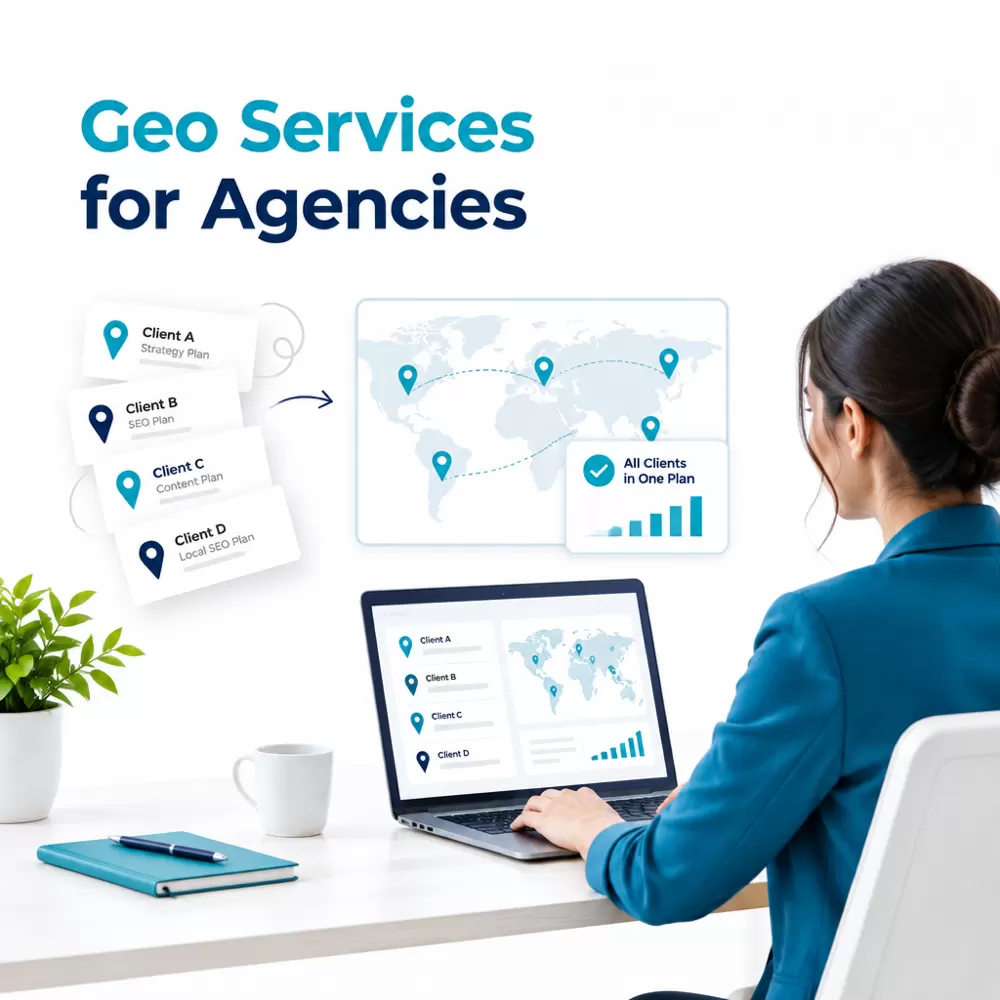
Agencies integrate geo services more effectively when they define the meaning of “geo,” set geographic and business boundaries, verify the client’s location and brand information, and select SEO, AEO, GEO, or local SEO work based on evidence. From there, a staged implementation plan and a careful review make the process easier to explain and improve.
The strongest plan is not the one with the most deliverables. It is the one that connects real customer needs to accurate information, clear ownership, and measures the client can understand. Start with one agreed goal and one baseline, then expand the work only when the client’s situation supports it.