WooCommerce SEO agency proposals can sound convincing while leaving basic questions unanswered: What work will actually happen? Who will make changes to the store? How will progress connect to leads or revenue? If you compare proposals by promises alone, it is difficult to tell whether the services, priorities, and responsibilities match your needs.
A better comparison starts with the work behind the claims. Look for evidence that the agency understands your store, a clear sequence of priorities, WooCommerce-specific technical coverage, defined implementation responsibilities, and reporting that helps you make decisions. The criteria below can help you assess a proposal without assuming that any provider includes a particular service or can guarantee a result.
Why WooCommerce SEO proposals can be hard to compare
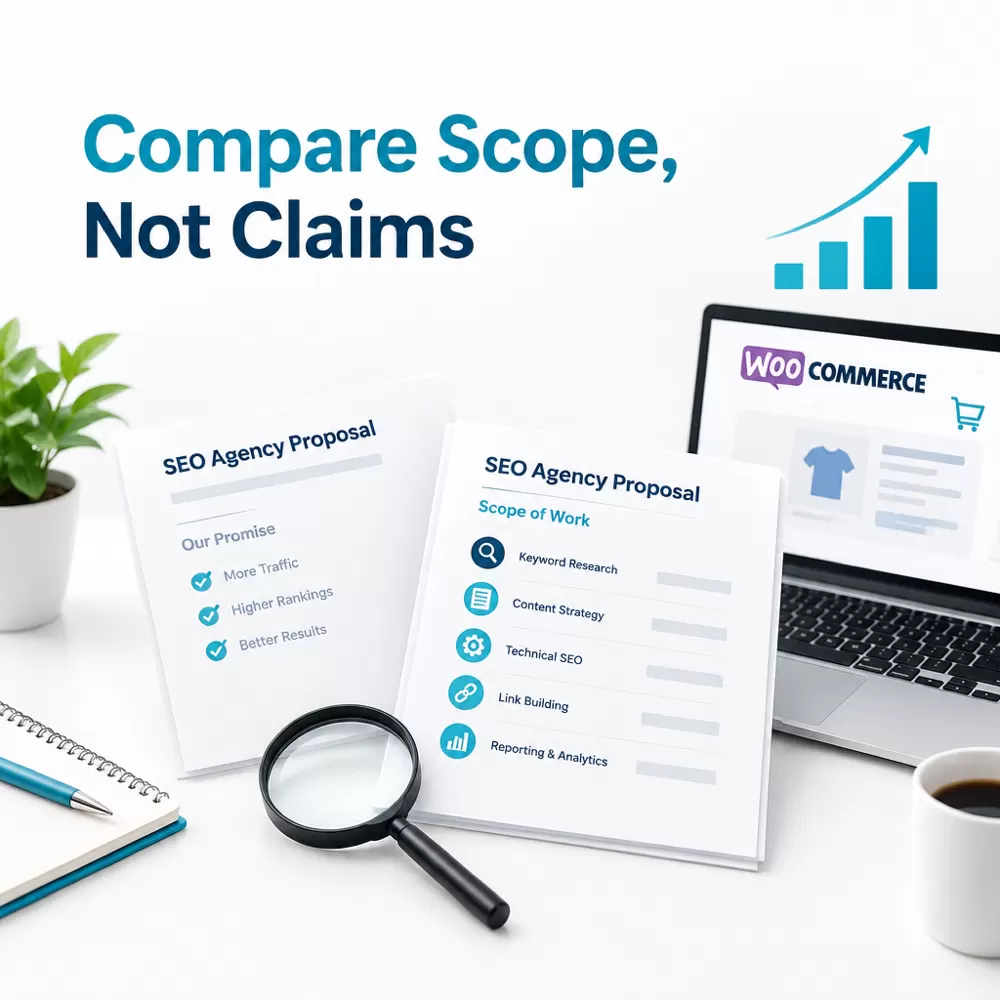
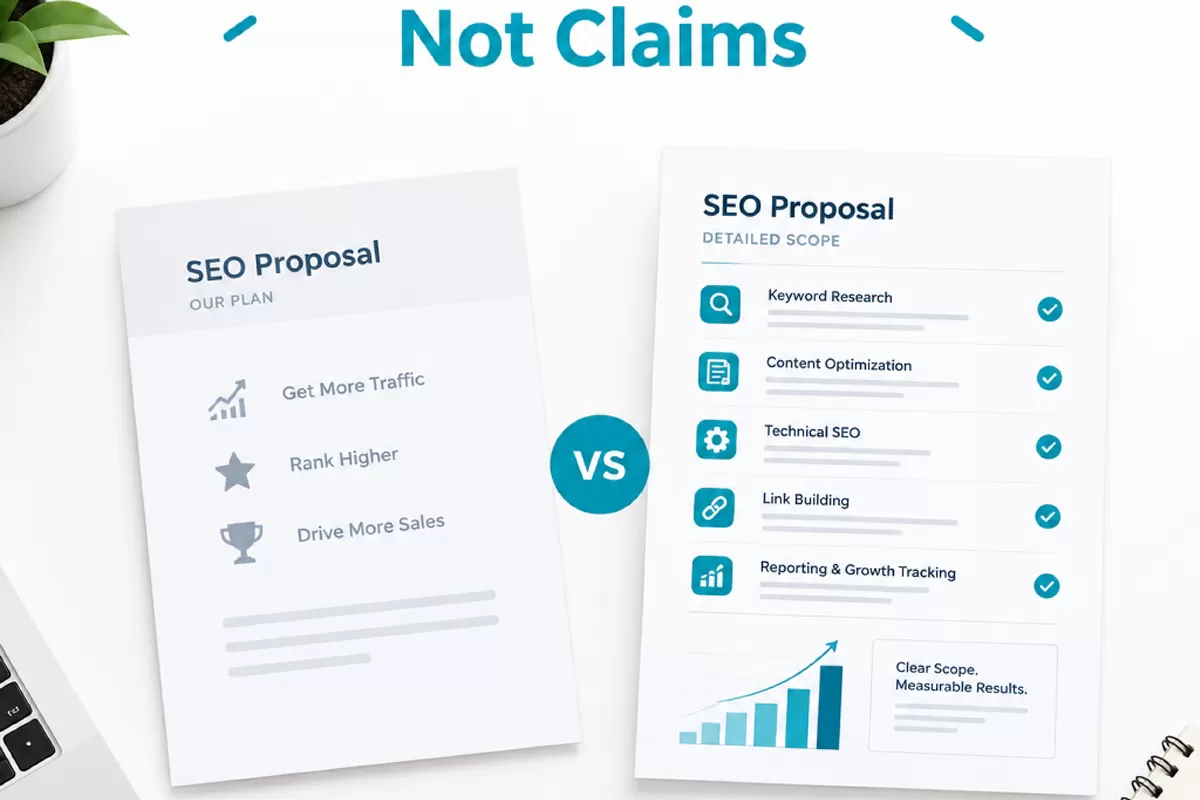
One proposal may emphasize technical SEO, while another focuses on content or visibility in search results. Both may use broad language such as “grow organic traffic” or “improve rankings.” Those goals are not a scope of work. Without details, you cannot tell whether the proposals address the same problems or whether one expects your team to do work the other has included.
Scope describes the tasks and deliverables. Process explains how the work will be prioritized, reviewed, and carried out. Responsibilities clarify who supplies information, approves changes, and implements them. Reporting shows how the work will be assessed. These pieces are connected: a technically thorough audit has limited value if nobody owns the fixes, and a list of content topics is hard to evaluate without a plan for publishing and measurement.
For example, “optimize product pages” could mean reviewing a handful of priority pages, creating recommendations for your team, or editing and publishing changes. Those are different levels of effort and involvement. Ask the agency to define its language rather than filling in the gaps yourself.
This article offers a framework for evaluating proposals, not a substitute for reviewing your store, technical setup, catalog, and business goals. A suitable scope depends on those details. If a proposal is based on limited information, treat its recommendations as preliminary and ask what needs to be verified before the work is finalized.
Compare discovery and priorities before deliverables
A useful proposal should show how the agency reached its priorities. Look for a discovery process that considers your store’s products, category structure, current organic visibility, customer journey, and business goals. The proposal does not need to diagnose every issue before an engagement begins, but it should explain what the agency has reviewed and what still needs investigation.
Priorities should connect a finding to an action. “Improve technical SEO” is too general to assess. A more useful description identifies the area to investigate, why it may matter, and how the agency plans to decide what to address first. The specifics will vary by store, but the reasoning should be understandable.
Check whether the proposed sequence accounts for dependencies. For instance, a content plan may rely on a clear category structure, while changes to product URLs may require careful review of redirects and existing search visibility. An agency should be able to explain what it wants to validate before making a change, not just present a long list of tasks.
- Ask what informed the recommendations. Did the agency review your store and goals, or is the proposal based mostly on a standard package?
- Look for a first-phase plan. Does it explain what will be checked first, what decisions depend on that review, and how the next priorities will be set?
- Separate findings from assumptions. Ask which observations are confirmed and which need access to analytics, the store, or other business information.
- Connect priorities to outcomes you can evaluate. Traffic may be useful, but product discovery, qualified visits, leads, and revenue can provide additional context.
Do not treat a longer audit or task list as proof of a better proposal. A focused set of justified priorities can be more useful than a large inventory with no order, owner, or explanation.
Inspect the WooCommerce-specific technical scope
WooCommerce stores combine a content management system, product catalog, categories, and purchase flow. The technical review should account for how those parts work together. Ask the agency to state which parts of your store it will assess and what kinds of issues are within the proposed scope. Avoid assuming that a general phrase such as “technical SEO” covers every area relevant to your setup.
Depending on the store, useful areas to discuss can include crawl access, indexation, canonical tags, product and category URLs, duplicate or thin pages, redirects, internal links, mobile usability, and structured data. Structured data is code that helps search systems interpret page details. These are evaluation prompts, not a claim that every store has a problem in each area or that every proposal should include the same fixes.
Ask how the agency will distinguish between a technical symptom and its cause. A page that does not appear in search results could have several explanations, so a proposal should not jump straight from a symptom to a broad fix. Clarify whether the scope covers investigation, recommendations, implementation, and a check after changes go live.
Also ask how changes will be handled if they affect product discovery or the shopping experience. Store owners may need to coordinate with a developer, hosting provider, or internal team. The proposal should identify where technical access is needed, how changes will be reviewed, and who will check that key pages still work as expected after implementation.
- Ask which WooCommerce page types are included, such as product, category, and informational pages.
- Clarify whether technical findings come with prioritized recommendations or just an audit document.
- Find out who implements changes and who tests them after release.
- Ask how the agency will flag a recommendation that needs developer review or could affect store functionality.
Evaluate content, local visibility, and authority work
Content proposals should explain what the agency plans to improve and why those pages matter to shoppers. “Create SEO content” leaves too much open. Ask whether the work covers existing product and category copy, new informational content, or both. Find out how topics will be selected, how product knowledge will be gathered, and who approves accurate details before publication.
Useful content work has a clear purpose in the buying journey. A category page may help shoppers compare a group of products, while an informational page may answer a question that arises before purchase. Ask how the proposed content supports those needs and how it will link naturally to relevant products or categories. A publishing target by itself does not show whether the content fits your catalog or customers.
Some proposals may also address Answer Engine Optimization (AEO), which focuses on making useful information easier for answer-focused search experiences to interpret, and Generative Engine Optimization (GEO), which considers how content may be understood and surfaced in generative search experiences. Ask what practical work those terms mean in the proposal. The work should be described as specific content, technical, or measurement tasks, not as a promise of placement in a particular answer.
Local visibility may matter if your business serves customers in a geographic area or has physical locations. Ask how that work relates to your actual service area and store operations. If local search is not relevant to your business model, the proposal should explain why it is included rather than treating it as an automatic requirement.
For link building, ask how potential links are assessed and what methods the agency uses. Ethical link building should be described in clear terms, including how relevance and quality are considered. Be cautious if the proposal relies on vague volume targets or cannot explain how link opportunities are selected. A promise to acquire a set number of links does not, on its own, show whether those links are appropriate for your business.
Define implementation ownership and reporting
A proposal should distinguish between recommendations and completed work. If the agency will provide an audit or a list of tasks, ask who applies the changes. If your team or developer is responsible, clarify whether the agency will provide implementation notes, answer questions, and review the work once it is complete. If the agency expects access to the store, ask how access and approvals will be managed.
Write down the practical handoffs. Who supplies product information? Who approves copy? Who schedules technical releases? Who can pause a change if it conflicts with a promotion or inventory update? When those responsibilities are left implicit, work can stall even when both teams are acting in good faith.
Reporting should help you understand both activity and impact. Ask what the agency plans to report, how often it will share updates, and how it will explain changes in performance. A useful report can connect completed work with organic visibility, relevant visits, leads, and revenue where measurement is available. It should also be clear about limitations, such as tracking gaps or changes that make comparisons less reliable.
Do not judge reporting by the number of charts. Ask what decisions a report is meant to support. Can you see which priorities were completed, what remains blocked, and what the agency recommends next? Are the reported metrics tied to your business goals, or are they presented without context? The agency should explain what it can measure and what depends on your analytics setup or internal data.
A strong proposal makes the path from finding to action to measurement clear. If you cannot tell who does the work or how you will review it, ask for that detail before you compare claims.
Questions to ask a WooCommerce SEO agency before choosing
Use the same questions with each agency so you can compare answers on equal terms. You are not looking for a memorized checklist. You want clear explanations that relate to your store and leave fewer important assumptions unresolved.
- What did you review to shape these priorities, and what still needs to be checked? This helps separate store-specific observations from initial assumptions.
- Which WooCommerce page types and technical areas are in scope? Ask what is included in the review and what would count as additional work.
- Which recommendations will your team implement? If implementation belongs to your team, ask what support, documentation, and follow-up review are included.
- How will you choose content topics and validate product details? Confirm who supplies expertise and who approves material before publication.
- What do AEO, GEO, local visibility, or link building mean in this proposal? Ask for concrete activities rather than relying on the labels alone.
- What will reporting show, and what decisions should it help us make? Clarify the metrics, reporting rhythm, and any measurement limitations.
- What could delay the work or change its priorities? This can surface dependencies such as access, approvals, development capacity, and data quality.
For a clearer picture of the service areas that can be relevant to a WooCommerce store, review this woocommerce seo agency guide. Use it as context for your questions, then evaluate each proposal against your own store and the specific work being offered.
Before choosing, put each proposal into the same simple comparison: discovery, priorities, technical scope, content and visibility work, implementation ownership, and reporting. Mark each item as clearly included, unclear, or outside the stated scope. Then ask for written clarification on the unclear items and confirm who is responsible for any work that sits outside the agency’s role.
A proposal is easier to trust when it explains its limits as plainly as its recommendations. Choose based on how well the process fits your store, how clearly work and responsibilities are defined, and whether reporting can support sensible next decisions. Broad promises may sound appealing, but a transparent scope gives you something concrete to review before work begins.