SEO teams are entering a measurement era where search engine rankings and AI citations both matter, but they do not mean the same thing. That distinction is easy to miss because the surface-level question looks familiar: Did we show up for the query? In practice, the answer depends on whether the system is retrieving documents or interpreting intent and generating its own retrieval behavior.
That difference matters for reporting, prioritization, and executive communication. If a keyword ranks well in Google but rarely appears in AI answers, the issue may not be content quality. It may be that the prompt was rewritten, decomposed, or filtered before the model ever chose a source. Likewise, a strong citation footprint does not automatically mean classic SERP dominance.
Core principle: rank position and citation count are related signals, but they are not interchangeable metrics. Treating them as equivalent creates false confidence and bad optimization decisions.
For SEO Deep Insights readers building modern dashboards, the goal is not to collapse everything into one vanity score. The goal is to measure each visibility layer accurately, then connect those layers to business outcomes. That starts by understanding why the same prompt can produce two very different measurement stories.
Why rank and citation are different metrics
Traditional SEO rank tracking measures where a page appears in a search engine results page for a specific query string. The system is mostly document retrieval: match terms, evaluate relevance, rank candidates, and present links. The query text is central, and the result is tightly tied to the exact phrasing you monitored.
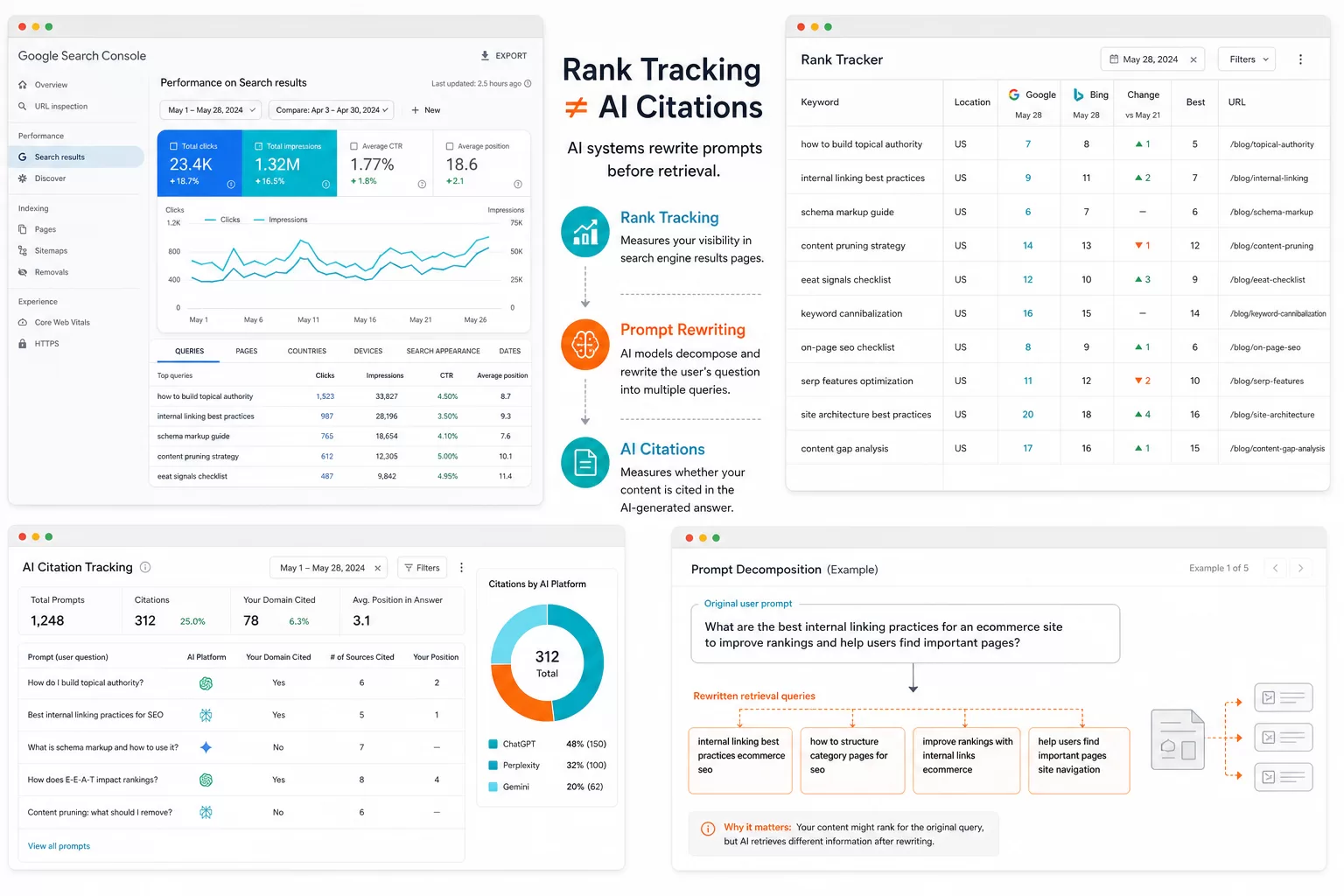
AI citation tracking measures something else entirely. In an LLM-powered answer engine, the model is not simply matching a query to a page. It is interpreting the prompt, deciding what the user likely means, generating one or more retrieval queries, filtering candidate sources, and then deciding whether to cite any of them. The final citation is the output of a multi-step process, not a direct rank equivalent.
That is why a single visibility score is so tempting and so dangerous. It seems efficient, but it hides the operational differences that actually drive performance. A page can rank well for a search query and still fail to be cited if the model rewrites the prompt into a different retrieval shape. The reverse can also happen: a page may be cited in AI answers even if it does not hold a top organic position for the original query.
- Search rankings reflect document relevance to a query string.
- AI citations reflect a model’s interpreted intent and source selection.
- Prompt logs show what the user typed, not necessarily what the model searched.
- Citation counts often hide the retrieval and filtering steps that produced them.
Reporting pitfall: comparing a rank report to a citation report as if they are measuring the same unit is like comparing pageviews to conversions without accounting for the funnel in between.
This is also where long-tail strategy gets misread. Query length is not the same as intent specificity. A longer prompt is not automatically a long-tail keyword, and a short query is not automatically a head term. Word count alone cannot explain why one system surfaces your content and another ignores it.
How AI rewrites your query before retrieval
The most important hidden variable in AI citation tracking is query decomposition. Many LLM-based systems do not search the web using the user’s exact prompt. Instead, they break the prompt into smaller retrieval queries, often shorter and more focused than the original text. In other words, the model acts like a proxy searcher.
That creates a measurement gap. Your dashboard may show the original prompt, but the retrieval event that led to a citation may have been a different string entirely. If the model turns a 20-word prompt into several four- or five-word searches, you are no longer measuring the same query object that you thought you were tracking.
This is why prompt length is such a poor proxy for visibility. A long prompt can be highly specific, but if the model compresses it into a shorter retrieval query, the citation outcome depends on the rewritten version. Likewise, a short prompt can be too ambiguous for the model to resolve cleanly, even if the keyword is easy to understand in a traditional search engine.
Practical takeaway: AI visibility is mediated by hidden transformations: prompt interpretation, retrieval-query generation, and citation filtering. If your reporting ignores those layers, you are measuring the wrong thing.
That hidden layer also explains why some queries behave nonlinearly across systems. A one-word prompt can fail in both places for different reasons: it is too broad for the model and too competitive in search. A highly specific phrase, by contrast, can perform better because it narrows intent and reduces competition. This is not a simple “longer is better” story; it is a specificity and competition story.
For teams working on LLM search behavior, the implication is clear: measure the prompt, but also model the likely retrieval shape. If your content is built around broad noun phrases, it may not align with how the system decomposes conversational intent. If your pages answer precise questions and support related subtopics, they are more likely to survive the query rewrite.
Where reporting breaks
Most reporting problems in a dual-search world come from one assumption: that every visibility signal can be normalized into a single score. That assumption breaks quickly once you compare classic SERP analytics with AI answer engines.
Here are the most common failures we see in search visibility reporting:
- Blended dashboards that combine ranks, citations, impressions, and mentions into one metric with no methodological separation.
- Poor keyword-set design that overweights head terms because they are easy to track, even though they are too vague for AI systems.
- Word-count bias that treats longer prompts as inherently better long-tail opportunities.
- False attribution when a citation is credited to the original prompt even though the model searched a different paraphrase.
- Overreading fluctuations in low-volume, high-specificity queries that behave differently across systems.
The most subtle problem is that the structure of the tracked set can determine the outcome. A team that monitors tight noun phrases may see weak performance because those phrases are both competitive and ambiguous. Another team that tracks full questions may appear stronger because the tracked set matches conversational behavior more closely. Neither dashboard is necessarily wrong, but they are not measuring the same thing.
Do not blend prompt coverage and rank visibility into one score. If the underlying retrieval mechanics differ, the score will be mathematically neat and strategically misleading.
There is also a strategic communication issue. Executives often want one number because one number feels manageable. But if you compress two systems into one metric, you lose the ability to diagnose whether a problem is caused by content gaps, query mismatch, model rewriting, or source selection behavior. That leads to wasted optimization cycles.
Instead, build reporting that separates:
- Classic rankings for target queries in search engines.
- AI citations for prompts and topics in answer engines.
- Prompt coverage for how much of the conversational intent space your content addresses.
- Outcome metrics such as clicks, assisted conversions, leads, or branded demand.
Building a dual-metric dashboard
A useful dashboard for a dual-search world should not try to force equivalence. It should show the relationship between systems while preserving their differences. That means designing around measurement frameworks, not just data exports.
Start with a simple architecture:
- Layer 1: Search rankings — monitor core money terms, topical clusters, and priority long-tail keywords in traditional SERPs.
- Layer 2: AI citations — track prompts, paraphrases, and topic families that trigger citations in AI answer engines.
- Layer 3: Query decomposition — map how prompts are likely rewritten into shorter retrieval queries.
- Layer 4: Business impact — connect both visibility types to traffic quality, conversion rate, and assisted value.
In practice, this means your dashboard should answer different questions:
- What ranks? Use traditional rank tracking and SERP analytics.
- What gets cited? Use AI citation tracking for prompt families and topic coverage.
- What is being rewritten? Compare prompt logs to likely retrieval queries.
- What matters commercially? Tie visibility to pipeline, leads, or revenue signals.
If you are already investing in Answer Engine Optimization (AEO): How to Win Featured Snippets, AI Answers, and Voice Search, this is where the measurement model becomes critical. AEO is not just about producing answer-friendly content. It is about understanding which queries are likely to be answered directly, which are likely to be decomposed, and which are still dominated by classic blue-link discovery.
The same logic applies to Generative Engine Optimization (GEO): Get Cited in ChatGPT, Gemini, Perplexity, and AI Overviews. GEO reporting should not be a repackaged rank report. It should reflect how generative systems source, paraphrase, and cite information across different prompt shapes.
Practical implications for SEO teams
For SEO teams, the strategic shift is less about chasing a new metric and more about improving measurement quality. That starts with cleaner definitions and ends with better decisions.
- Audit your keyword set for intent specificity, not just word count. A “long” query is only useful if it reflects a meaningful search or prompt pattern.
- Separate reporting streams for rankings, citations, and prompt coverage so stakeholders can see where each signal comes from.
- Test paraphrase variants of important prompts. The model may retrieve differently when the wording changes slightly.
- Prioritize topic clusters that answer adjacent questions, since AI systems often decompose prompts into multiple smaller searches.
- Use outcome-based validation to decide whether visibility is actually driving value.
There is a deeper implication here for strategy. If AI systems rewrite user prompts before retrieval, then content must be designed for both the original query and the inferred subqueries. That means clearer definitions, better topical coverage, more explicit supporting language, and stronger entity relationships. It also means teams should stop assuming that a strong keyword rank automatically translates into AI answer visibility.
Bottom line: in a dual-search world, the winning team is not the one with the flashiest blended dashboard. It is the team that can explain exactly what was measured, what was rewritten, and what business outcome followed.
SEO is not losing relevance; it is gaining another retrieval layer. The challenge is to measure that layer without confusing it with the one we already know. When rankings and citations are reported separately, the story becomes clearer: where you are visible, how you are discovered, and which system is doing the work.