AI Overviews are forcing a hard reset in how SEO teams interpret visibility. A page can be cited by Google’s AI and still fail to win the outcome that matters most: being recommended. That distinction is not academic. It changes how brands should build “best” content, how they measure performance, and how they think about authority in AI search.
For B2B software queries especially, the old playbook of publishing a self-promotional best listicle and expecting it to drive preference is getting less reliable. AI systems may still use that page as source material, but then recommend a competitor instead. In other words, your content can help train the answer while your brand gets left out of the answer.
Key takeaway: In AI search, citation visibility is not the same as recommendation visibility. If your reporting treats them as interchangeable, you may be overestimating your real market position.
What the study found
For hands-on help with this topic, explore SEO Services for Legal Services.
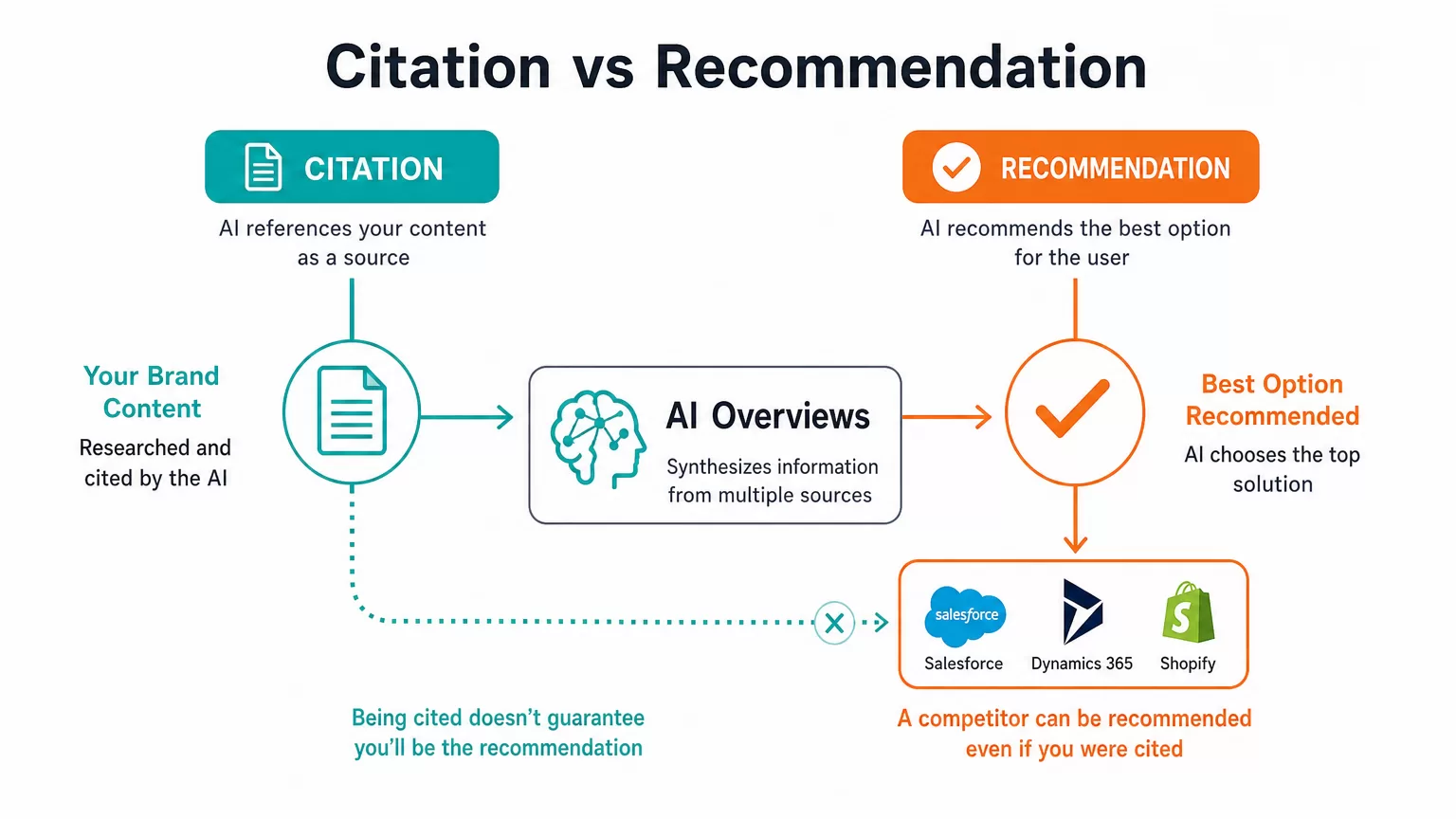
The pattern is simple but strategically uncomfortable. In a sample of 100 B2B “best [category] software” queries, AI Overviews frequently cited brand-owned listicles. Across the observed prompts, those self-promotional pages were cited 323 times. But citation did not reliably translate into endorsement.
In 224 cases, Google cited a brand’s own page and still did not recommend that brand. That means the mismatch showed up in 69% of cases. For teams that have been treating AI citations as a proxy for success, that is a major warning sign.
The broader pattern also matters. The queries were checked across three dates, and 80 prompts triggered an AI Overview. This was not a one-off anomaly. It suggests a repeatable behavior in a query class where brands often rely on “best” pages to capture demand.
- Self-promotional listicles can be used as source material.
- Competitors can still be recommended over the citing brand.
- External authority appears to matter more than self-assertion.
That last point is especially important for B2B SEO. If a brand’s own page says it is the best, but the ecosystem does not reinforce that claim, AI systems may treat the page as a useful input and still reject the brand as the final answer.
Why citations are not recommendations
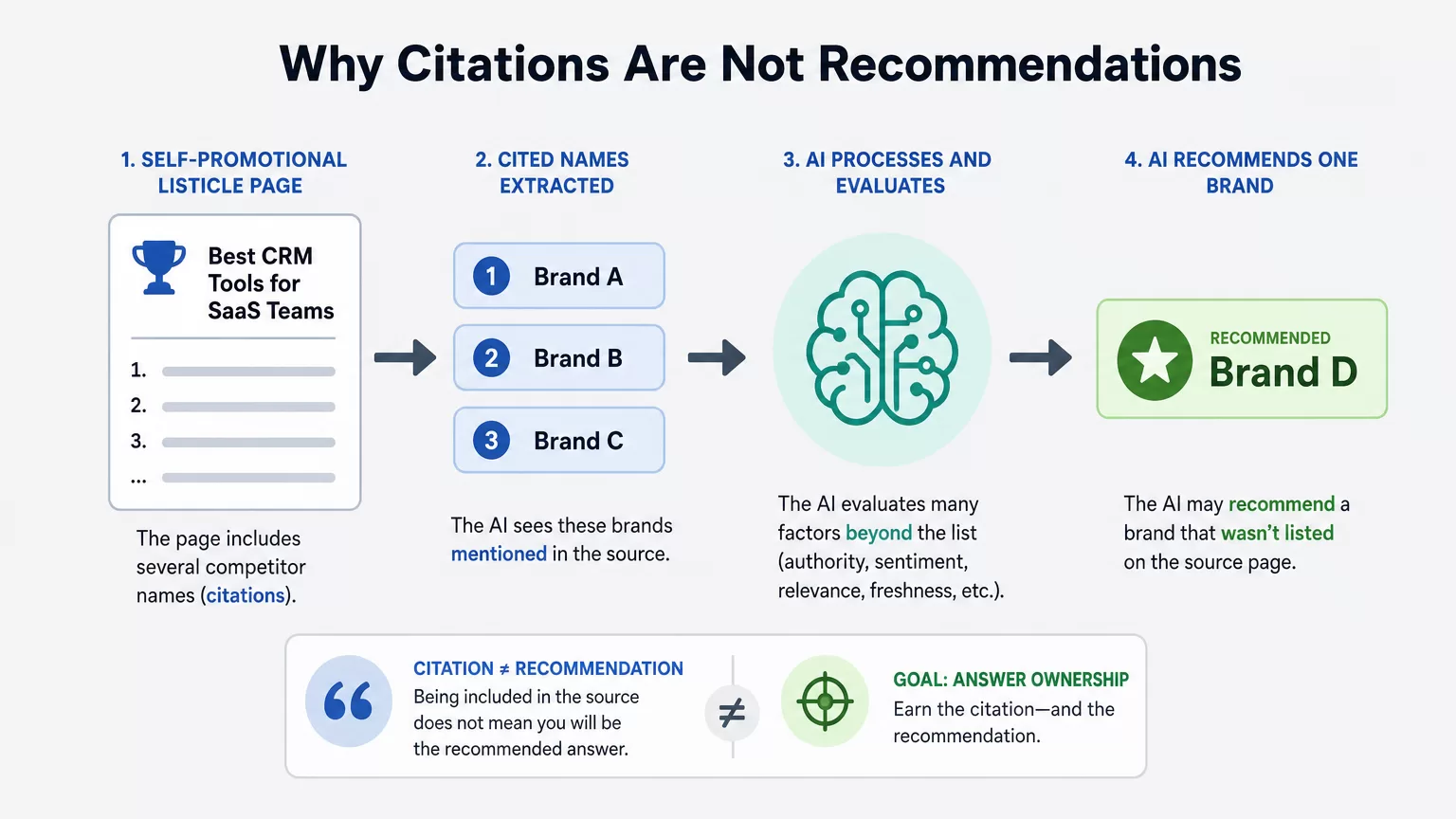
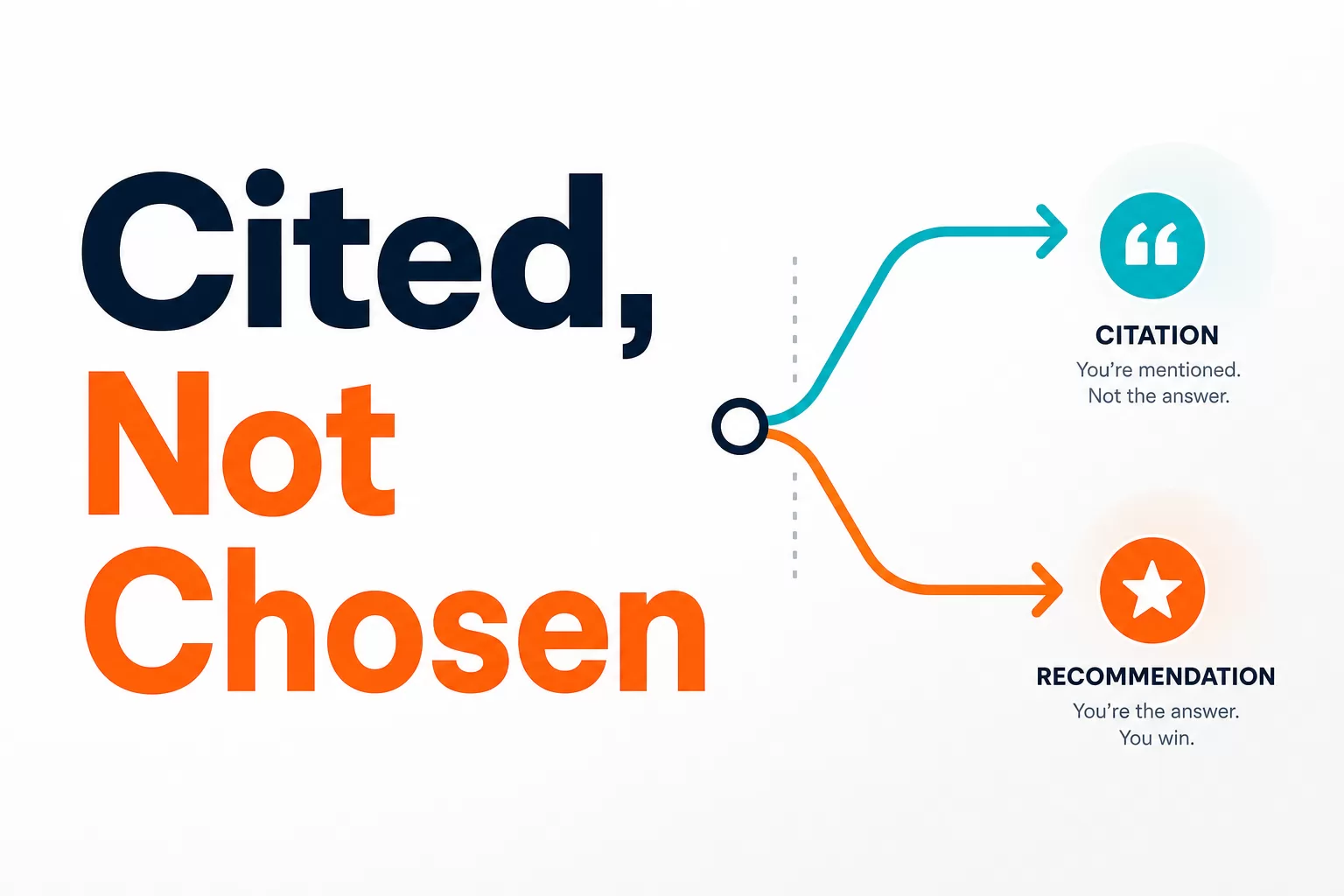
This is the conceptual shift that many SEO dashboards still miss. A citation means the model used a page as a source. A recommendation means the model surfaced a brand as the answer-worthy choice. Those are different layers of trust, and they do not always move together.
Think of it this way: a page can be informative enough to quote, but not authoritative enough to endorse. That is especially likely when the page is a self-promotional listicle that places the brand first and frames competitors as supporting names. Historically, this could work as a ranking and conversion tactic. In AI Overviews, it can backfire.
Why this matters: AI systems may extract the competitive shortlist from your page, then decide the shortlist belongs to someone else.
That creates a strange but very real content dynamic:
- Your page helps define the category.
- Your page names the competitors.
- The AI uses that information to recommend the competitors.
- Your brand receives visibility without preference.
This is why the old assumption that “if we rank, we win” no longer holds cleanly in AI search. We now have to separate source inclusion from answer ownership. A page can contribute to the answer without controlling the recommendation.
The implication for Generative Engine Optimization (GEO) is straightforward: brands need to optimize not just for being read, but for being trusted enough to be selected. That requires stronger external validation, better evidence, and clearer category leadership than a self-ranked listicle can usually provide on its own.
It also explains why third-party signals matter so much. The analysis showed a broader reliance on external sources, with more citations flowing to community and media-style content. In practical terms, AI appears to reward what the ecosystem says about a brand more than what the brand says about itself.
How brands can adapt
The response is not to stop publishing “best” content altogether. The response is to stop treating that format as a standalone authority engine. Brands need a more durable strategy built around earned credibility, not just self-declared superiority.
For teams working in competitive B2B categories, the shift should look like this:
- Move from self-promotion to proof. Add third-party validation, customer evidence, expert commentary, and transparent methodology.
- Reduce dependence on first-place self-ranking. If every listicle puts your brand first, AI may still cite the page but ignore the claim.
- Build broader category authority. Mentions, links, and independent references can matter more than repeating “we are the best.”
- Use comparison content with real differentiation. Explain who the product is for, where it fits, and where it does not.
- Support the page with ecosystem signals. Thought leadership, product education, and third-party mentions help reinforce credibility.
For answer-focused programs, an Answer Engine Optimization (AEO) mindset helps. The goal is not just to surface in the answer box; it is to become the most defensible answer. That means aligning content with user intent, external evidence, and the kinds of signals AI systems appear to trust.
There is also a practical content strategy lesson here. Brands that rely heavily on large-scale “best” page production, especially AI-generated variants, may be amplifying the wrong signal. More pages do not automatically create more recommendation power. In some cases, they simply create more opportunities for AI to cite your content and recommend someone else.
One useful test is to ask a blunt question about each commercial page: Would a neutral reader believe this because it is true, or because we said it? If the answer is mostly the latter, the page may still be useful for indexing and citation, but weak for recommendation.
Measurement and risk implications
This is where many teams get into trouble. Traditional reporting often bundles everything together: rankings, impressions, clicks, and now AI citations. But if citation and recommendation are separate outcomes, they need separate measurement frameworks.
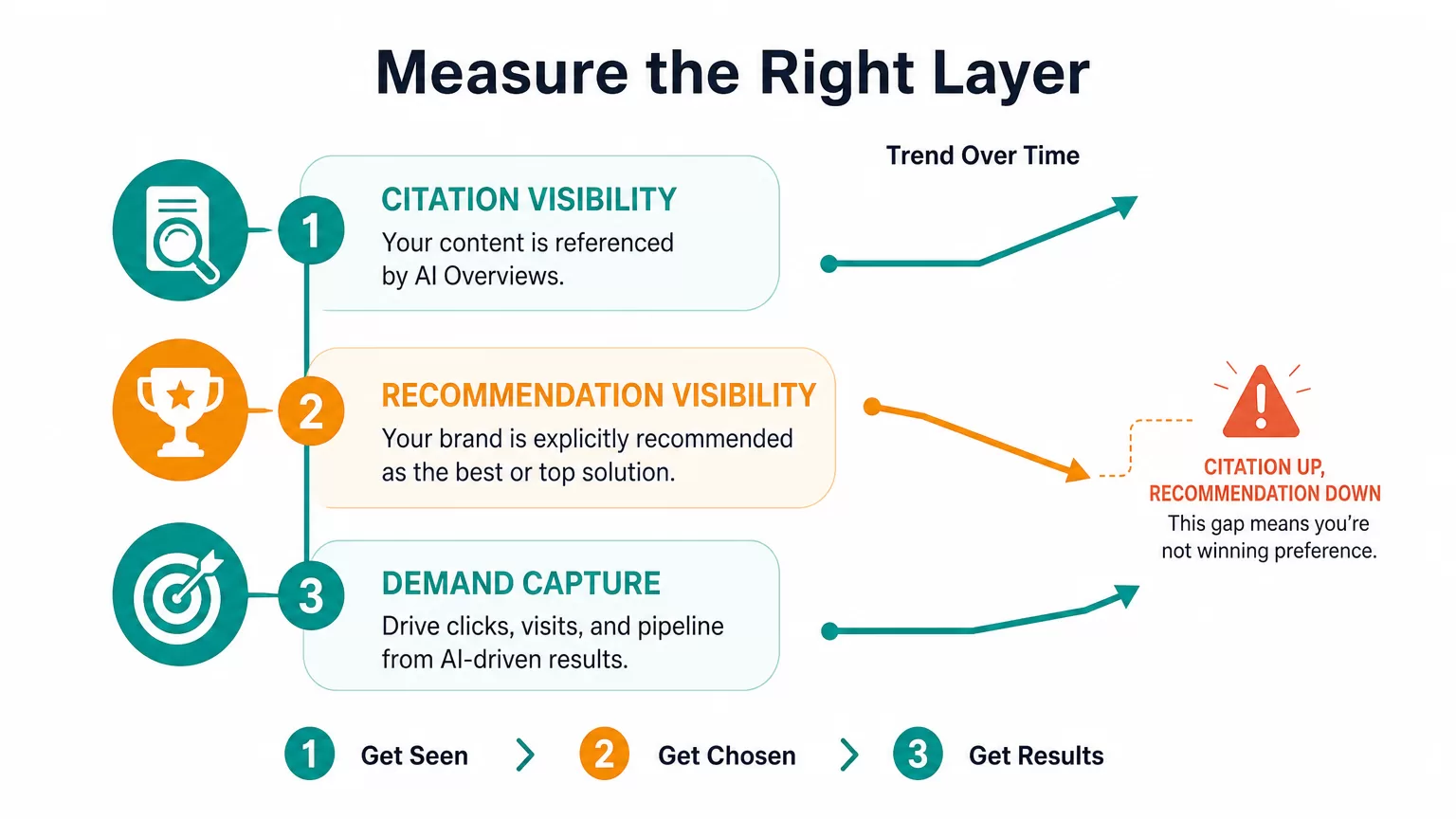
At minimum, teams should track three different layers:
- Citation visibility: how often the brand’s pages are used as sources.
- Recommendation visibility: how often the brand is actually named as the preferred option.
- Demand capture: whether that visibility leads to clicks, branded searches, demos, or assisted conversions.
Without that separation, a report can look healthy while actual preference declines. A brand may celebrate being cited in AI Overviews while competitors quietly absorb the recommendation share.
Measurement warning: A rising citation count can mask a falling recommendation rate. If you only report source inclusion, you may miss organic visibility decline until it is already hurting pipeline.
The visibility risk is not theoretical. Earlier observations in this space have linked heavy dependence on self-ranked “best” pages with 30% to 50% visibility declines in some SaaS and B2B contexts. The pattern suggests that scaling the wrong content model can create fragility rather than resilience.
There is also a compliance angle. When company-controlled pages are presented in ways that resemble independent reviews or objective rankings, brands should review disclosure practices carefully. Depending on the structure and claims involved, there can be FTC Consumer Review Rule risk if disclosures are unclear or if the content implies independent endorsement where none exists.
That risk is not limited to legal teams. It affects SEO operations too. If a page is designed to influence consumers by appearing neutral while actually being promotional, it may create reputational and regulatory exposure alongside search performance issues.
For teams in regulated or review-sensitive categories, this should trigger a content audit immediately. Ask whether the page is clearly labeled, whether the methodology is transparent, and whether the page could be reasonably interpreted as an objective resource rather than a sales asset.
Practical SEO/GEO actions
If AI Overviews can cite your content without endorsing your brand, the strategy has to evolve. Here are the practical moves we recommend for modern SEO, AEO, and GEO programs:
- Audit all “best” listicles. Identify pages that rank your own brand first and rely on thin competitive framing.
- Separate citation goals from recommendation goals. Build reporting that shows both, not one blended metric.
- Strengthen third-party proof. Earn mentions, reviews, expert quotes, and references from credible external sources.
- Rewrite comparison pages for usefulness. Focus on fit, constraints, use cases, and decision criteria instead of self-congratulation.
- Expand beyond listicles. Publish product education, category explainers, and problem-solving content that builds trust over time.
- Review disclosure language. Make sure promotional intent, methodology, and review criteria are clear.
- Track AI Overviews manually. Monitor whether your content is being cited, whether your brand is recommended, and which competitors are winning the final slot.
In practice, the strongest strategy is to build a content ecosystem that can survive the AI filter. That means less dependence on self-asserted “best” claims and more investment in category authority. It also means accepting a harder truth: in AI search, the page that gets read is not always the brand that gets chosen.
For brands serious about long-term search performance, this is the moment to align SEO with GEO strategy, AEO, and real-world trust signals. The goal is no longer just to be visible in the citation layer. The goal is to become the recommendation that remains after the model has filtered out the noise.
Bottom line: AI Overviews have made the gap between being cited and being recommended impossible to ignore. Brands that keep optimizing only for source inclusion will miss the bigger prize: answer ownership, category trust, and durable demand capture.