For years, SEO teams have been trained to read performance through a familiar lens: rankings, organic traffic, and conversions. Those metrics still matter. But they no longer tell the full story of how buyers discover, evaluate, and choose brands.
Today, search performance is shaped across search engines, AI answers, social platforms, review sites, marketplaces, and private communities. By the time a buyer lands on a website, much of the decision-making has already happened elsewhere. That means a healthy dashboard can still hide a strategic problem.
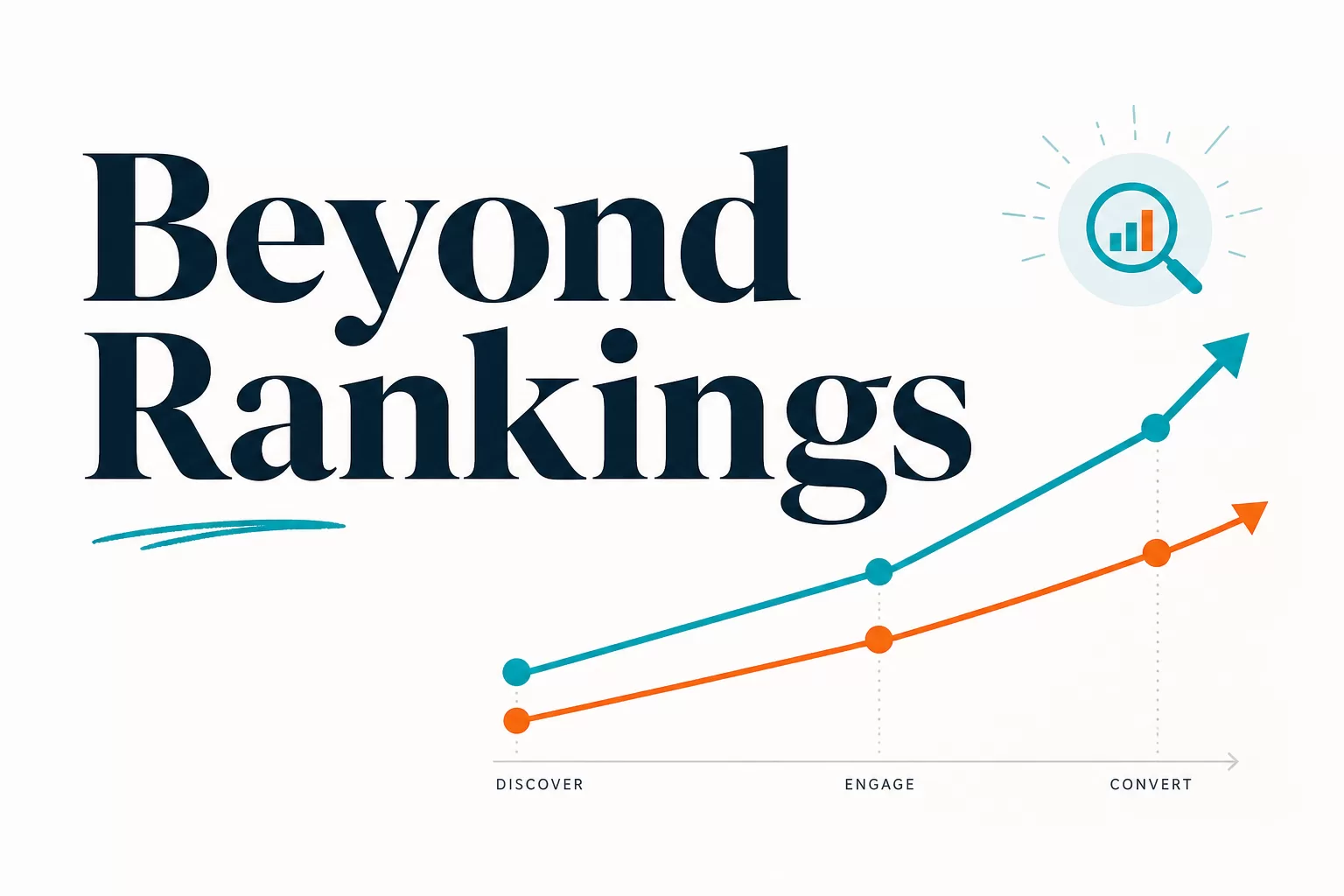
The key shift: search performance is no longer just about winning clicks. It is about being present where demand forms, being interpreted correctly when you appear, and building momentum that compounds over time.
That framework is more useful than rankings alone because it reflects how modern buyers actually move. They ask questions in one place, compare options in another, and validate trust in a third. If your measurement model ignores that journey, you may optimize the wrong layer of the funnel.
Why rankings alone miss real performance
For hands-on help with this topic, explore SEO Services for Real Estate.
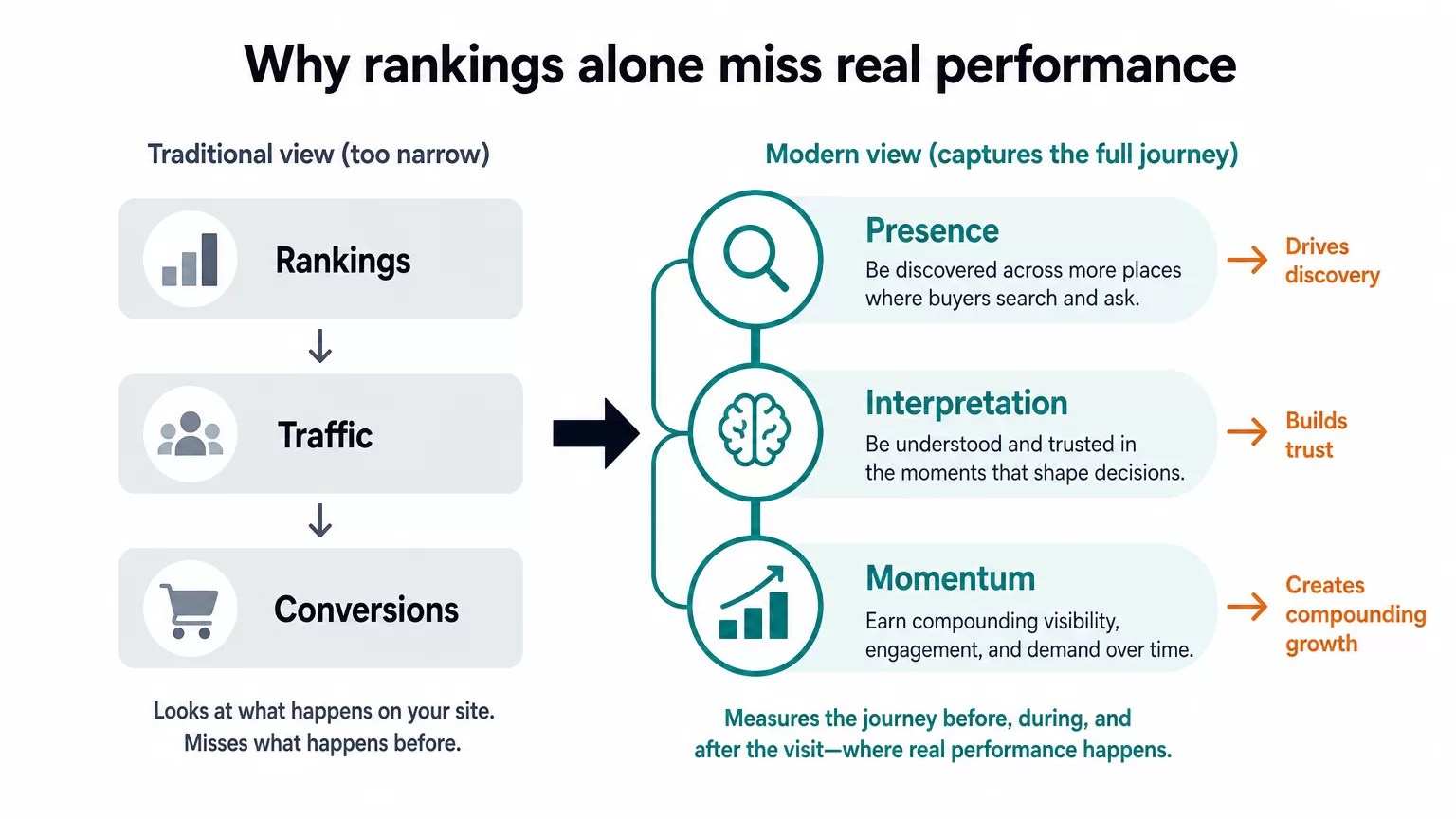
Rankings are an outcome, not the full diagnosis. A page can rank well and still fail to create market share. It can generate traffic and still attract the wrong audience. It can even convert efficiently while missing the category discovery moments that shape long-term growth.
This is where many teams over-credit conversion efficiency. Strong branded search, respectable CPA, and steady lead volume can look like proof of health. But those signals may only show that existing demand is being harvested well. They do not prove the brand is winning the broader market conversation.
That distinction matters because brand discovery happens before brand intent. If a buyer first encounters the category through comparison searches, creator content, marketplace browsing, reviews, or an AI-generated answer, then a site that only performs once the brand is already known is arriving too late.
Important warning: CRO cannot fix upstream invisibility. If your brand is absent during exploration, there is nothing for a landing page to convert.
This is why SEO teams need a measurement model that captures more than the final click. A better model asks:
- Are we visible where demand starts?
- Are we being understood in a way that reduces doubt?
- Is our visibility compounding into stronger market position?
Once you start asking those questions, rankings become one input among many, not the entire scorecard.
The three questions that reveal search success
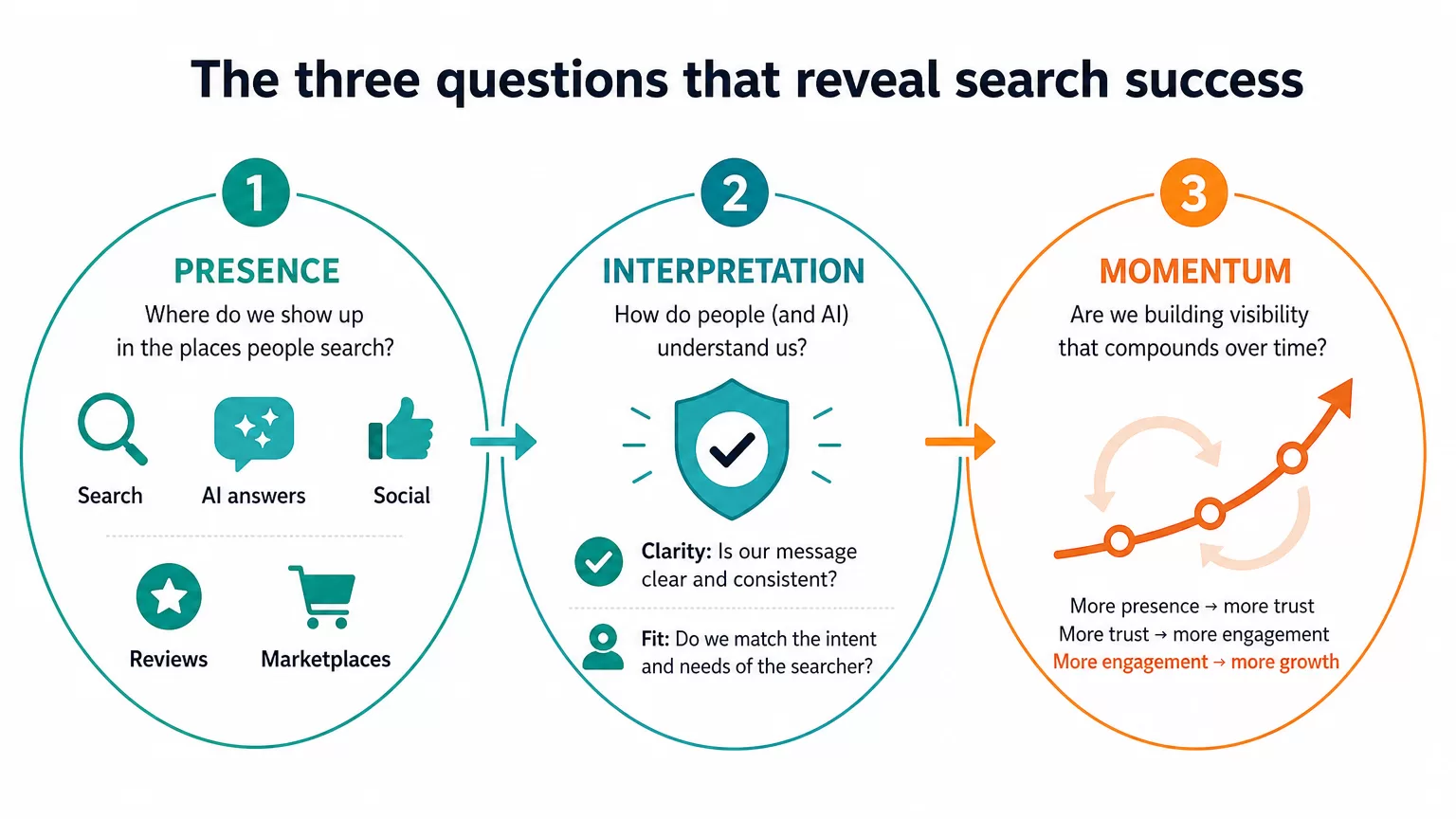
Search performance is easier to diagnose when you break it into three questions: presence, interpretation, and momentum. Together, they show whether a brand is discoverable, credible, and compounding.
Measuring presence where demand forms
Presence asks whether your brand shows up where category demand begins, not just where it converts. That includes early informational queries, comparison searches, review consumption, marketplace browsing, creator-led discovery, social search, and AI-generated answers.
In practice, presence is about more than ranking for a few commercial terms. It is about being included in the places where buyers first define the problem and shortlist solutions. If your brand only appears in branded searches, you may be harvesting demand created elsewhere instead of shaping it.
To measure presence, teams should track:
- Unbranded visibility for problem-aware and solution-aware queries
- Category share of voice across search and AI surfaces
- Inclusion in review and marketplace discovery
- Visibility in social search and creator mentions
This matters especially in categories where exploration is long and consideration sets are fluid. In those environments, missing early discovery moments means missing the shortlist entirely.
If your team is building a broader visibility strategy, our guide to Generative Engine Optimization (GEO) is a useful next step for understanding how brands appear inside AI-generated answers.
Measuring interpretation and trust
Interpretation asks a different question: when people find you, do they understand you the right way?
Visibility without favorable interpretation is fragile. A brand can appear in search results or AI answers and still lose because the summary is vague, incomplete, inconsistent, or unconvincing. Buyers are not just asking, “Does this brand exist?” They are asking, “Is it right for me?”
That judgment is shaped by how your brand is described across channels. If ads, organic snippets, reviews, landing pages, and AI answers tell different stories, the buyer has to assemble the narrative themselves. That creates friction and weakens trust.
Interpretation is where trust becomes measurable: the question is not only whether you were found, but whether the market understood you as a credible choice.
Useful signals for interpretation include:
- Branded vs. unbranded demand mix
- Review sentiment and recurring objections
- Click-through behavior from comparison queries
- Conversion quality by intent stage
- AI answer consistency across core topics
AI search makes this even more important. Brands are no longer competing only for clicks; they are competing to be included, described, and trusted inside an answer. That answer may be compressed, unstable, and different from month to month. A source can be cited often and still send very little traffic. Yet the traffic it does send may be unusually valuable.
That is why referral volume alone is not enough. Some AI-driven visitors convert at much higher rates than traditional search visitors, which means teams should evaluate traffic quality alongside traffic quantity. For a deeper look at this shift, see What Improves AI Search Visibility.
Measuring momentum and compounding
Momentum asks whether visibility is compounding or merely holding steady.
Static rankings can flatter a weak strategy. Momentum reveals whether presence and interpretation are reinforcing one another over time. Are you showing up in more discovery moments? Are AI answers mentioning you more consistently? Are review sentiment and social validation improving? Is unbranded demand growing faster than branded demand alone?
Momentum shows up as:
- Rising share of voice in category discovery queries
- More frequent inclusion in AI and answer-engine results
- Improving conversion efficiency from new audiences
- Growing non-brand traffic from high-intent queries
- Stronger downstream engagement from previously unfamiliar users
The strategic value of momentum is that it separates temporary wins from durable growth. A campaign spike is not the same as a compounding advantage. If visibility does not widen the next opportunity, it is not truly building market position.
What the data says about AI visibility by category
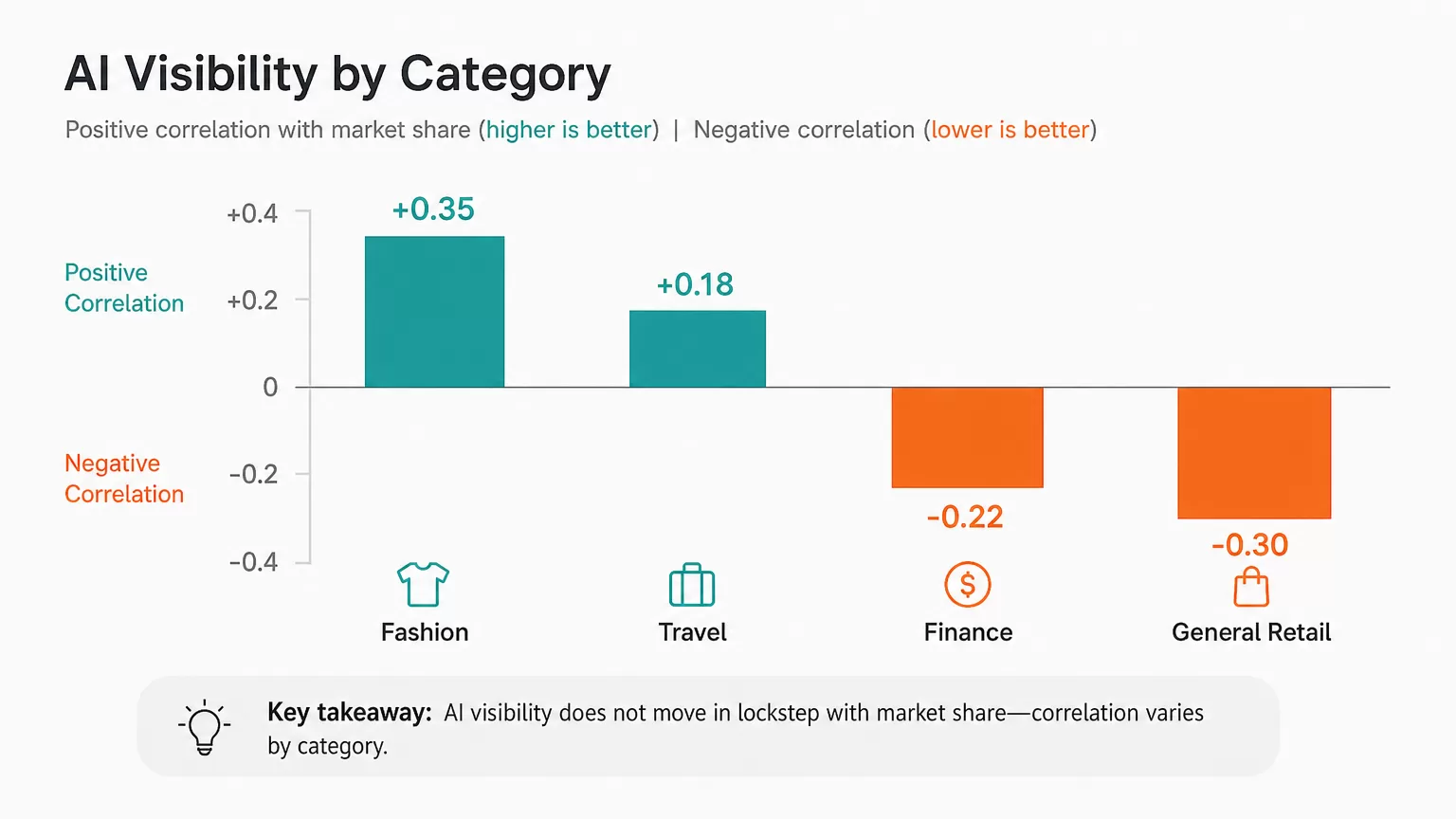
One of the most important lessons from recent visibility patterns is that AI visibility is not universally predictive of market share. That may sound counterintuitive, but category behavior matters. A metric that is meaningful in one industry can be weak or even misleading in another.
Across a broad set of tracked brands, the relationship between LLM visibility and market share is only modest on average. In some categories, the relationship is strong. In others, it is neutral or negative. That means generic advice to “be everywhere in AI” is too simplistic.
Here is the practical takeaway:
- Fashion tends to show a stronger positive relationship between AI visibility and market share.
- Travel also shows a meaningful positive relationship, which fits a category where early discovery strongly shapes the shortlist.
- Finance can show a negative relationship, suggesting that AI visibility does not automatically map to commercial strength.
- General retail may also show a negative relationship, reinforcing the need for category-specific measurement.
Why does this happen? Because categories differ in how people search, how much trust is required, and where decisions are made. In travel, buyers often begin with broad exploration and comparison. In finance, trust, regulation, and brand preference may behave very differently. In retail, marketplaces and price comparison can dominate the decision path.
Bottom line: AI visibility should be measured as a category-specific signal, not as a universal proxy for market share.
That nuance is critical for SEO leaders. If your category is highly exploratory, AI inclusion may be a major discovery lever. If your category is trust-heavy or transaction-heavy, AI visibility may still matter, but its commercial impact may look very different.
Practical measurement framework for SEO teams
To operationalize presence, interpretation, and momentum, SEO teams need a measurement framework that connects search data with broader discovery signals.
Start with a simple audit:
- Presence audit: Where do buyers first encounter the category? Map visibility across search, AI answers, marketplaces, reviews, and social search.
- Interpretation audit: How is the brand described? Compare messaging across snippets, AI summaries, reviews, and landing pages.
- Momentum audit: Is unbranded visibility growing? Are branded searches rising because of discovery, or only because of retention and repeat demand?
Then connect those audits to business outcomes:
- Discovery metrics: unbranded impressions, share of voice, category mentions
- Trust metrics: review sentiment, comparison CTR, assisted conversions
- Growth metrics: new-user conversion rate, repeat visibility, branded demand lift
This is also where teams should be careful not to over-isolate channels. Search performance is now multi-surface. A brand may gain credibility in reviews, get discovered through social search, and then close through organic or direct traffic. The channel that gets the last click is not always the channel that created the opportunity.
If you manage multiple verticals, segment your reporting by category rather than forcing one universal benchmark. A travel brand, a finance brand, and a retail brand may all be “visible” in very different ways. The right question is not whether AI visibility matters in general. It is where it matters, how it is interpreted, and whether it compounds.
SEO teams that win the next era of search will not just report rankings. They will diagnose discovery, trust, and compounding growth across the full buyer journey.
That is the real advantage of this framework. It turns search performance from a narrow reporting exercise into a strategic system for understanding market presence. And once you measure the right things, you can build the right ones.