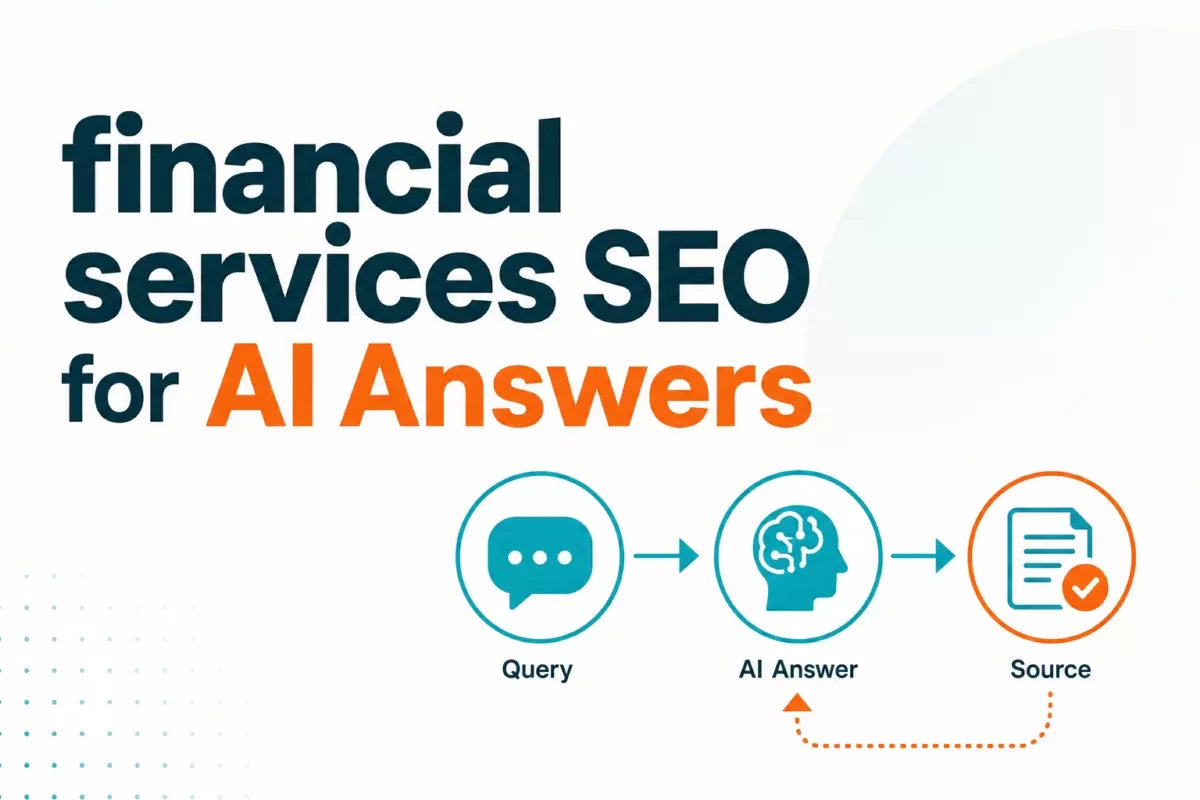
Search visibility is no longer just about ranking blue links. Today, users may find answers in traditional search results, featured snippets, AI-generated summaries, voice assistants, and answer engines that synthesize information from multiple sources. That shift is why the SEO vs AEO conversation matters now more than ever.
At a high level, SEO helps your pages rank in search engines. AEO helps your content become the answer that search systems, AI tools, and assistants are most likely to surface. The two are not enemies. In practice, the strongest content strategies support both.
In this guide, we’ll break down the core differences between AEO and SEO, where they overlap, and how to build content that can win visibility across both search and answer experiences.
Key idea: SEO gets you discovered. AEO helps you get selected as the answer.
What SEO Actually Optimizes For
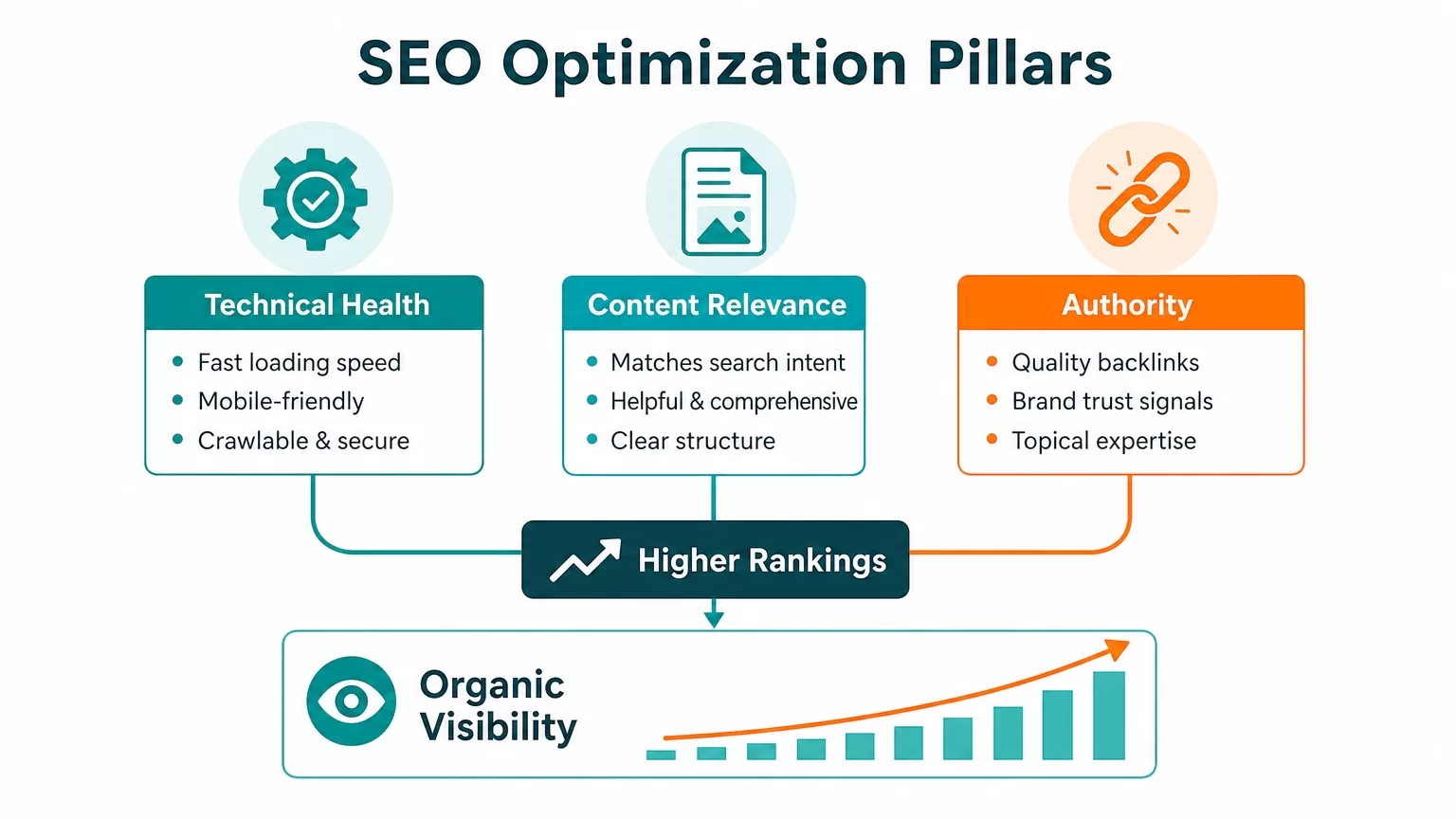
SEO is the discipline of improving visibility in search engines by making pages easier to crawl, understand, and rank. It focuses on signals like relevance, authority, technical quality, and user satisfaction. When done well, SEO helps your content appear for the queries your audience is already searching.
Traditional SEO work usually centers on a few core areas:
- Keyword targeting and topical relevance
- Technical SEO like crawlability, indexation, and page speed
- On-page optimization including headings, internal links, and metadata
- Content depth and search intent alignment
- Authority building through links and brand signals
The goal is not just to attract traffic, but to attract the right traffic. If a page ranks for a query but fails to satisfy the searcher, it won’t stay competitive for long. That’s why SEO has always been partly about understanding intent, not just matching keywords.
For brands in competitive spaces, including those exploring SEO Services for Cryptocurrency & Blockchain, the fundamentals still matter: technical health, content quality, and a clear site architecture that supports topical authority.
What AEO Actually Optimizes For
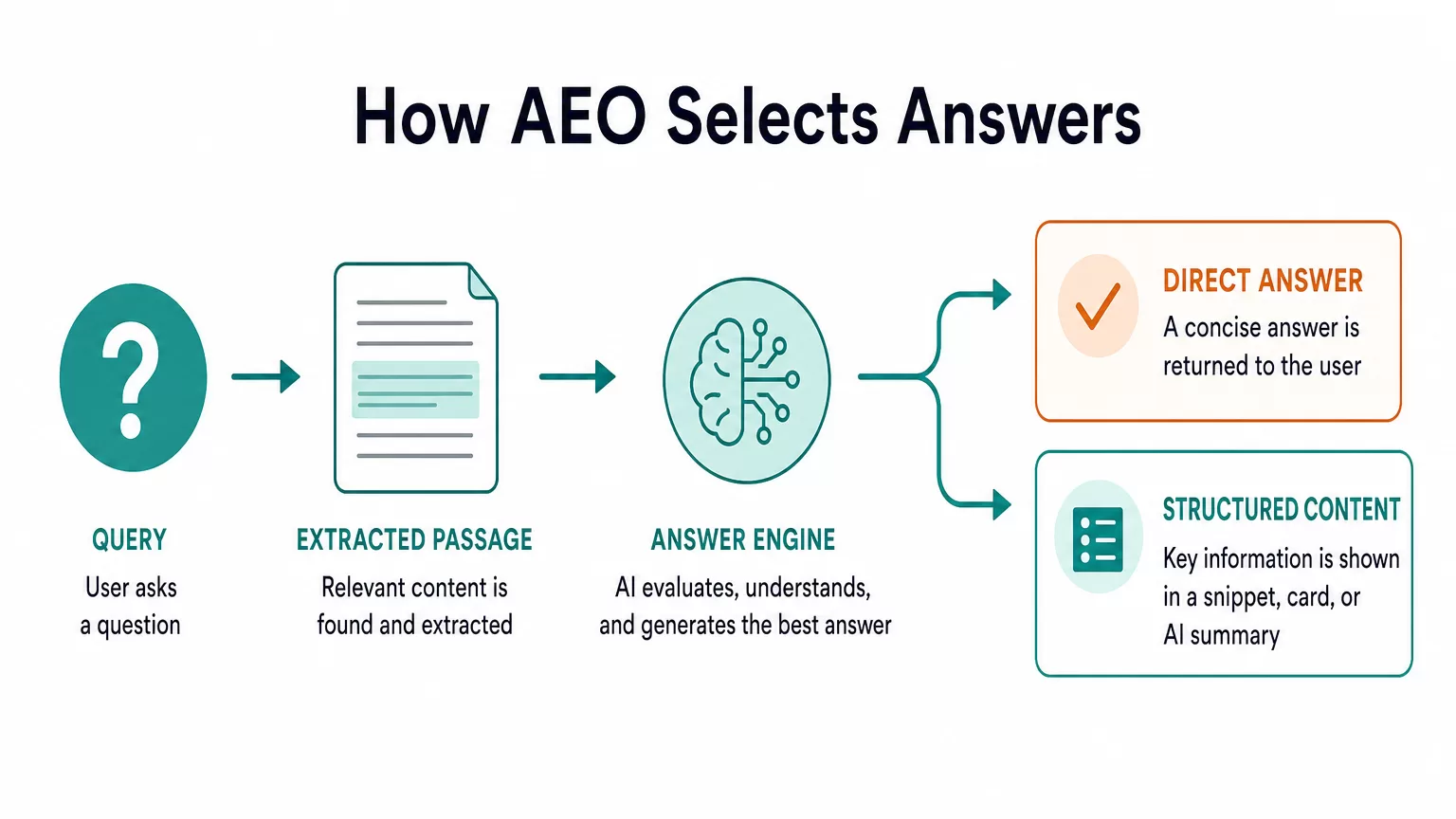
Answer engine optimization is about making content easy for systems to extract, summarize, and present as a direct answer. That includes AI search experiences, voice results, featured snippets, and other interfaces that prioritize concise, structured responses over a list of links.
Where SEO often asks, “How do we rank this page?” AEO asks, “How do we make this the most useful answer?” That difference changes how content should be written and structured.
AEO typically prioritizes:
- Clear, direct answers near the top of the page
- Question-based headings that mirror how people ask
- Structured data where relevant
- Entity clarity so systems understand who or what you’re discussing
- Concise definitions, summaries, and step-by-step explanations
AEO is especially important for informational queries, comparison searches, and “how do I” moments where users want fast clarity. If your content can be quoted, summarized, or lifted into an answer box, it has a better chance of showing up in modern search experiences.
Practical takeaway: AEO rewards content that is easy to parse. SEO rewards content that is easy to discover and trust. The best content does both.
SEO vs AEO: The Core Differences
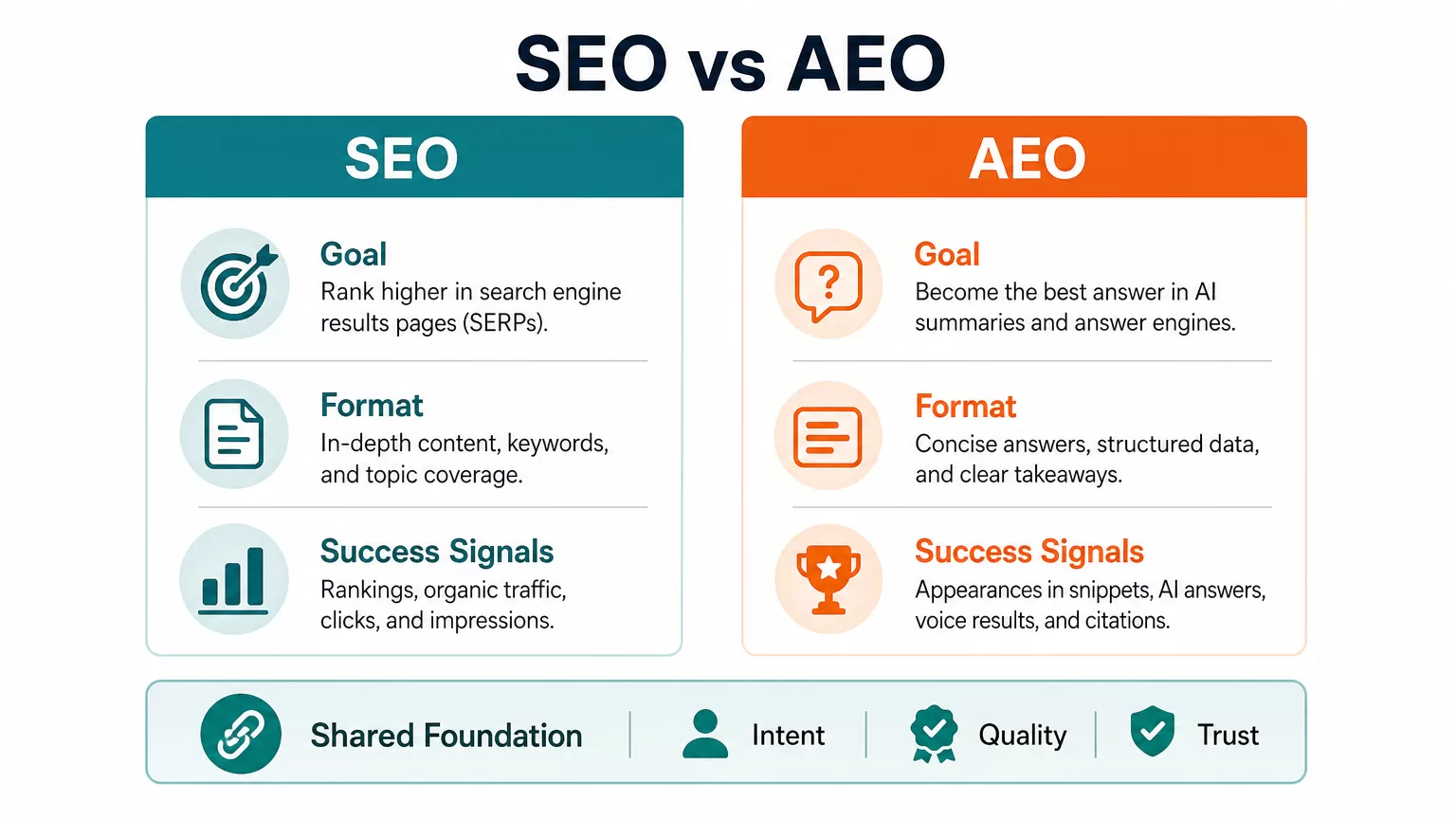
SEO and AEO overlap, but they are not identical. The easiest way to think about them is that SEO is broader, while AEO is more answer-focused.
1. Primary goal
SEO aims to drive organic visibility and traffic from search results. AEO aims to make your content the selected answer in a search or AI interface.
2. Output format
SEO often supports long-form pages, category pages, product pages, and blog articles designed to rank. AEO often favors short answer blocks, lists, definitions, FAQs, and highly structured passages that can be extracted cleanly.
3. Success metrics
SEO success is usually measured through rankings, clicks, impressions, organic sessions, and conversions. AEO success is harder to measure directly, but it can show up in snippet wins, answer inclusion, branded query growth, and improved visibility in AI-driven experiences.
4. Content structure
SEO content can be expansive and exploratory. AEO content needs to be modular, with clear subheads, concise summaries, and language that directly answers common questions.
5. Retrieval logic
Search engines rank pages using many signals. Answer engines often look for passages that are easy to extract, verify, and synthesize. That means clarity matters just as much as comprehensiveness.
Here’s the simplest version:
- SEO helps a page compete.
- AEO helps a page get quoted.
- Both depend on quality, trust, and relevance.
Where SEO and AEO Overlap
Despite the differences, the foundation is shared. If your site is technically weak, your content is thin, or your information architecture is confusing, neither SEO nor AEO will perform well for long.
The overlap is strongest in these areas:
- Search intent: both require a deep understanding of what the user actually wants
- Topical authority: both reward consistent coverage of a subject area
- Content quality: both need accurate, useful, original information
- Technical accessibility: both depend on crawlable, indexable pages
- Trust signals: both benefit from expertise, citations, and clear sourcing
In other words, you do not need separate content ecosystems for SEO and AEO. You need one strong content system that is built to satisfy both ranking algorithms and answer systems.
How to Build Content That Wins in Both
If the goal is visibility across search and AI surfaces, the content strategy needs to be deliberate. The best approach is to write for humans first, then structure the page so machines can understand it quickly.
Start with the question behind the keyword
Every query has an intent. Before writing, identify whether the searcher wants a definition, comparison, process, recommendation, or explanation. The more precisely you match that intent, the more likely your content is to rank and be selected as an answer.
Lead with the answer
For AEO-friendly content, do not bury the main point three paragraphs deep. Open with a short, direct answer, then expand with context. This helps both users and answer systems identify the core takeaway fast.
Use clear sectioning
Break content into logical sections with descriptive headings. Question-based H2s and H3s work especially well for comparison and informational content because they mirror how people search.
Write in modular blocks
Short paragraphs, bullet lists, and definition-style callouts make content easier to scan. They also make it easier for search systems to extract a relevant passage.
Support claims with evidence
Even when writing for AEO, trust matters. Use first-party data where available, cite reliable sources when appropriate, and keep terminology consistent. A clear, credible page is more likely to be surfaced than a vague one.
Strengthen internal linking
Internal links help search engines understand hierarchy and topical relationships. They also guide users to deeper pages that answer adjacent questions, which improves the overall content ecosystem.
Use schema where it makes sense
Structured data can help clarify page type and content relationships. It is not a shortcut, but it can reinforce what a page is about and improve machine readability.
Rule of thumb: If a passage can stand alone as a useful answer and still fit naturally into a broader article, it is doing double duty for SEO and AEO.
What to Measure When You Care About Both
One of the biggest challenges in the SEO vs AEO conversation is measurement. SEO is straightforward enough to track through rank monitoring, Search Console, and analytics. AEO is more indirect, but that does not mean it is invisible.
For SEO, keep an eye on:
- Average position
- Impressions and clicks
- Organic landing page sessions
- Conversions from organic traffic
- Index coverage and technical issues
For AEO, look for signals such as:
- Featured snippet ownership
- Growth in question-based queries
- Increased visibility for concise informational pages
- Brand mentions in AI-generated summaries, where trackable
- Higher engagement on pages structured around direct answers
Because AEO visibility can be harder to attribute, teams should use a combination of rank tracking, query analysis, and content audits. Patterns matter. If a page starts appearing for more long-tail questions or begins earning more impressions for informational searches, that may indicate stronger answer visibility even before clicks rise.
A Practical Workflow for SEO and AEO
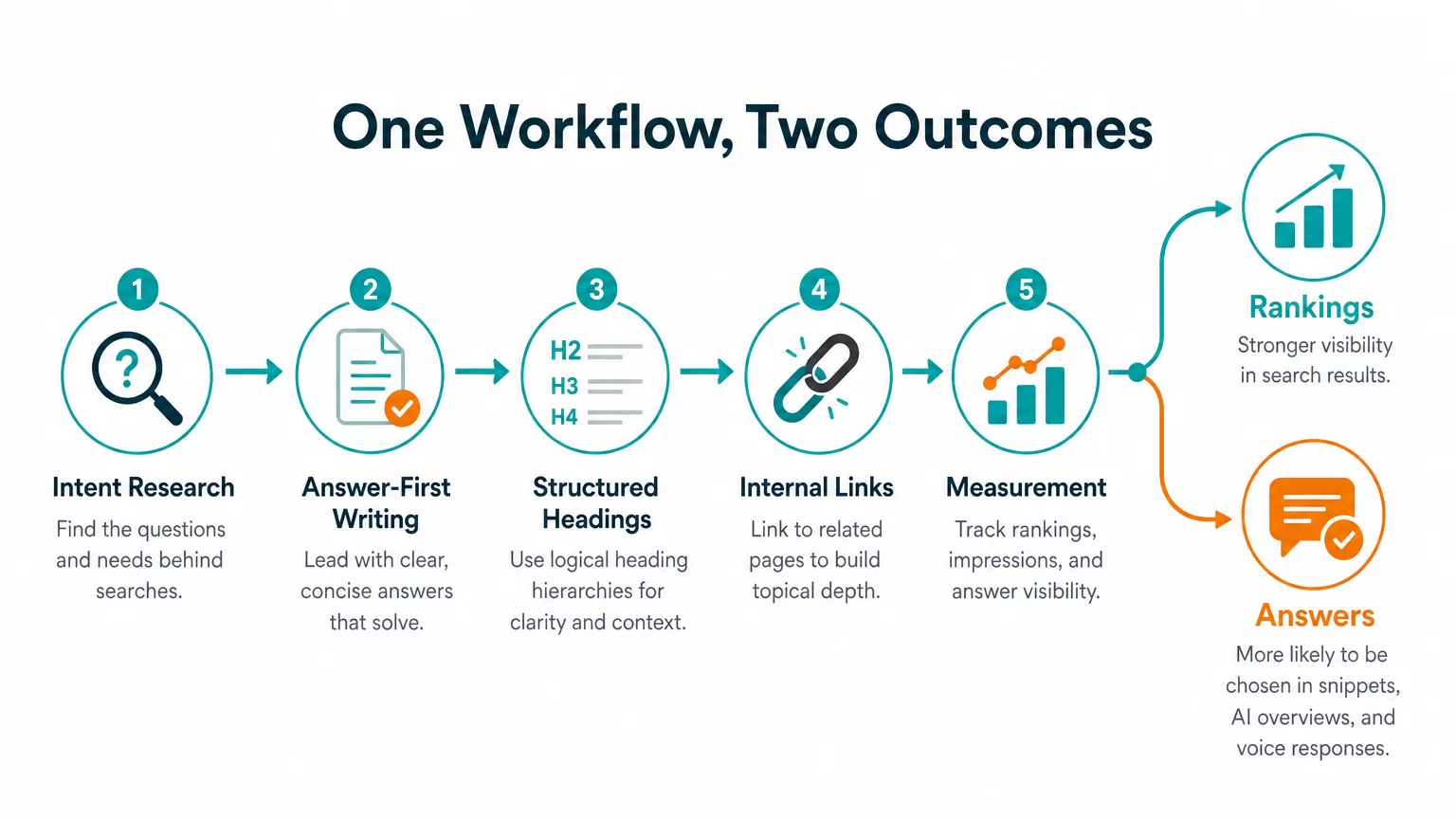
To make this manageable, think in terms of a repeatable workflow rather than a one-off optimization sprint.
- Audit existing content for intent match, clarity, and snippet potential
- Map questions to each topic cluster and content asset
- Rewrite intros so the main answer appears early
- Expand headings to include conversational, question-led phrasing
- Add supporting context for readers who want depth after the answer
- Improve internal links to reinforce topical authority
- Monitor performance in Search Console and rank tracking tools
This workflow works especially well for evergreen content, comparison pages, service pages, and educational articles. It also helps teams avoid the trap of writing either overly dense SEO content or overly thin answer content. The sweet spot is content that is both comprehensive and extractable.
Final Take: SEO vs AEO Is Not an Either/Or Choice
The future of visibility is not about choosing between SEO and AEO. It is about building content that can perform in both environments. SEO gives you reach in traditional search. AEO increases your chances of being the answer in AI-driven and zero-click experiences.
If your content strategy is still built only around rankings, you are likely leaving visibility on the table. If it is built only around short answers, you may miss the depth and authority needed to compete in search. The strongest approach blends both: clear answers, strong structure, technical health, and topical depth.
That is the real win in the SEO vs AEO debate. Not picking a side, but designing content that earns attention wherever search happens.
Bottom line: Optimize for discovery, structure for extraction, and write for trust. That is how you win visibility in both SEO and AEO.