Google Business Profile is becoming more than a listing page. With Gemini moving into the workflow, local SEO is shifting toward an AI-assisted operating model where teams can ask questions, analyze performance, draft responses, and update profile details without bouncing between multiple tools.
For SMBs and the marketers who support them, that is a meaningful change. The real story is not just that Google is adding another AI feature. It is that Gemini is being connected to business-specific context: reviews, search performance, customer actions, and profile data that already shape local visibility in Google Search and Google Maps.
When AI has access to real business data, it stops being a generic writing tool and starts acting like a local search assistant.
That distinction matters. Local SEO has always depended on accurate data, fast response times, and disciplined profile management. Gemini may not replace those fundamentals, but it could dramatically change how teams execute them.
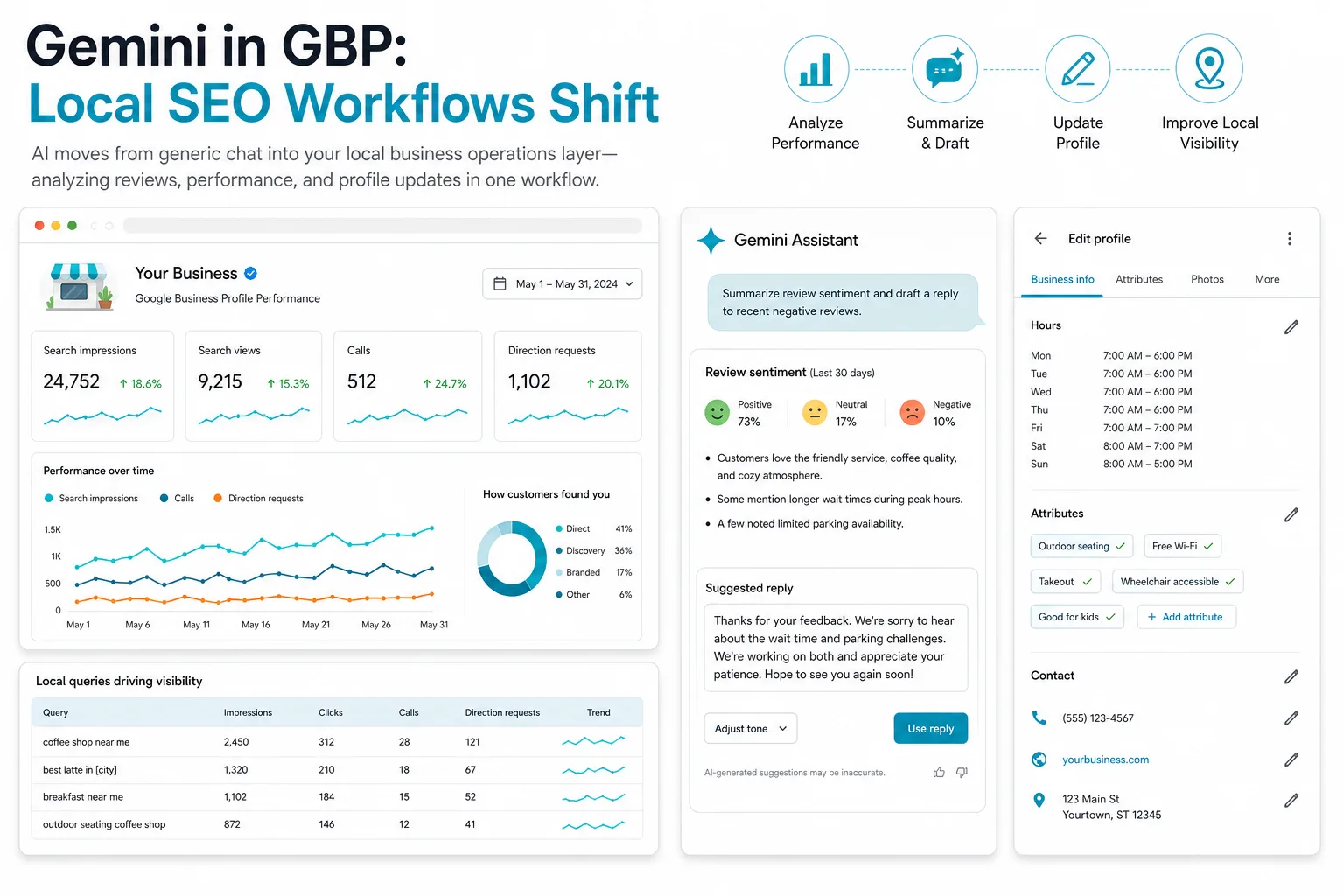
What Gemini Can Do Inside Google Business Profile
The most important takeaway is that Gemini is not being positioned as a standalone chatbot. It is being embedded into the business context of Google Business Profile, which means it can work from actual profile data instead of requiring repeated setup prompts.
In practical terms, that opens up several useful workflows:
- Performance questions: ask how the business performed over a given month and get an answer grounded in real profile metrics.
- Review analysis: surface star ratings, recent feedback, and the themes customers mention most often.
- Keyword discovery: identify the search terms people used to find the business, which can inform local keyword strategy.
- Profile updates: adjust hours, contact information, action links, attributes, and other listing details.
- Content tasks: draft or manage profile posts, offers, and event updates.
- Menu and media management: for eligible businesses, update menu sections, item descriptions, prices, and image assets.
That is a notable evolution. Instead of treating Google Business Profile as a dashboard that requires manual navigation, Gemini turns it into a conversational interface. For busy local teams, that could reduce friction across the most repetitive tasks in GBP optimization.
Key shift: local search management is moving from “click through the interface” to “ask the system to execute.”
Why This Matters for Local SEO
Local SEO has always been a mix of visibility, trust, and conversion. A profile that ranks well but answers customer questions poorly is still underperforming. Gemini’s integration matters because it connects analysis and action inside the same ecosystem.
That has three strategic implications:
1. Faster insight loops
Marketers can move from raw data to interpretation more quickly. Instead of manually pulling reports, teams may be able to ask Gemini what changed in search impressions, direction requests, calls, or engagement during a specific period. That shortens the time between signal and response.
2. Better alignment with local intent
Knowing the exact search terms customers use to find a business is valuable for local keyword research. Those queries often reveal intent that broader SEO tools miss. For example, a restaurant may discover that customers search for a specific dish, neighborhood, or service style rather than the brand name itself.
3. More operational local SEO
This update reinforces a trend we have been seeing across search: optimization is becoming more operational. GBP is no longer just a place to publish hours and collect reviews. It is becoming an active business layer where content, reputation, and customer actions are managed continuously.
That matters even more in a world where visibility is increasingly fragmented across search results, Maps, and AI-driven experiences. If you want the broader context, this shift also connects to the rise of Zero-Click Google Searches in 2026: What SEO Must Change.
For SMBs, the biggest win may not be speed alone. It may be consistency: fewer missed updates, faster replies, and better use of the data already sitting inside Google.
Tasks Gemini Can Automate
Not every local SEO task should be automated, but Gemini can clearly reduce manual workload in several areas. The best use cases are the repetitive, data-rich, and low-risk tasks that still consume a surprising amount of time.
- Drafting review responses: Gemini can help write replies based on the actual tone and content of customer feedback.
- Summarizing review themes: it can identify recurring praise, complaints, or service patterns.
- Updating hours: including special holiday hours, event schedules, or temporary closures.
- Editing business attributes: such as service options, accessibility details, or contact fields.
- Publishing profile posts: offers, announcements, and events can move through a faster draft-review-publish workflow.
- Managing media: eligible businesses may be able to upload or update images through public URLs.
For agencies, this could compress several SOPs at once. A monthly GBP maintenance checklist that once required multiple tabs, manual notes, and separate approval steps may become a short prompt-driven workflow.
Important warning: automation should speed up work, not replace judgment. Profile accuracy, brand voice, and customer trust still need human review.
That is especially true for review management. AI can draft a polished response, but a generic or overly formal reply can make a business sound detached. The best approach is to use Gemini for first drafts, then edit for empathy, specificity, and local credibility.
Strategic Risks and Opportunities
Every major platform shift creates both leverage and dependency. Gemini inside Google Business Profile is no exception.
Opportunities
- Lower operational overhead: SMBs can execute more with fewer manual steps.
- Better reporting: performance analysis may become easier for non-specialists to understand.
- Faster reputation management: review response times can improve.
- More complete profiles: easier editing can encourage stronger data hygiene.
Risks
- Over-automation: businesses may publish responses that feel templated or impersonal.
- Data quality issues: AI is only as good as the underlying profile information.
- Platform concentration: more workflows inside Google can reduce flexibility across tools.
- False confidence: faster answers do not always mean better strategy.
There is also a broader ecosystem implication. If Google continues to connect business data across surfaces, local optimization may become increasingly tied to the company’s own interface and data layer. That could make third-party reporting less central for some teams, even if it remains important for cross-channel analysis.
We are also watching how this may intersect with other Google business tools. If Gemini begins to connect more deeply with analytics and performance data, the line between local SEO, reporting, and operational management will blur even further. That is why the future of Gemini Adds Business Profile Tools: Local SEO Shift is worth tracking closely.
How Marketers Should Prepare
The best response is not to wait for the feature to mature before adjusting workflows. Marketers should start preparing now for a more conversational, AI-assisted GBP environment.
- Audit profile data: verify hours, categories, attributes, service areas, links, and contact details.
- Clean up review workflows: define which review types can be auto-drafted and which require senior approval.
- Document brand voice: create response guidelines so AI drafts sound human and local.
- Track the right metrics: monitor impressions, calls, direction requests, website clicks, and review trends.
- Build approval guardrails: especially for holiday hours, urgent changes, and customer-facing replies.
- Use query insights: turn customer search terms into local content, service pages, and FAQ updates.
From a workflow perspective, the smartest teams will treat Gemini as an assistant, not a strategist. It can accelerate execution and surface useful patterns, but the marketing team still needs to decide what matters, what to prioritize, and how to turn local signals into growth.
Bottom line: Gemini makes Google Business Profile more actionable, but the winners will still be the teams that combine automation with strong local SEO judgment.
For SMBs, this is a welcome change. For agencies, it is a reminder that local SEO is becoming more integrated, more conversational, and more dependent on clean data. The businesses that prepare now will be better positioned to use Gemini for faster optimization, stronger reputation management, and clearer performance analysis as Google continues evolving the GBP experience.