AI-era visibility is changing the rules of discovery. In traditional SEO, publishers could often win by matching keywords, tightening on-page optimization, and building enough topical relevance to earn a spot in the results. That still matters, but it is no longer enough on its own.
Today, visibility depends on whether a page is discoverable by search systems, valuable to real readers, and distinct enough to deserve citation in AI answers. That is a much higher bar. It also explains why some sites are losing traffic while others continue to earn clicks, mentions, and trust.
AI search does not reward the most optimized page in the abstract. It rewards the page that is accessible, compelling, and genuinely worth consuming.
For publishers and marketers, that means the goal is no longer just ranking. The goal is to create content that survives two filters at once: machine access and human demand. That is where durable AI search visibility starts.
What Google Is Really Saying
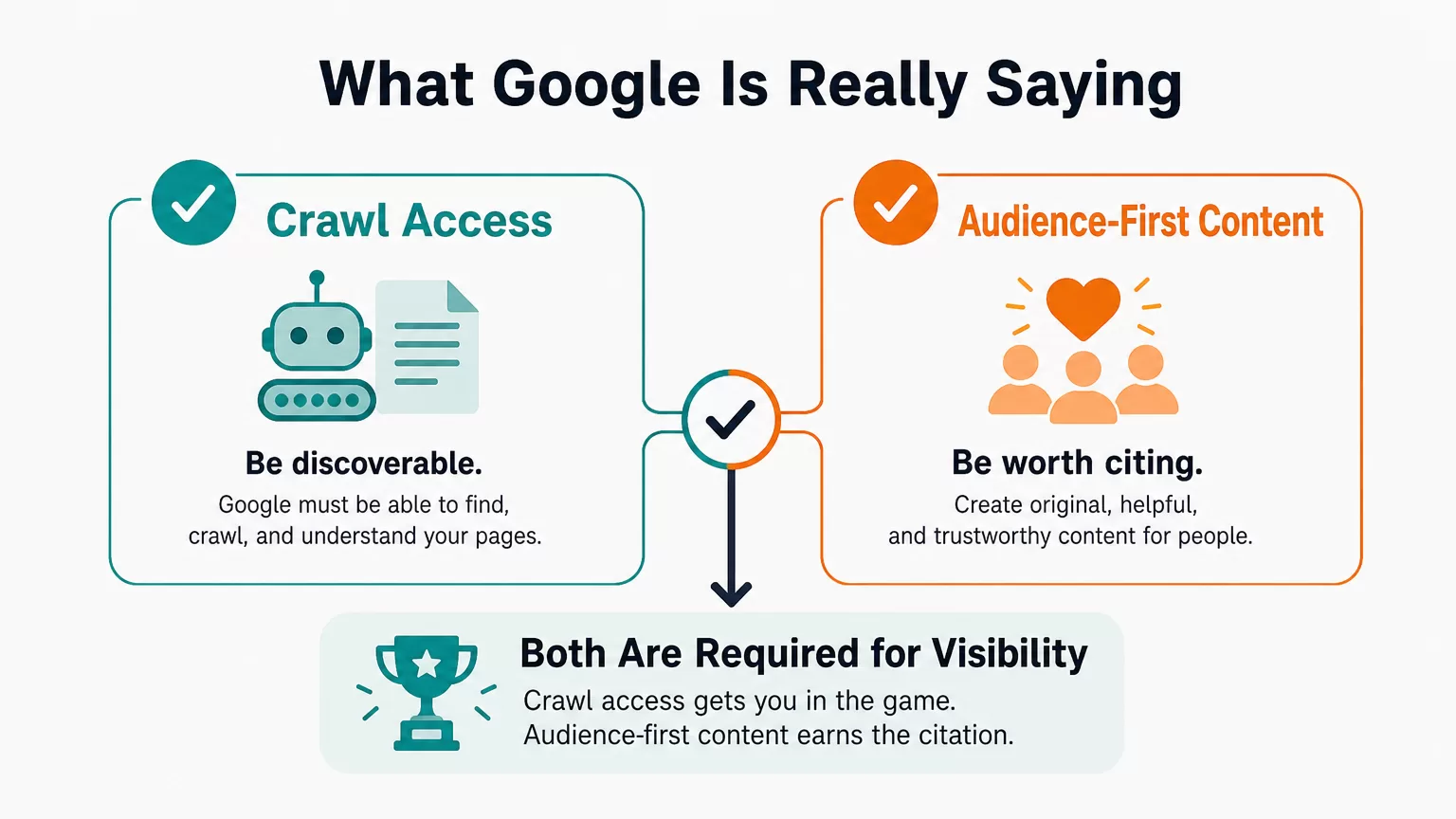
Google’s messaging around AI-era search has been consistent in one important way: publishers should not expect visibility if they block access or publish content that feels interchangeable. The underlying guidance is simple, even if the implications are broad.
- Allow crawl and access so search systems can find and understand your content.
- Publish compelling, audience-first content that people actually want to read.
- Differentiate your perspective so your page is not just another copy of the same story.
This is not a call to abandon SEO. It is a reminder that SEO now sits inside a broader content quality framework. If a page is technically available but editorially weak, it may be indexed yet still ignored. If it is compelling but blocked, it may be great for readers in theory and invisible in practice.
That is why the strongest content strategies align technical accessibility with editorial value. For teams building a Content Marketing SEO program, the winning formula is not volume alone. It is a system for producing content that search engines can reach and audiences want to spend time with.
Why Traffic Drops Aren’t Only About AI
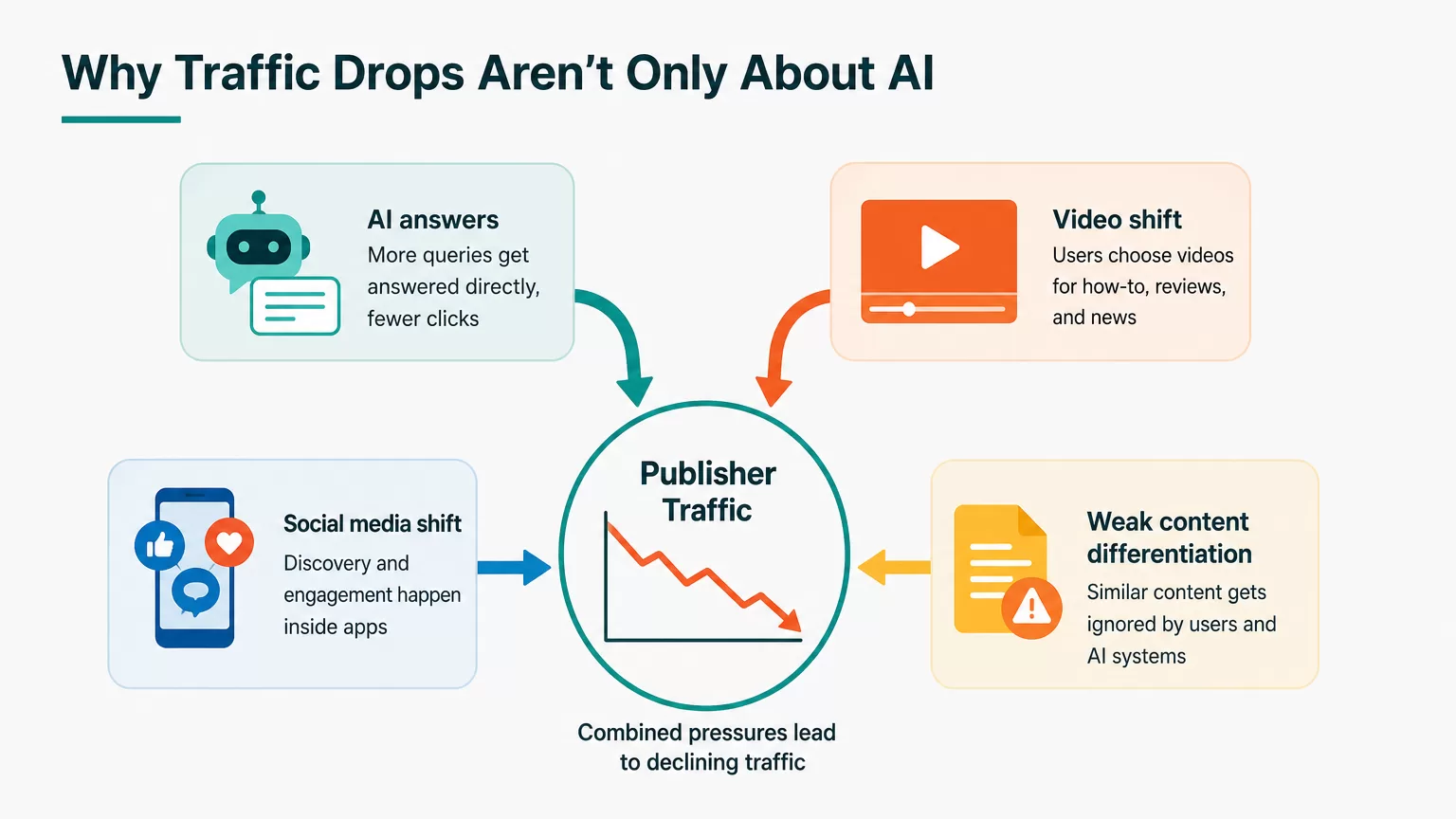
It is tempting to blame AI answers for every decline in publisher traffic. But that story is too narrow. AI may be part of the pressure, yet it is rarely the only force at work.
Several shifts are happening at once:
- Audience behavior is fragmenting as more people choose video, social media, and creator-led formats over text-heavy articles.
- Search result behavior is changing as users satisfy simple queries faster, often without clicking through.
- Content competition has intensified because many topics are now covered by dozens or hundreds of near-identical pages.
- Trust has become harder to earn when readers can instantly compare multiple sources and formats.
This is why traffic loss should be treated as a multi-causal problem, not a single-platform problem. If a publisher sees fewer visits, the answer is not always “AI took the clicks.” Sometimes the content is too generic. Sometimes the format no longer matches how the audience prefers to consume information. And sometimes the page simply does not offer enough reason to click when a summary is already available.
The uncomfortable truth: if your page is the 1,000th version of the same idea, AI is not the only thing competing with it.
In other words, AI did not create the demand problem. It exposed it.
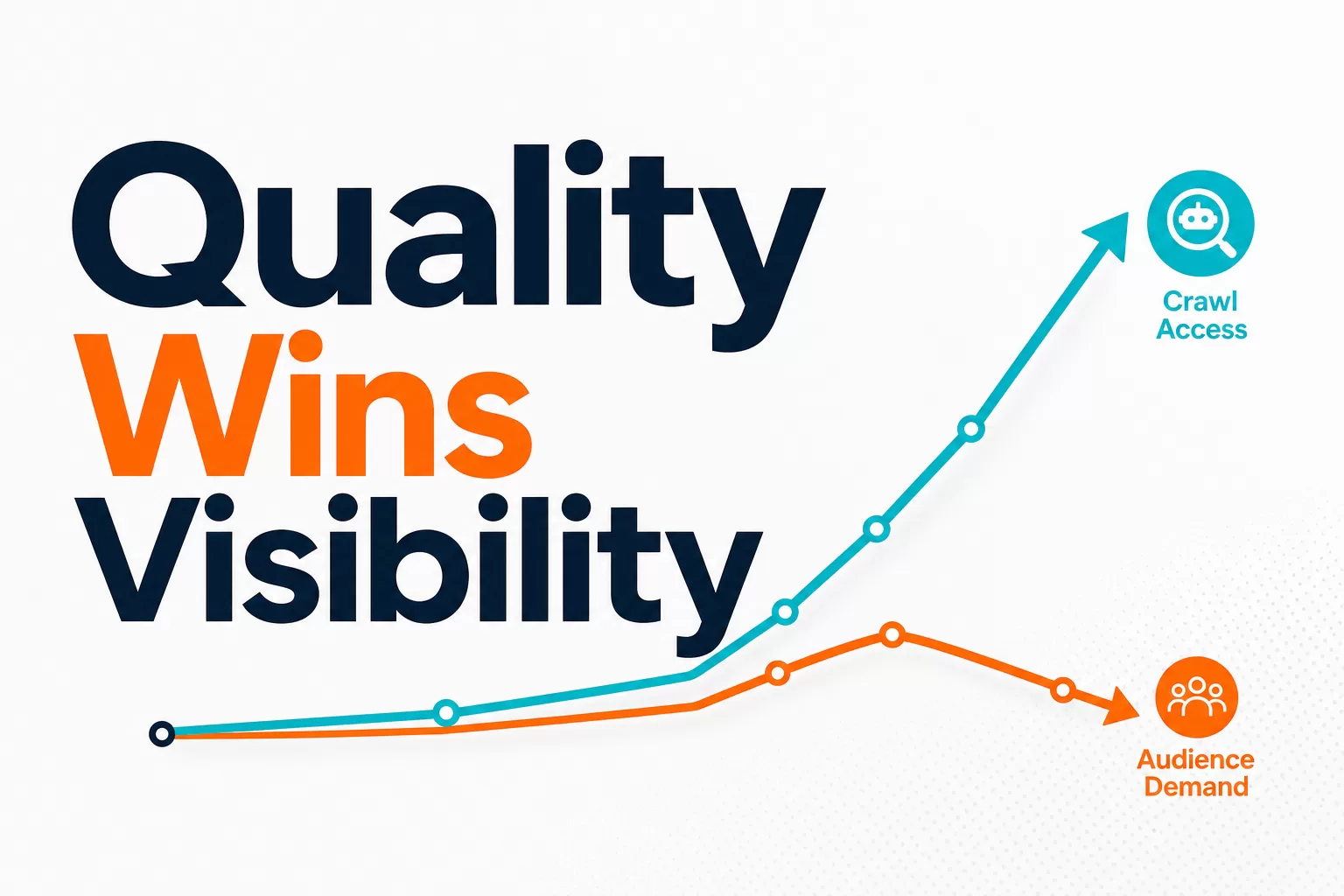
The Two Conditions for Visibility
AI-era visibility depends on two non-negotiable conditions. Miss either one, and performance suffers.
- Condition 1: Crawlability and discoverability — search systems must be able to access, interpret, and surface the page.
- Condition 2: Content quality and audience fit — the page must satisfy a real need better than alternatives.
The first condition is foundational. If a page is blocked, hidden, or poorly structured, it cannot compete. The second condition is what determines whether the page deserves attention once it is found.
That second condition is where many strategies fail. Teams often optimize for keyword coverage, but not for audience intent. They answer the query mechanically instead of solving the underlying problem. They publish broadly relevant content that is technically correct but emotionally flat, repetitive, or thin on original insight.
Discoverability gets you into the conversation. Quality keeps you in it.
This is also where click-through rate becomes a meaningful signal. If users repeatedly skip a result, or abandon it quickly after clicking, that is often a sign that the content is not matching intent strongly enough. AI answers may reduce some clicks, but they do not eliminate the need for pages that earn the click because they are clearly better than the alternatives.
Crawl access vs content quality
It helps to separate these two ideas, because they are often confused:
- Crawl access is about whether search engines can reach your content.
- Content quality is about whether people want to read it, share it, and trust it.
A page can have perfect crawl access and still lose visibility if it is generic. A page can be brilliant editorially and still underperform if technical barriers keep it from being discovered. The best publishers treat both as core requirements, not competing priorities.
For teams working in education, media, or high-intent informational niches, this balance is especially important. Even specialized programs such as SEO Services for Education & E-learning need content that is structured for search systems and shaped around how real learners search, compare, and decide.
What Publishers Should Change Now
The response to AI-era visibility is not to publish more of the same. It is to build content that is harder to replace.
- Audit for originality: Remove or rework pages that simply restate what is already widely available.
- Prioritize unique expertise: Add firsthand insight, original analysis, or practical context that a summary cannot fully replace.
- Match format to intent: Some topics deserve articles; others may perform better as video, charts, explainers, or social-native snippets.
- Strengthen technical access: Check crawlability, internal linking, indexability, and structured data so valuable pages can be found.
- Measure beyond rankings: Track clicks, engagement, citations, and assisted conversions, not just position changes.
There is also a strategic mindset shift required. Content should not be created to satisfy algorithms first and readers second. That approach is increasingly fragile. AI-mediated discovery is better at recognizing when content is merely optimized versus when it is genuinely useful.
Publish for people first, but make sure machines can still find what people value.
That is the long-term play. It is not a shortcut, and it is not a trick. It is a durable content strategy built for a search environment where AI answers, classic rankings, and audience trust all interact.
For publishers and marketers, the message is clear: AI search visibility is not won by chasing keywords alone. It is earned by creating content that is discoverable, differentiated, and worth reading in the first place.
If your content can satisfy that standard, it has a better chance of earning clicks today, citations tomorrow, and trust over time.