Google AI Overviews are forcing SEO teams to separate two things that used to move together: traffic volume and traffic quality. A randomized field experiment now adds weight to what many practitioners have suspected from SERP observation alone: when AI Overviews appear, organic clicks fall sharply. But the more interesting finding is that the clicks which still happen do not look worse in a measurable way.
That distinction matters. If AI Overviews were simply filtering out low-value visits, the remaining organic traffic should have shown stronger engagement. Instead, the evidence points to a different story: AI Overviews absorb attention, satisfy some searchers directly on the results page, and suppress legitimate demand capture from organic listings.
Bottom line: AI Overviews appear to reduce outbound organic clicks without proving that the lost clicks were low quality.
For SEOs, that changes the measurement conversation. Ranking reports alone cannot explain traffic volatility in an AI-first SERP. We now need to track query intent, zero-click behavior, click-through rates, and post-click engagement together if we want to understand what AI search visibility is really doing to a site.
What the study measured
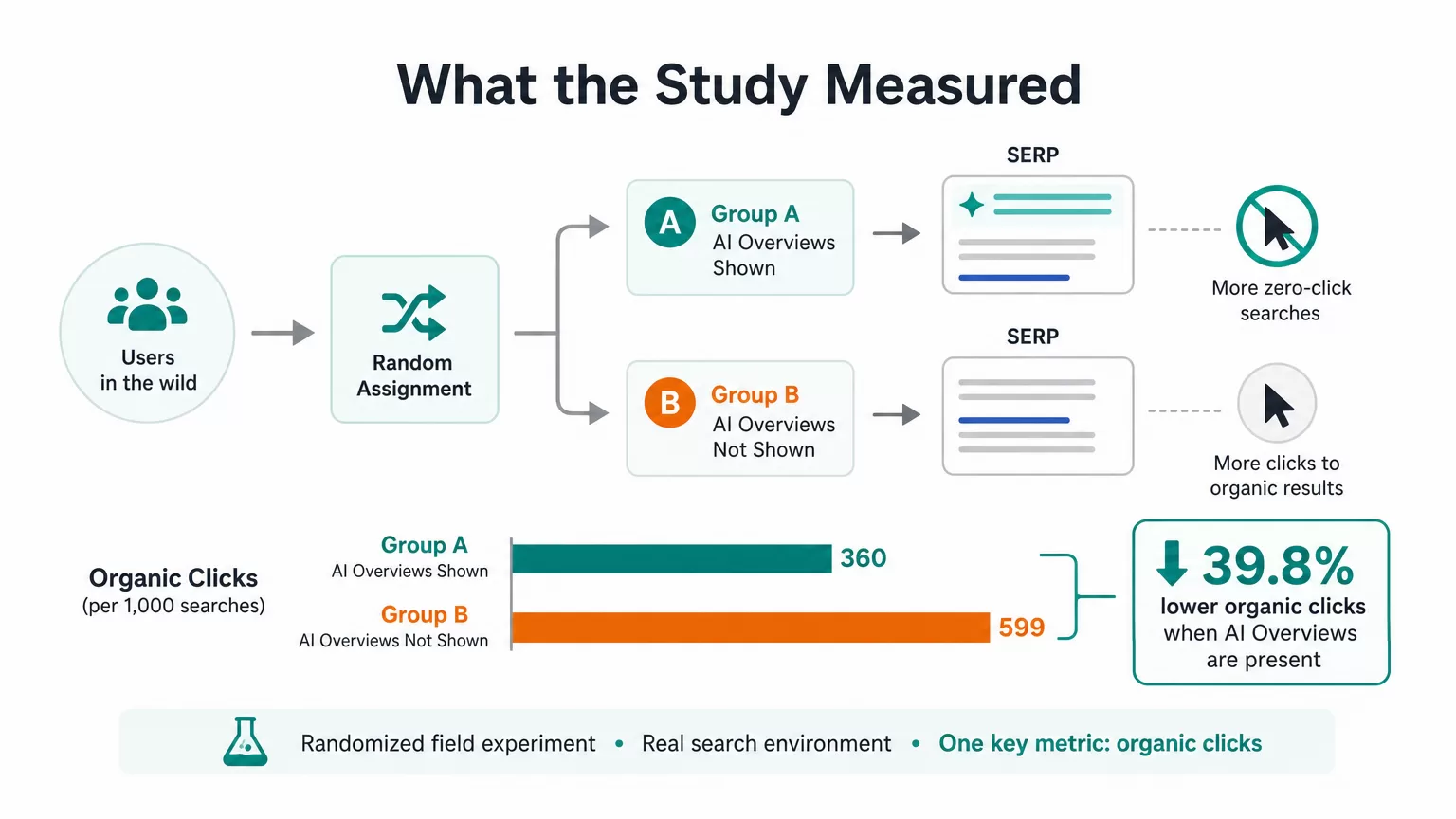
The analysis used a randomized field-experiment design, which is stronger than a simple before-and-after traffic comparison. Users were exposed to different search result conditions, allowing the researchers to estimate the causal effect of AI Overviews on search behavior rather than just correlating traffic changes with a SERP feature rollout.
That matters because AI Overviews are not a static ranking factor. They are a dynamic interface layer that can change how users interact with the results page before they ever reach a website. In this setup, the main question was straightforward: what happens to organic clicks when an AI Overview is present?
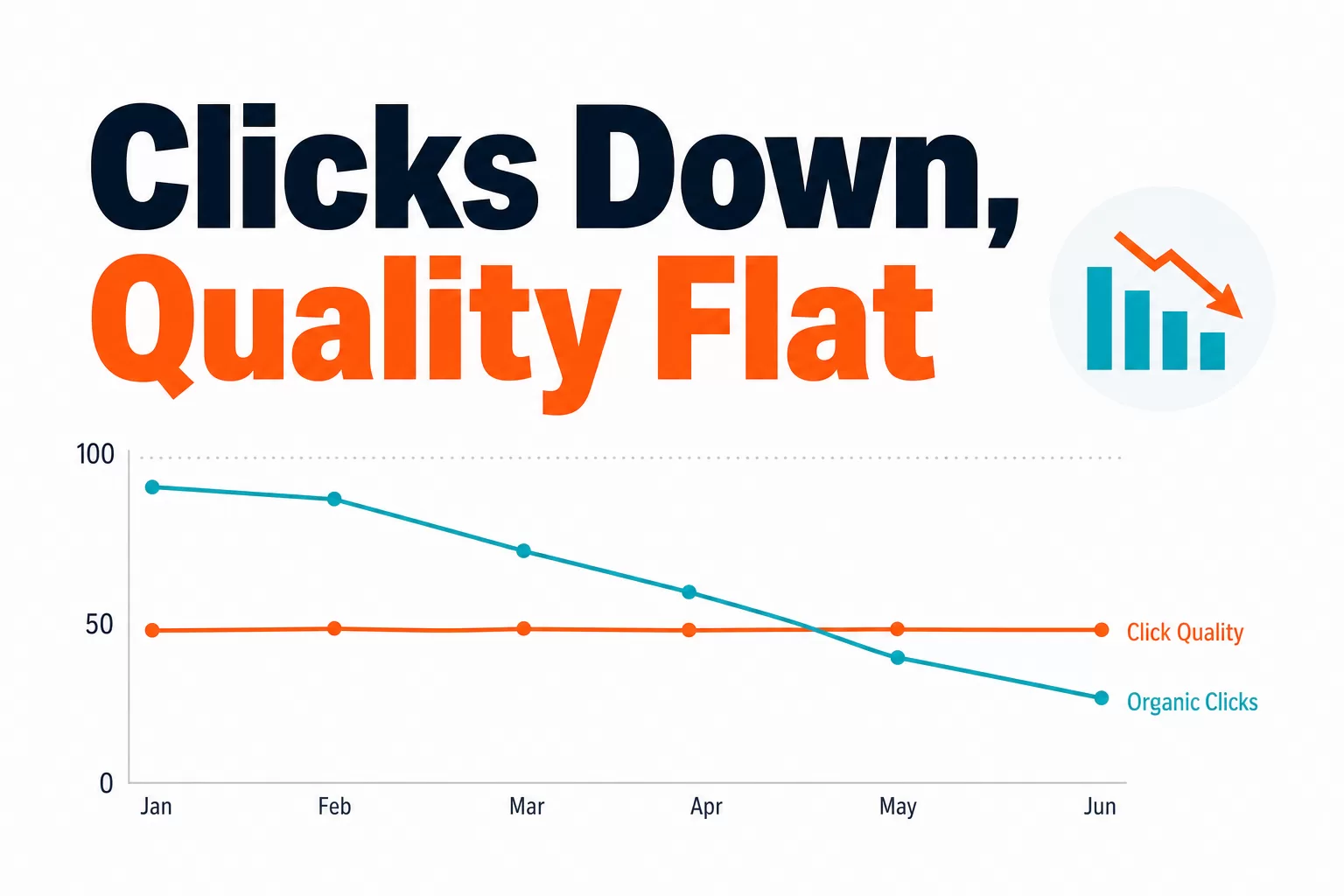
The answer was clear. When AI Overviews were shown, organic clicks dropped by 39.8%. Earlier analysis from the revised paper had already pointed to a 38% reduction, so the updated work sharpened the conclusion rather than reversing it.
The study also found that zero-click searches increased when AI Overviews were present. That is an important companion finding because it shows the feature is not merely shifting clicks around the page. It is intercepting a meaningful portion of user attention and resolving some searches directly in the SERP.
- Traffic effect: organic clicks fell by 39.8% with AI Overviews present.
- Behavioral effect: zero-click searches increased.
- Methodology: randomized field experiment, not anecdotal SERP observation.
- Interpretation: ranking stability does not guarantee traffic stability.
For teams already working with Keyword Research & Analysis, this is a reminder that query-level intent mapping now needs to account for whether a SERP is likely to answer the query before a click happens.
The click quality findings
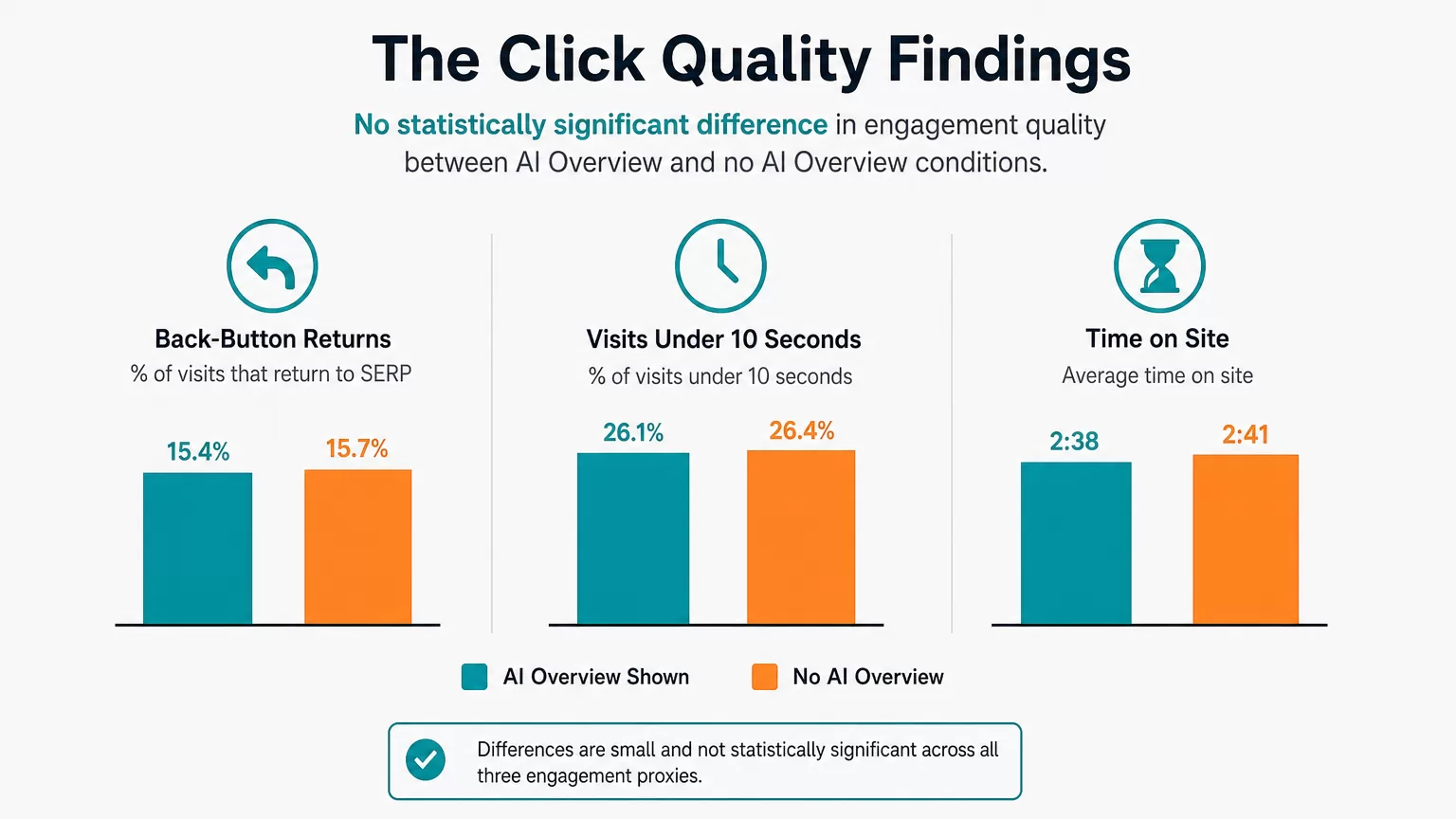
Google has suggested, in effect, that AI Overviews may be removing weaker clicks while preserving better ones. The experiment tested that idea using practical engagement proxies: back-button returns to the results page after same-tab clicks, visits ending within 10 seconds without interaction, and time on site.
On those measures, the clicks that remained after AI Overviews appeared were not statistically worse. In other words, the data did not support the claim that the lost traffic was mostly low-value or bounce-prone traffic.
Important takeaway: The SERP feature suppressed clicks, but it did not clearly improve the quality of the clicks that survived.
That is a subtle but consequential distinction. If AI Overviews were mainly pruning low-intent visits, we would expect the remaining organic traffic to show lower bounce behavior in the no-Overview condition or stronger engagement when the Overview was present. The analysis did not show that pattern.
Practically, this means SEOs should be cautious about accepting “fewer but better clicks” as a default explanation for traffic loss. A drop in visits is still a loss, even if the average engagement profile of the remaining traffic looks similar.
- Back-button behavior: no meaningful difference.
- Short visits: no statistically significant change.
- Time on site: no statistically significant difference.
- SEO implication: traffic suppression is real; quality improvement is not proven.
That is why measurement frameworks need to move beyond rankings. If you want a better model for interpreting these shifts, the approach outlined in Measure Search Performance Beyond Rankings is becoming less optional and more foundational.
Why informational queries were hit hardest
The effect was not evenly distributed across query types. Informational queries were hit hardest, while navigational and transactional queries showed no measurable change in this dataset.
That pattern makes sense. Informational searches are the easiest for an AI Overview to compress into a direct answer. If the user wants a definition, a quick explanation, a comparison, or a summary of steps, the search result itself can satisfy the need before the click.
By contrast, navigational queries usually require a destination, and transactional queries often imply a task, purchase, or conversion path that still depends on a website visit. So AI Overviews function less like a universal traffic drain and more like a query-intent filter that disproportionately affects top-of-funnel discovery.
In practical terms: the more answerable the query, the more vulnerable it is to AI Overview interception.
The study also suggests that the traffic impact may grow over time if AI Overviews expand to more queries. That makes this a forward-looking SEO issue, not a temporary fluctuation. As the feature appears on a larger share of searches, even modest per-query suppression can compound into meaningful traffic loss at scale.
- Informational: most exposed to AI Overview summary behavior.
- Navigational: relatively stable.
- Transactional: relatively stable.
- Long-term risk: broader rollout could amplify aggregate traffic loss.
This is also where Answer Engine Optimization (AEO): How to Win Featured Snippets, AI Answers, and Voice Search becomes strategically relevant. If a query can be answered in the SERP, your content needs a stronger reason to earn the click.
What this means for SEO measurement
The biggest measurement lesson is that rankings are no longer a sufficient proxy for visibility. A page can hold position stability and still lose meaningful traffic if the SERP surface changes upstream.
That creates a new reporting problem. Traditional dashboards often treat impressions, clicks, and average position as the core story. But AI Overviews can change the click path without changing the rank itself. That means teams need to separate:
- Exposure: whether the query triggered an AI Overview.
- Demand capture: whether the user clicked through or stopped at the SERP.
- Engagement quality: whether those clicks actually produced meaningful sessions.
- Intent mix: which query classes are most vulnerable.
In practice, that means pairing Search Console with analytics, rank tracking, and query segmentation. A drop in clicks on informational queries should not be read the same way as a drop in transactional clicks. If AI Overviews are present on a large share of searches, the right question is not just “Did rankings change?” but “Did the SERP change the path to the site?”
It also means SEO teams should watch for zero-click share and click-through rate compression by intent group. Those metrics are more likely to reveal the real impact of AI search visibility than headline traffic alone.
Measurement shift: from rank tracking alone to intent-level visibility, click loss, and downstream session quality.
Strategic implications for content and visibility
The content response should not be panic or abandonment. It should be differentiation. If AI Overviews can summarize a page’s core answer in the SERP, then the page needs to offer something the summary cannot fully replace.
That usually means building content with one or more of the following layers:
- Original data that cannot be paraphrased away.
- Unique tools such as calculators, templates, or interactive decision aids.
- Deeper procedural detail for users who need execution, not just explanation.
- Expert commentary that adds interpretation and judgment.
- Comparisons and tradeoffs that help users choose, not just learn.
For informational content especially, the goal is no longer to answer the query and stop there. The goal is to create a reason to click by offering depth, specificity, or utility beyond what an AI summary can compress.
That also changes how teams think about AI search visibility. Winning in this environment is not just about appearing in the answer layer. It is about protecting demand capture when the answer layer is present. That is where broader AEO and GEO planning intersects with classic SEO strategy.
Strategy in one sentence: optimize for answerability where needed, but build enough distinct value that the click still matters.
For brands that rely heavily on informational traffic, the takeaway is especially sharp. If a large share of your discovery traffic comes from answerable queries, AI Overviews can reduce top-of-funnel visits even when your rankings remain strong. The response is to diversify content formats, strengthen comparison and evaluation pages, and invest in assets that create a click-worthy gap between the summary and the page.
In the AI search era, SEO success will increasingly depend on understanding where the SERP satisfies the user before your page does. The sites that adapt fastest will be the ones measuring that shift clearly, then building content that earns attention for reasons a summary cannot fully replace.