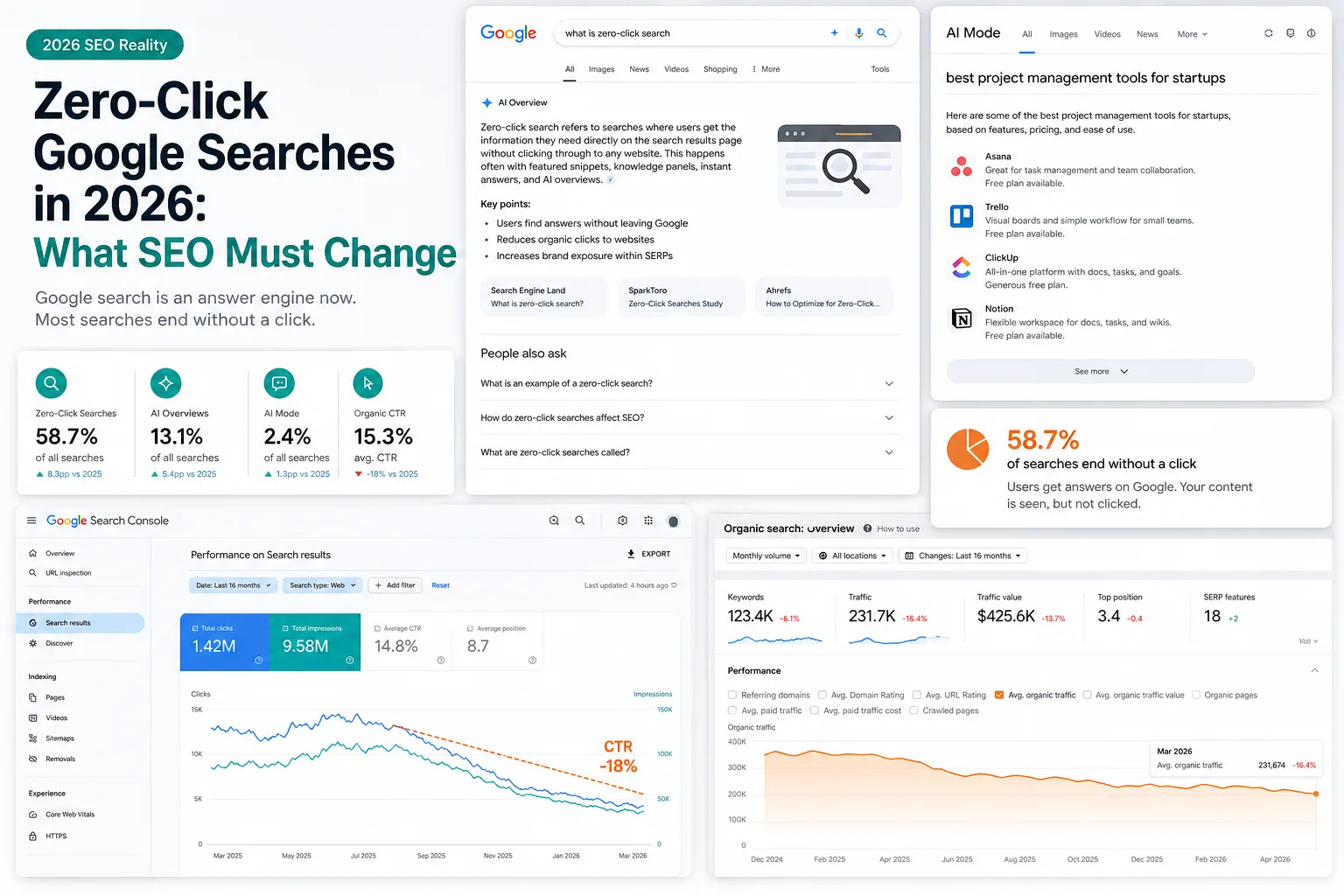
Google search is changing from a referral system into an answer system. In 2026, that shift is no longer theoretical: a majority of searches now end without a click, and AI Overviews are absorbing more of the user journey before an organic result ever gets attention. For SEO teams, the implication is bigger than traffic loss. Rankings still matter, but visibility is no longer guaranteed to produce sessions. The new challenge is understanding which queries still drive clicks, which ones are answered on the SERP, and how brands can build demand when Google keeps more of the interaction on-platform.
What zero-click search means in 2026
Zero-click search in 2026 is no longer a niche SERP pattern or a temporary side effect of a new feature. It is a structural shift in how Google distributes information. The search results page increasingly answers the query directly through AI Overviews, knowledge panels, local packs, shopping modules, and other on-SERP experiences—so the user often gets what they need without clicking through to a website.
That matters because Google is becoming both the destination and the gateway. For many informational queries, the search journey now ends on the results page. For SEOs, that changes the core question from “How do we earn the click?” to “How do we earn visibility, trust, and downstream demand when the click may never happen?”
This shift is not uniform across all query types. Intent still determines behavior:
- Informational queries are the most exposed to zero-click outcomes, especially when AI Overviews can synthesize a direct answer.
- Branded queries often still drive clicks, but many users resolve simple navigational needs from the SERP itself.
- Local searches frequently end with a map interaction, call, directions request, or hours lookup rather than a website visit.
- Transactional searches can still generate strong click demand, but product grids, pricing snippets, and merchant experiences now absorb more of the journey.
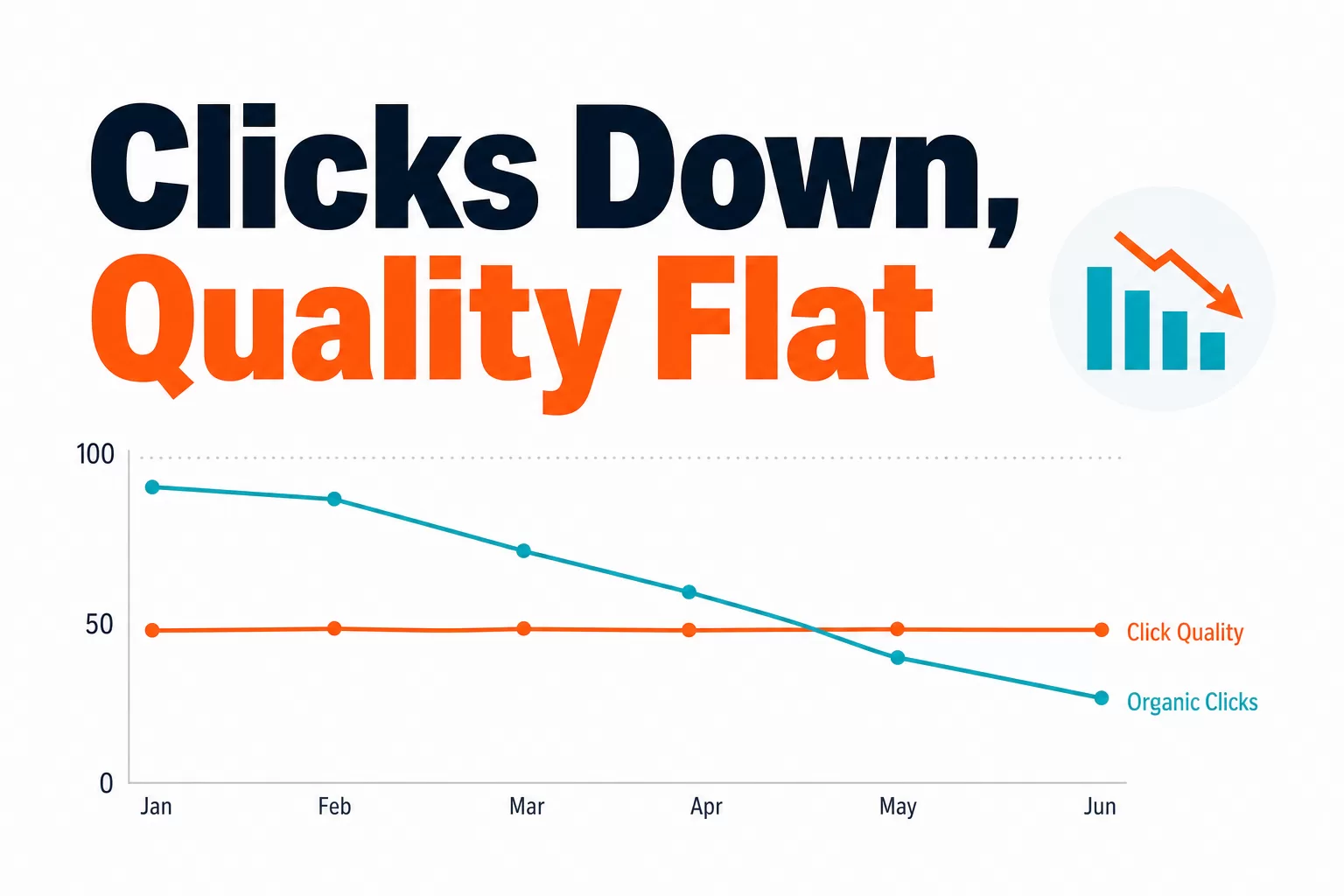
In practice, this means a page can win rankings and still lose sessions. That is the strategic tension of 2026: visibility is not the same as traffic. A query may generate fewer clicks but more impressions, more branded recall, or more assisted conversions later in the funnel. If teams only evaluate organic performance through sessions, they will miss the value created by being present in the answer layer.
That is why modern SEO measurement has to expand beyond rankings and visits. We need to read Search Console impressions alongside click-through rate, compare query classes by intent, and connect organic visibility to assisted discovery and demand creation. In some cases, the right win is a click. In others, it is being cited inside the answer experience that shapes the next search.
For teams building that capability, our Answer Engine Optimization (AEO): How to Win Featured Snippets, AI Answers, and Voice Search and Generative Engine Optimization (GEO): Get Cited in ChatGPT, Gemini, Perplexity, and AI Overviews guides are useful companions to this shift.
The data behind the decline
The reported 68.01% zero-click rate for U.S. searches from January through April 2026 is striking, but the number only becomes useful when we place it in context. Earlier benchmark studies have consistently pointed in the same direction: fewer searches end with a visit to an external website, and more are resolved directly on Google’s results page. The exact percentage will vary by dataset and methodology, but the directional trend is hard to ignore.
That matters because this is not just a story about rankings slipping. It is a story about click opportunity shrinking relative to total search demand. A query can still generate strong visibility, impressions, and brand exposure while producing fewer outbound visits. In other words, absolute search demand may be stable or even growing, while the share of searches that send traffic to publishers declines.
Methodology is the first thing to check before drawing conclusions. This study includes organic results, paid placements, and Google-owned properties, which means it measures the full search experience rather than organic listings alone. It also relies on Similarweb desktop and mobile panel data, with an assumed mobile-heavy split. That is important because mobile search behavior tends to favor faster, more self-contained answers, and Google’s interface on mobile often compresses the number of visible external opportunities.
Compared with 2019 and 2020 benchmarks, the 2026 figure reflects a continuation of the same structural shift: Google has steadily expanded answer formats, shopping modules, local packs, knowledge panels, and now AI-generated experiences. The 2024 benchmark already showed that zero-click behavior was no longer an edge case. By 2026, the issue is not whether zero-click search exists, but how much of the query landscape it now captures.
We should still be careful not to overclaim certainty. Panel-based estimates are directional, not a perfect census of every search. They are best used to answer questions like:
- Are users leaving the results page less often than they used to?
- Which query classes still generate external clicks?
- Where are AI Overviews and other SERP features absorbing attention?
That distinction is critical for strategy. A keyword with high impressions and low clicks may not be “underperforming” in a traditional sense; it may simply be living in a SERP where Google is satisfying the intent before the user ever reaches a site. For teams tracking organic performance, the real challenge is separating visibility from traffic yield. This is why query-level analysis, SERP feature tracking, and landing-page intent mapping matter more than ever. For a deeper look at answer-led search behavior, see our guide to Answer Engine Optimization (AEO): How to Win Featured Snippets, AI Answers, and Voice Search and our framework for Generative Engine Optimization (GEO): Get Cited in ChatGPT, Gemini, Perplexity, and AI Overviews.
Why AI Overviews are changing CTR
AI Overviews are accelerating the zero-click trend because they do something traditional organic listings have never been able to do at scale: answer informational intent directly inside the SERP. When a query is broad, exploratory, or comparison-driven, the user often gets enough context from the summary, follow-up prompts, and cited sources to stop there. That means the click is no longer the default outcome of visibility.
Recent reporting has shown AI Overviews appearing on more than 20% of tracked queries in some datasets, and the practical impact is hard to ignore: when an AI Overview is present, CTR can drop by nearly 60% versus comparable results without one. The exact numbers will vary by device, query class, and brand demand, but the direction is consistent. The SERP is absorbing more of the journey before a user reaches a website.
This shift hits certain content types first:
- Top-of-funnel informational pages that answer “what is,” “how to,” and “why does” queries.
- Comparison and evaluation content where the user wants a quick synthesis before digging deeper.
- Definition-led pages that used to win featured snippets or sitelinks-style visibility.
- Evergreen educational content that can be summarized cleanly by a model.
In other words, AI Overviews are not just another ranking feature. They are a distribution shift. The old model assumed that ranking higher created a proportional increase in clicks. The new model is more selective: visibility may still rise, but the click opportunity can shrink because the answer surface itself is doing more of the work.
That also changes how we should read performance data. A page can lose CTR without losing relevance. In fact, it may still be influencing the user journey if it appears in cited sources, follow-up exploration, or branded recall. Teams need to separate impressions, citations, clicks, and downstream conversions instead of treating organic traffic as the only signal that matters.
For brands trying to stay present in these answer-heavy SERPs, the strategic response is to build content that is easy to extract, easy to trust, and easy to cite. That is where frameworks like Answer Engine Optimization (AEO): How to Win Featured Snippets, AI Answers, and Voice Search become useful: they help teams design pages for answer surfaces, not just blue-link rankings.
Practical takeaway: if a query can be answered in one paragraph, assume AI Overviews may compress the click path. Optimize for citation, clarity, and next-step engagement—not just position.
What AI Mode could mean next
AI Mode is still a small slice of Google behavior, but it is the clearest signal yet of where the search experience may be headed: farther away from the classic list of blue links and deeper into an on-platform answer layer. Recent measurement put the transition rate at just 0.34%, which sounds minor until you pair it with Google’s own claim that AI Mode has reached 1 billion monthly users and reports of rapid query growth. That combination suggests an interface that is not yet dominant, but is being trained into the habits of a very large audience.
If AI Mode becomes a more common starting point for search, the mechanics of discovery change in ways SEOs need to take seriously. Users may ask broader, more conversational questions and receive deeper synthesis directly in Google’s interface. That means fewer reasons to click out for basic informational queries, more opportunities for Google to mediate the answer, and more competition for attention within the answer itself rather than on the open web.
In practical terms, that could mean:
- More summary-first journeys: the first interaction happens inside an AI-generated response, not on a landing page.
- Fewer outbound clicks: especially for queries where the answer can be assembled from multiple sources.
- Higher value for cited visibility: being included, referenced, or surfaced inside the answer may matter as much as ranking position.
- More pressure on content structure: clear entities, concise explanations, and strong topical coverage become even more important.
The strategic question is no longer only, “Can we rank?” It is also, “Can we be selected, summarized, and trusted inside answer environments?” That is where traditional SEO and AI-era visibility start to overlap. Teams that already think in terms of intent coverage, source credibility, and content usefulness will be better positioned than those still optimizing solely for ten blue links.
SEO is moving from page ranking to answer participation. If AI Mode expands, visibility will depend less on winning a single SERP position and more on earning inclusion across Google’s synthesized response layer.
For a broader framework on optimizing for these answer surfaces, the GEO lens is useful: Generative Engine Optimization (GEO): Get Cited in ChatGPT, Gemini, Perplexity, and AI Overviews. The takeaway is not to abandon classic SEO, but to extend it. Track rankings, yes—but also monitor whether your brand appears in AI summaries, answer boxes, and other zero-click environments where discovery now increasingly begins.
SEO strategies beyond clicks
The practical response to zero-click growth is not to chase every lost visit; it is to rebuild SEO around intent, visibility, and downstream demand. In 2026, many informational queries will be answered in AI Overviews, AI Mode, or other SERP surfaces before a user ever reaches a website. That does not make those queries worthless. It means teams need a portfolio view of search performance, where the goal is not only the click, but also the impression, the citation, the brand recall, and the eventual conversion.
Start by segmenting keywords into three broad groups: informational, commercial investigation, and high-intent / branded. Informational terms are most exposed to zero-click outcomes, so treat them as visibility and authority builders. Commercial and branded terms deserve more aggressive optimization because they are closer to revenue and more likely to produce clicks even when AI answers are present. This is where search demand and conversion intent still overlap strongly.
- Use Search Console to separate impression loss from click-through loss. If impressions hold steady while clicks fall, the page may still be visible but receiving fewer visits because the SERP changed.
- Compare analytics and rank tracking to see whether traffic declines match ranking declines. If rankings remain stable but sessions drop, the issue is often answer-surface displacement, not content failure.
- Monitor SERP features such as AI Overviews, featured snippets, local packs, and video blocks so you can tell when a query is being absorbed by the results page.
- Watch branded search trends as a proxy for demand creation beyond the site.
That wider measurement model matters because some losses are not really losses in demand. A query may now satisfy the user inside Google, but the brand can still benefit if it is named, cited, or repeatedly surfaced. For deeper guidance on answer-first visibility, see our Answer Engine Optimization (AEO): How to Win Featured Snippets, AI Answers, and Voice Search and Generative Engine Optimization (GEO): Get Cited in ChatGPT, Gemini, Perplexity, and AI Overviews resources.
On the content side, improve eligibility for answer surfaces with concise definitions, clearly structured headings, FAQ blocks, and strong entity clarity. On the technical side, make sure important pages are crawlable, indexable, fast, and internally linked from relevant hubs. But protect conversion pages from being over-optimized for answer extraction; product, pricing, and lead-gen pages should be built to convert, not just summarize.
Resilient SEO in a zero-click world is a portfolio strategy: some queries should earn clicks, some should earn visibility, and some should earn memory. The brands that win will combine search presence, brand demand, and multi-platform reach instead of relying on rankings alone.