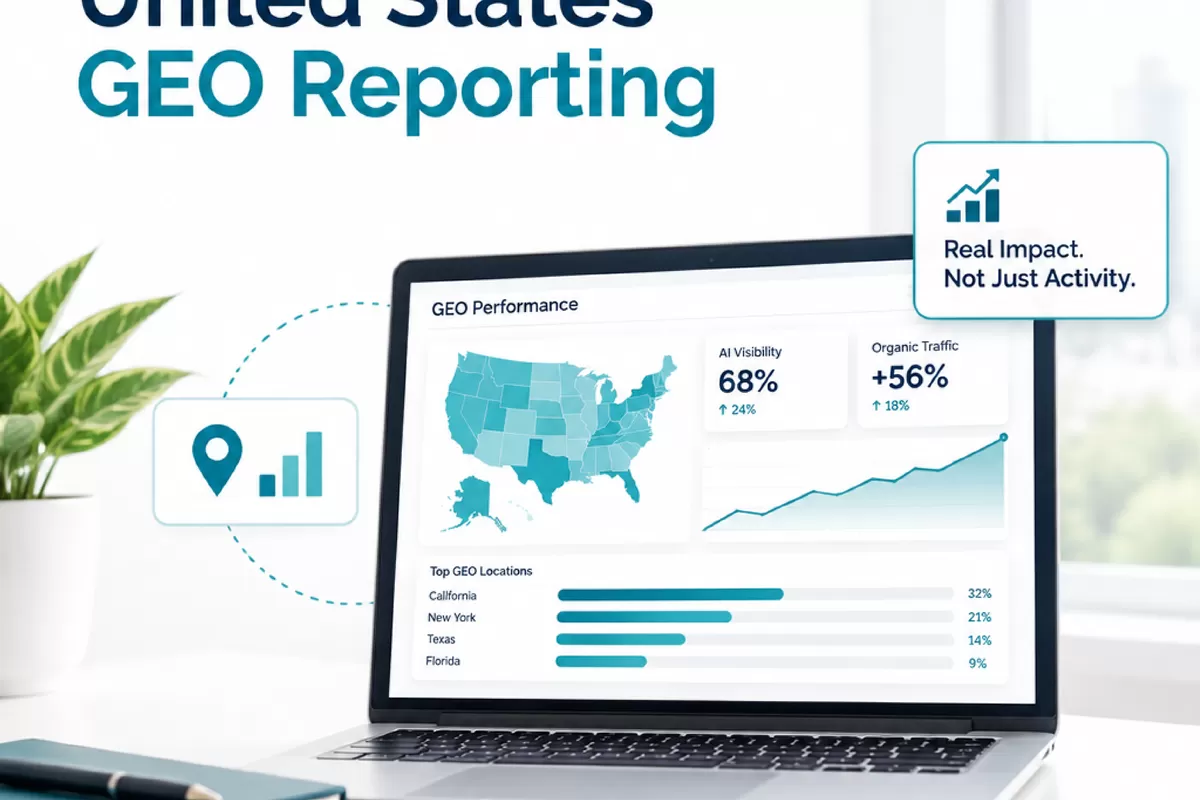
For digital marketing agencies in the United States, “geo services” can mean two different things: targeting people based on where they are, or improving how a brand appears in generative search answers. They can both support visibility, but they solve different problems. Treating them as interchangeable can lead to the wrong work, unclear reporting, and missed opportunities.
Start by identifying what a client needs to be found for, where the audience is searching, and which results matter. Location-based targeting can help reach people in specific places. Generative Engine Optimization (GEO) focuses on a brand’s visibility in AI-generated answers. A coordinated plan can bring either approach together with search engine optimization (SEO) and Answer Engine Optimization (AEO), but the right mix depends on the client’s goals and search behavior.
What does “geo” mean in a digital marketing plan?
In marketing conversations, “geo” is an ambiguous shorthand. It may refer to geographic or location-based targeting, which uses a person’s location or a chosen place to shape who sees a message. It may also refer to Generative Engine Optimization, which aims to make a brand’s information useful and understandable in generative AI search experiences.
These approaches work on different visibility problems. A local service business may need to show up for people searching for a provider near them. A business with a broader audience may want its expertise and accurate information represented when someone asks an AI search tool a relevant question. A client can have both needs, but one does not automatically address the other.
Agencies should clarify the meaning before scoping work, discussing goals, or reporting performance. In particular, distinguish location-based tactics from GEO as part of an integrated SEO, AEO, and GEO program. That simple step prevents a familiar planning mistake: promising a local visibility outcome when the proposed work is actually about generative search, or vice versa.
Location targeting and generative engine optimization solve different problems
Location-based targeting helps a business reach people in a defined place. Depending on the client’s needs and channels, that may involve setting geographic parameters for campaigns, improving local search presence, or creating useful pages for the places a business genuinely serves. The key question is whether a person’s location changes the relevance of the offer or information.
GEO addresses a different question: can generative search systems find, understand, and draw on clear, relevant information about a brand when responding to a user’s question? GEO does not mean selecting a radius around a business or targeting an ad to a ZIP code. It also does not guarantee that a brand will appear in an AI-generated answer. Agencies can improve the clarity and usefulness of a client’s digital information, then monitor visibility where reliable data is available.
SEO and AEO connect to both, but they are not synonyms. SEO improves a site’s ability to be crawled, understood, and found in organic search. AEO, or Answer Engine Optimization, focuses on making content easy to interpret and use when search experiences provide direct answers. GEO extends the agency’s attention to generative answers. Local SEO, meanwhile, supports discovery tied to places and local intent.
- Location-based targeting: Choose it when the audience, service, or offer is tied to a place.
- GEO: Choose it when the client wants to improve the quality and discoverability of information relevant to generative search answers.
- SEO and AEO: Use them to strengthen the underlying site and content that support organic discovery and answer visibility.
No single approach is universally better. A home services company working in a limited service area may prioritize local visibility and location-based campaigns. A national organization with complex products may need more work on clear, authoritative content and how its expertise is represented in search and AI answers. The agency’s job is to match work to the actual discovery problem.
How local visibility works in the United States
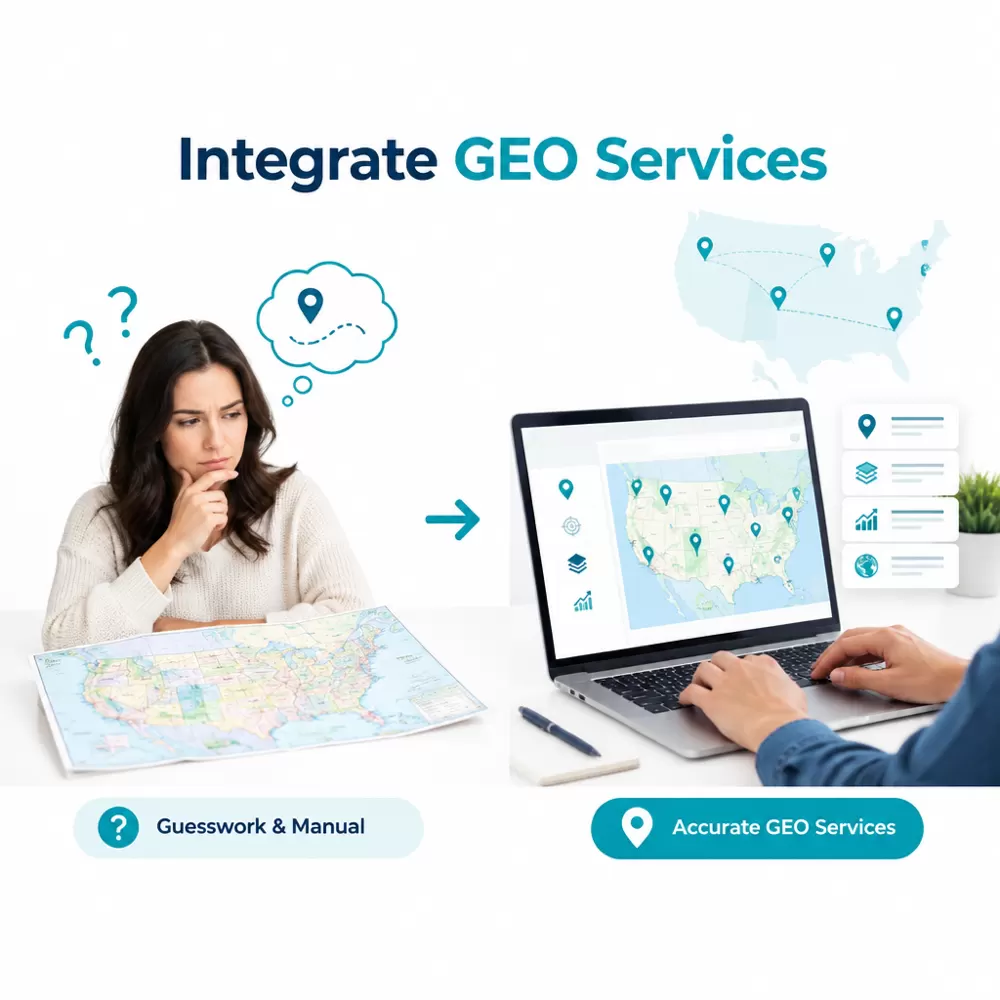
For a business serving customers in person or traveling to them, local search behavior matters. People often include a city or service in a query, or use phrases such as “near me.” They may also see map results before standard organic listings. In those situations, local SEO and a well-maintained Google Business Profile (GBP) can be relevant parts of the visibility plan.
Start with the basics. Check that the business name, address, and phone number (NAP) are accurate and consistent across important business listings. Confirm that the GBP represents the real business, including its location or service area and the services it actually provides. Avoid creating location claims for places the client does not serve. Inaccurate or overextended coverage can frustrate searchers and undermine trust.
Local landing pages can help when a business has distinct, legitimate service coverage or locations. Each page should give readers useful information about that place, the service offered, and how to contact the business. Simply swapping a city name into otherwise identical pages is unlikely to help a customer make a decision. Agencies should also account for how customers talk about their location, which may include a neighborhood, suburb, county, or metro area rather than only a city name.
Reviews are another practical part of local presence. Help clients create a straightforward process for requesting honest feedback, and make sure responses are appropriate and professional. Do not promise a particular ranking from reviews or ask customers to post scripted praise. Instead, treat review activity as a way to build trust and understand recurring customer concerns.
The United States is not one uniform local market. A business may operate across multiple states, metro areas, or neighborhoods, each with different coverage and customer language. Build the plan around verified locations and service boundaries. Then assess whether map visibility, organic local pages, and location-targeted campaigns are reaching the intended audience, rather than assuming that nationwide reach is the same as local relevance.
Questions to ask before choosing where to begin
A useful kickoff does more than ask which channel the client wants to try. It establishes what customers need, where discovery is breaking down, and what evidence the agency can use to evaluate progress. These questions can help:
- Where does the client actually serve customers? Confirm physical locations, service areas, travel limits, and any places that should not be targeted.
- How do customers look for the business? Ask whether they use a place name, a “near me” query, a product or service description, or a question about expertise.
- What is the visibility gap? Is the brand missing from local discovery, hard to find in organic results, or difficult to understand from its published information?
- What does the client want a searcher to do? A phone call, a store visit, a quote request, or a better-informed product choice may call for different content and measurement.
- Is the business information dependable? Check the site, listings, service descriptions, and location details for inconsistencies before expanding content or campaigns.
- What can the agency measure reliably? Agree on available evidence, such as relevant organic traffic, local actions, qualified inquiries, or observations of how the brand appears in selected generative search experiences.
Use the answers to choose a starting point, not to force every client into a standard package. If a multi-location business has incorrect listings and thin local pages, repairing those foundations may be more practical than starting with generative search visibility. If a brand already has clear location coverage but publishes vague, poorly structured information, content and technical review may deserve attention. Some clients will need parallel work, but each workstream should have its own purpose.
How agencies can coordinate location work, GEO, SEO, and AEO
A coordinated plan works best when each discipline has a defined role. SEO can address technical access, site structure, and relevant organic content. AEO can help make answers to common questions direct and easy to interpret. GEO can focus on the completeness and clarity of information that may be used in generative search. Local SEO can support geographic discovery, while location-based targeting can put a message in front of audiences in selected places.
These efforts can reinforce one another, but they should not be collapsed into a single promise. For example, a regional business might first verify its GBP, NAP details, and genuine service locations. The agency could then improve useful service and location pages, make key answers clear, and review whether the brand’s expertise is represented accurately across its site. If there is a reason to target campaigns by place, that work can be planned separately and measured against its own objective.
For agency strategists evaluating an integrated service plan, how can digital marketing agencies integrate geo services to boost client brand visibility? The SEO Deep Insights page describes integrated SEO, AEO, and GEO for digital marketing agencies, including technical fixes, local visibility, content, ethical link building, and reporting tied to performance. Use that scope as service context, then define the deliverables and success measures for the specific client rather than implying every tactic suits every account.
To keep the plan practical, write a short brief for each workstream. State the audience, the visibility problem, the work being proposed, what it depends on, and how progress will be reviewed. A local page project may depend on verified business details and useful location-specific information. A GEO content review may depend on subject matter expertise and accurate source material. If the client cannot supply reliable facts, flag that limitation before publication.
How to measure progress and avoid common mistakes
Measurement should match the approach. For local visibility, review whether business information is accurate and monitor available signals such as map visibility, GBP interactions, relevant local organic traffic, and qualified calls or inquiries. Interpret changes in context: a rise in profile interactions, for example, does not by itself prove that a campaign caused more sales.
For SEO and AEO, use relevant organic performance and engagement data alongside checks that key pages are accessible, clearly organized, and answer the intended questions. For GEO, be careful about interpreting AI answer observations. Results can vary by query, platform, and context, and an observed mention is not the same as a guaranteed or stable placement. Record what was checked, when it was checked, and which questions were used. Pair those observations with the quality of the underlying content and other available evidence.
Common mistakes often come from treating the label as the strategy. “We need GEO” is not a useful brief until the agency knows whether the client means geographic targeting or Generative Engine Optimization. Other avoidable issues include targeting locations the business does not serve, publishing thin city pages, overlooking inconsistent NAP details, and claiming that structured content or a profile update guarantees a particular ranking or AI citation.
Before launch, agree on a baseline and a review cadence. Keep local, organic, and generative-search observations distinct in reporting so a client can see what changed and what remains uncertain. If results are weak, check the foundations before adding more tactics: are the locations accurate, is the page useful, can search engines access the site, and does the content answer a real customer question?
Practical next step: list the client’s priority audience, actual service locations, most important customer questions, and the discovery problem that needs attention first. Then assign location-based targeting, local SEO, SEO, AEO, or GEO to that specific problem. This gives the agency a clear scope, gives the client a reason for each activity, and makes later evaluation more meaningful.