A WooCommerce SEO report can show keyword movement, completed tasks, and traffic trends, yet still leave a store owner wondering what any of it means for the business. The gap is often not a lack of data. It is a lack of context linking the store’s goals to the work, changes in search visibility, and relevant business measures.
A useful review makes those connections clear without claiming that a ranking change caused a sale. It explains what the agency planned, what it completed, what changed in search, and what the available store data can and cannot tell you. If you are comparing a woocommerce seo agency or already working with one, use the reporting conversation to assess clarity, not just the number of charts.
Why WooCommerce SEO reports can miss store goals
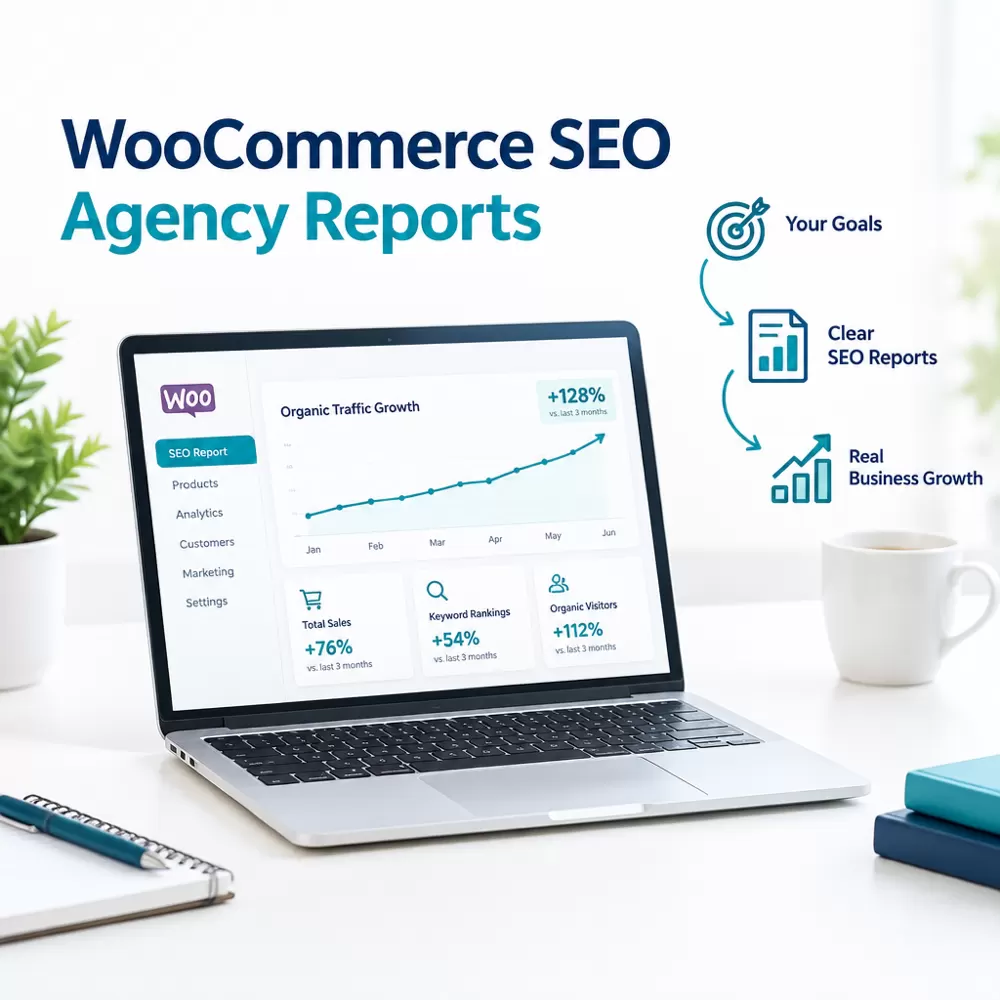
SEO reporting often starts with measures that are easy to track: rankings, clicks, impressions, or completed tasks. These can help explain search performance, but they do not automatically answer a store owner’s central questions: Are the right products being found? Are relevant visitors reaching useful pages? Is the work supporting the business priorities we agreed on?
A report can feel busy while leaving those questions unanswered. For example, a ranking change may refer to a broad query that has little connection to the products a store wants to grow. More organic visits may come to informational pages, while important category or product pages remain hard to find. Neither observation makes the work worthless. It means the figures need an explanation tied to the intended audience and goal.
Store priorities also differ. One business may want stronger visibility for a particular product category. Another may need technical fixes so search engines can reliably crawl important pages, or may want local visibility for customers in a defined service area. A report should reflect the priorities actually agreed with the agency, rather than treating every store as if it has the same objectives.
Search visibility is one part of the picture, not proof of business impact. Rankings and clicks can change for reasons outside the agency’s work, and a visitor’s path from search to purchase can include multiple visits or channels. Honest reporting describes what was observed, what might explain it, and where the available evidence stops.
What useful WooCommerce SEO agency reporting should connect
At its simplest, useful reporting links five things: the store goal, the planned work, the work completed, the search visibility being monitored, and business measures relevant to that goal. The chain gives both sides a way to discuss progress and decide what to do next.
- Goal: State the store priority in plain language, such as improving discovery of a product category or resolving a technical barrier affecting important pages.
- Planned work: Explain the actions selected to support that priority. This could involve technical SEO, content, local visibility, ethical link building, or optimization for answer and generative search experiences.
- Completed work: Record what was done, which pages or site areas it affected, and whether any planned item was delayed or changed.
- Search visibility: Show relevant observations, such as changes in impressions, clicks, or rankings for the pages and queries being addressed. Include the date range and comparison used.
- Business measures: Where suitable data is available, review relevant outcomes such as leads or revenue alongside the search data, while being clear about attribution limits.
This structure makes a review more useful than a task log or a set of disconnected charts. If the work was to improve a product category, for instance, the discussion should identify that category, the changes made to it, how its search visibility is being assessed, and which store measures could provide useful context. It should not imply that one ranking movement directly produced a purchase.
SEO Deep Insights approaches WooCommerce work across SEO, Answer Engine Optimization (AEO), and Generative Engine Optimization (GEO), alongside technical fixes, local visibility, content, and ethical link building. Reporting tied to leads and revenue should still distinguish between activities, search signals, and business outcomes. Those are related parts of the review, but they are not interchangeable evidence.
How to read work, visibility, and business measures together
Start with the work itself. Ask what the agency intended to change and why that action relates to the agreed goal. A technical fix may address crawlability, which is a search engine’s ability to discover and access pages. Content work may make a page more useful for shoppers researching a product. AEO and GEO work focuses on making relevant information clearer for answer-oriented and generative search experiences. The report should make the purpose of each workstream understandable without expecting you to infer it from a task name.
Then look at the search evidence. Check that the report identifies the period being reviewed and what it is compared with. A short period can be noisy, while a longer comparison may include changes in seasonality, promotions, product availability, or the broader search environment. Ask whether the data refers to the store overall or to the pages and queries connected to the work. Those distinctions can change how you interpret the same chart.
Finally, consider relevant business measures. For an ecommerce store, the agency and store team may review leads or revenue where the tracking and business context make that useful. But an increase or decrease observed during the same period as SEO work does not, by itself, establish a cause. Paid campaigns, pricing, inventory, merchandising, site changes, and customer behavior can all affect business results. The agency should say what it can reasonably connect and what remains uncertain.
A change in search visibility is a signal to investigate, not proof that SEO caused a change in sales or leads.
Good reporting is therefore both analytical and careful. It helps the team decide whether to continue, adjust, or investigate a piece of work. It does not turn every movement into a success story, or dismiss useful progress simply because a direct revenue link cannot be established.
Which measures matter, and what context they need
The right measures depend on the store goal. Rankings may help show whether important queries are becoming more visible, but they should be interpreted alongside the relevance of those queries and the pages appearing in search. Impressions can show that pages are appearing in search results. Clicks indicate that some searchers chose to visit. Neither one tells you on its own whether visitors were a good fit or completed a valuable action.
For a category visibility goal, it may make sense to examine search signals for that category and the relevant landing pages, then discuss how those observations relate to store activity. For a technical project, reporting should explain which issue was addressed and what was checked afterward. For local visibility, the review should clarify which locations or local pages are in scope. For content work, it should identify the pages and audiences the content is meant to serve.
Business measures need their own context. Confirm that tracking is functioning and agree on which action counts as a meaningful lead or revenue measure for your business. If the store has changed its checkout, analytics setup, product assortment, or promotional calendar, note that before interpreting a trend. When the measurement is incomplete, the report should say so rather than presenting a precise-looking figure as definitive proof.
Timing matters, too. The date work was completed may not be the date a search engine reflects a change, and different types of work can take different amounts of time to assess. Ask the agency what period is reasonable for reviewing each activity, what early indicators it expects to inspect, and when the team will revisit the decision. This is a planning conversation, not a promise of a particular ranking or sales outcome.
How to evaluate a WooCommerce SEO agency’s reporting
Before hiring an agency, ask to see how it explains the relationship between goals, work, and measurement. You are looking for a clear method, not a promise that every SEO action will produce a predictable result. Ask how reporting changes when the store’s priority changes, how completed tasks are documented, and how the agency handles results that are flat or difficult to attribute.
For an overview of its WooCommerce approach, review woocommerce seo agency. As you evaluate a potential partner, check that its stated work covers the areas your store needs and that its reporting can distinguish planned actions from observed search and business changes.
Useful questions to ask in a sales conversation or regular review include:
- Which store goal does each major workstream support, and how will we know whether the work was completed?
- Which pages, product categories, queries, or locations are included in this review?
- What date range and comparison are shown, and what seasonal or operational context could affect the interpretation?
- How do you separate work completed from changes observed in search performance?
- Which leads or revenue measures are relevant to our goal, and what tracking limitations should we understand?
- If visibility changes but business measures do not, what will you investigate before recommending the next action?
- What information do you need from our team about stock, promotions, pricing, site releases, or other marketing activity?
A strong answer should be specific enough to guide a decision, but not overconfident. If an agency treats a ranking increase as proof of revenue growth, ask how that conclusion was established. If it reports activity without explaining its purpose, ask which goal the work supports. If it cannot answer every question immediately, it should be able to identify what information is missing and how the team will resolve that gap.
Common reporting mistakes and practical next steps
One common mistake is treating more data as better reporting. A long report can still obscure the few signals that matter for the agreed priority. Another is mixing different page types, queries, or time periods without explaining the change in scope. This can make a trend look stronger or weaker than it is. Ask for consistent definitions and clear notes whenever the reporting method changes.
It is also easy to confuse activity with progress. Publishing content, fixing an issue, or earning a link describes work performed. It does not establish that search visibility improved, or that a business outcome followed. The reverse mistake is to dismiss foundational work because the effect is not immediately visible. Technical corrections and clearer content can address real barriers, but their value still needs to be assessed in context over an appropriate period.
Attribution is another frequent source of confusion. Store results may reflect several channels and operational changes at once. A report should not assign all movement to SEO simply because it happened during an SEO engagement. Look for transparent language about contribution, uncertainty, tracking, and other possible influences. This is more useful than a confident claim that the data cannot support.
To improve your next review, bring a short list of current store priorities and any major changes that could affect interpretation. Ask the agency to map each active workstream to a priority, summarize what was completed, show the relevant search observations, and discuss appropriate business measures. End the conversation with a decision: continue the work, adjust the plan, investigate a tracking or site issue, or collect more context before drawing a conclusion.
A report earns trust when it helps you make that decision. It should show what the agency did, why it mattered to the plan, what changed in search, and how the store can assess the business context without overstating causation. That gives WooCommerce store owners a practical basis for judging both the work and the quality of the agency relationship.