AI search is changing how brands think about visibility, but it is also creating a new market for old tricks. As GEO brand mentions become a popular talking point, some vendors are quietly repackaging paid placements, irrelevant citations, and mass posting as if they were modern generative optimization.
That framing is seductive because it sounds strategic: build more mentions, increase your citation rate, and improve your presence in AI answers. The problem is that not every mention is a meaningful signal. In practice, low-quality off-site activity can distort AI search visibility without building real trust, and it can leave brands paying premium retainers for reputational noise.
Key idea: off-site signals matter in AI search, but only when they come from relevant, trustworthy sources with editorial integrity. A mention is not automatically a validation signal.
The paid brand mention problem in GEO
For hands-on help with this topic, explore SEO Services for Personal Branding.
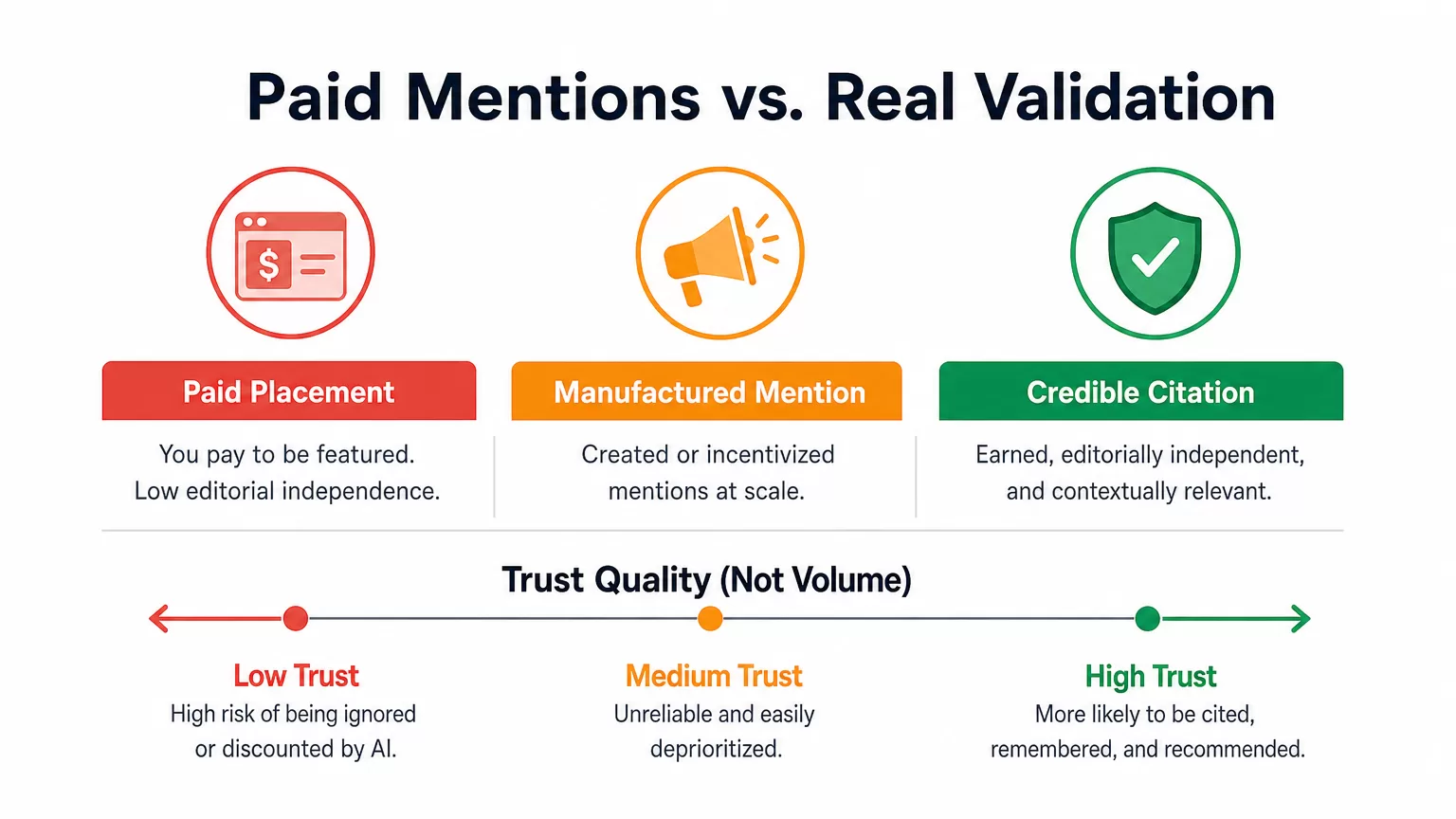
The core issue is definitional drift. Generative Engine Optimization should be about earning visibility in AI systems through credible, context-rich signals. Instead, some offerings use GEO language to sell what is essentially a blend of paid placements, PBN inventory, and unrelated mentions on pages designed to monetize attention.
This is where the market gets dangerous. Many teams now believe that AI systems reward off-site references in a straightforward way, which is partly true. But when that belief is used to justify buying mentions on weak pages, the strategy stops being optimization and starts looking like a dressed-up version of manipulative SEO.
- Paid mention: a placement purchased primarily for visibility, not editorial merit.
- Credible citation: a reference earned from a relevant source with topical authority.
- Spam signal: a mention pattern that exists mainly to manufacture perceived popularity.
One reason this works as a sales pitch is that AI search is still new enough that many marketers cannot easily separate legitimate influence from manufactured exposure. That uncertainty creates room for vendors to sell volume as value. But volume alone does not equal trust, and trust is what reputation-based systems tend to reward over time.
If a GEO proposal leans heavily on “we’ll get your brand mentioned everywhere,” it is worth asking a harder question: mentioned where, by whom, and for what reason?
Why off-site validation matters in AI search
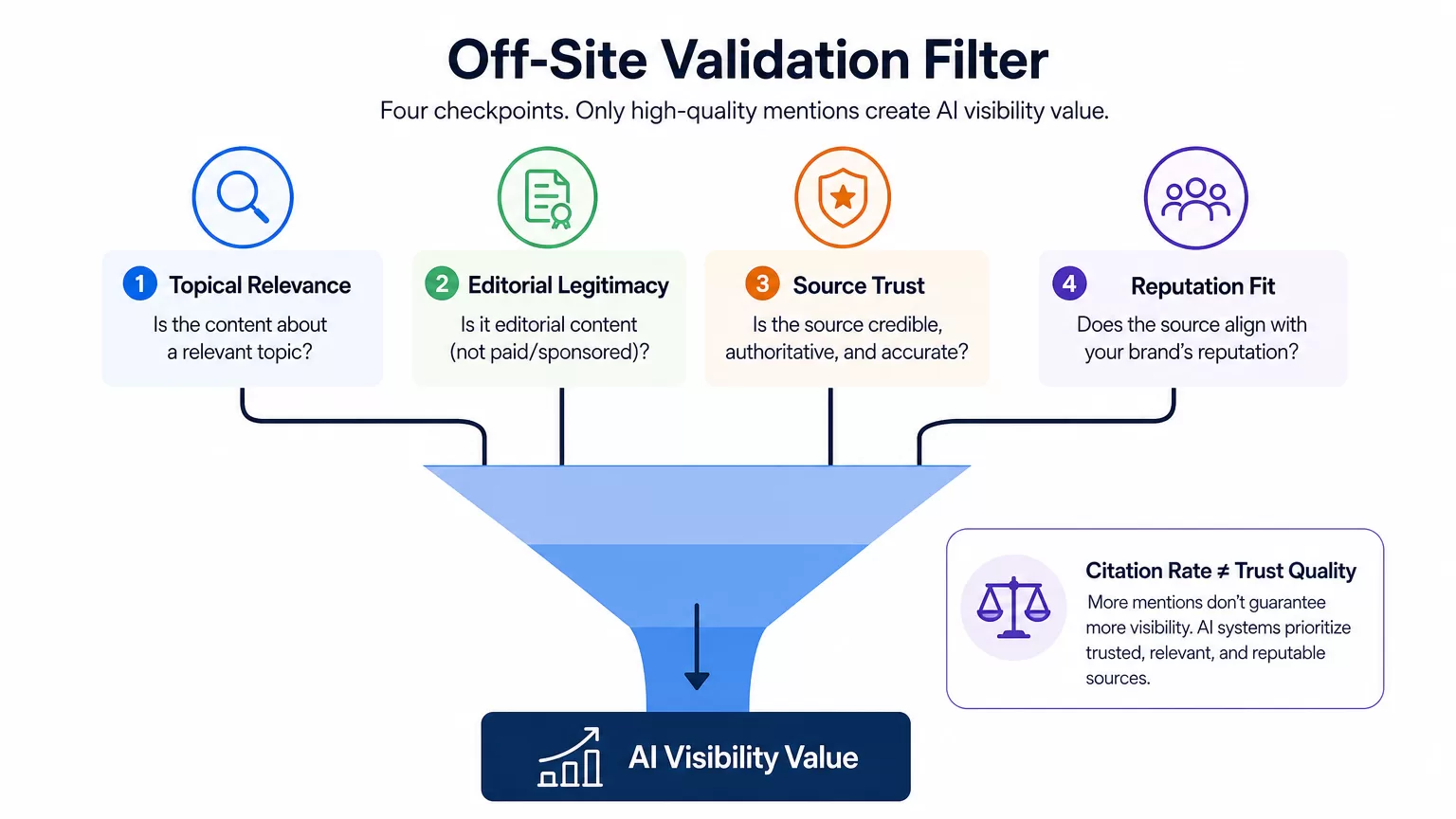
Off-site validation is not the problem. In fact, it is one of the most important ingredients in modern SEO, AEO, and GEO strategy. AI systems need external evidence to decide whether a brand is real, relevant, and worth surfacing. That evidence may come from editorial coverage, expert roundups, industry communities, trusted directories, or other contextually aligned sources.
The mistake is treating every mention as equal. A reference from a respected, topically aligned site can reinforce brand authority. A mention on a thin page surrounded by commercial anchors, unrelated topics, or obvious payment patterns can do the opposite. It may still register, but it can weaken the overall trust profile instead of strengthening it.
Relevance is the filter. Without topical fit and source credibility, a mention is just noise with a byline.
For teams evaluating AI answers, the practical question is not whether off-site signals matter. It is whether the signal is:
- Topically relevant to the brand’s category and audience
- Editorially legitimate rather than obviously manufactured
- Trustworthy enough to support reputation, not just exposure
- Consistent with the brand’s broader authority footprint
This is also where reputation management and GEO intersect. AI visibility is not only about being found; it is about being associated with the right context. If a brand appears in low-quality environments, the association can become a liability even when the mention technically exists.
For a deeper framework on earning credible AI visibility, see our guide on How to Optimize Content for AI Search Citations.
How paid mentions mimic black hat link building
Paid brand mentions often look new because the packaging is new. The tactics are not. They resemble classic black hat SEO patterns: buying placements, using irrelevant pages, leaning on private networks, and scaling output faster than quality can be reviewed.
The resemblance matters because the underlying logic is the same. If a system appears to reward external references, a manipulative operator will try to manufacture those references at scale. That has always been the playbook behind spammy link building, and GEO has not changed that incentive.
- PBN-style inventory: mention opportunities on networks built to simulate authority.
- Irrelevant placements: pages that have little topical connection to the brand.
- Mass posting: volume-driven distribution designed to create the appearance of demand.
- Astroturfing: artificial endorsement patterns that mimic organic conversation.
There is also a workflow problem inside many agencies and in-house teams. Junior marketers are often asked to approve placement lists without the expertise to judge whether a page is legitimate, relevant, or part of a manipulative scheme. That creates a governance gap: the people reviewing the spend may not be the people best equipped to assess the risk.
Another concern is pricing opacity. Some vendors charge a premium retainer while also passing publisher fees through to the client. On paper, that can make low-value placements feel like strategic media buys. In reality, the brand may be paying twice: once for the service wrapper and once for the mention itself.
That is not a durable authority-building model. It is a short-term visibility trade that can be expensive to unwind.
The temporary effectiveness window
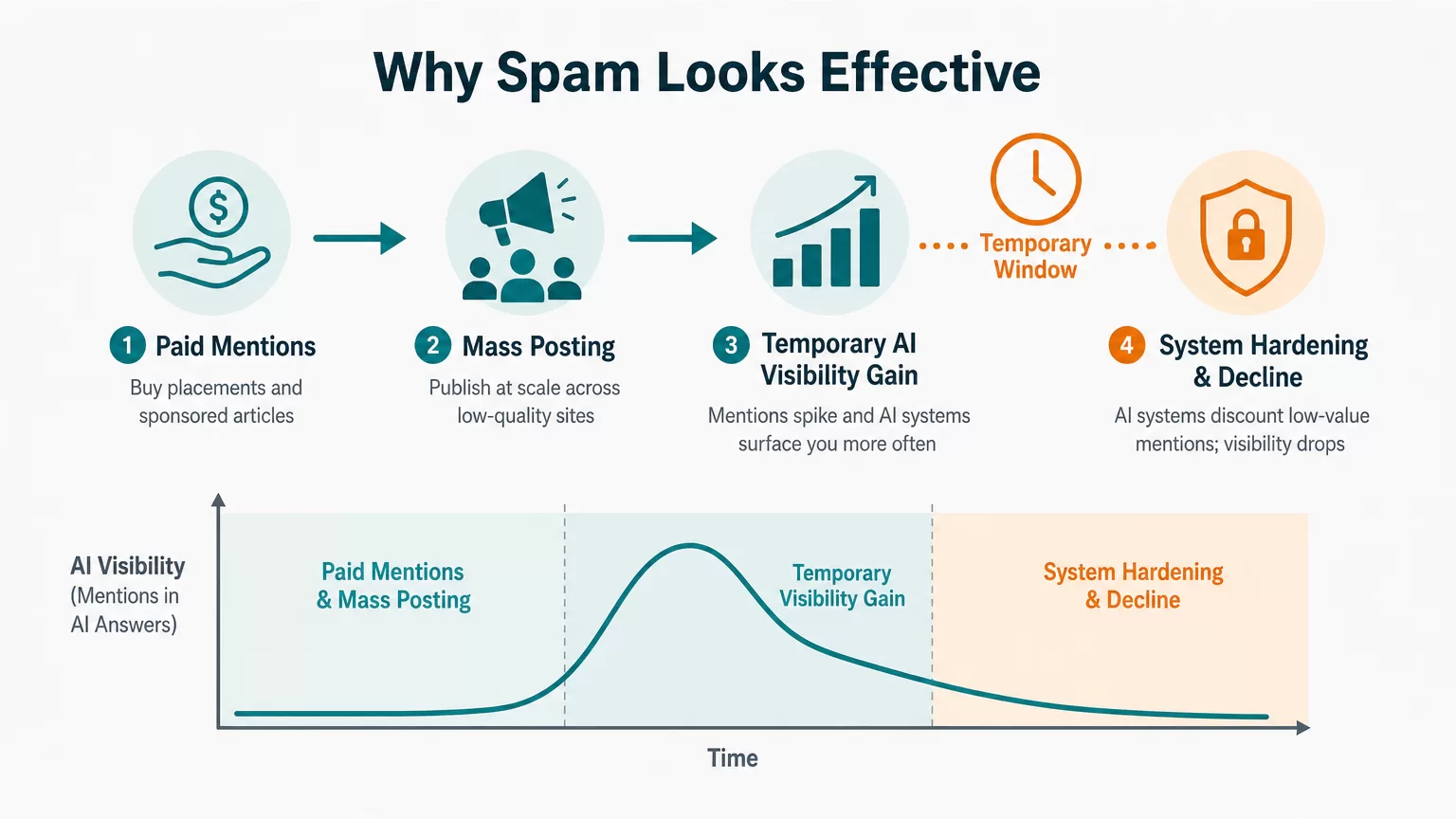
Some spammy GEO tactics appear to work because AI citation systems are still maturing. Compared with Google’s long-evolved spam detection infrastructure, many LLM-driven visibility systems are easier to influence today. That does not make the tactics legitimate; it just means the enforcement layer has not fully caught up yet.
This creates a temporary effectiveness window, but it should not be mistaken for a long-term advantage. Brands that optimize for low-quality mention volume may see short-lived gains in citation frequency or perceived presence. The problem is that the same tactics are likely to become less effective as systems improve their authority, relevance, and spam filters.
Short-term exploitability is not a strategy. It is a timing gap. And timing gaps close.
That matters for planning because the economics of manipulative GEO are upside-down. The brand pays for placements that may have a limited lifespan, uncertain relevance, and potential reputational downside. If the tactic depends on a system being immature, then the brand is building on unstable ground.
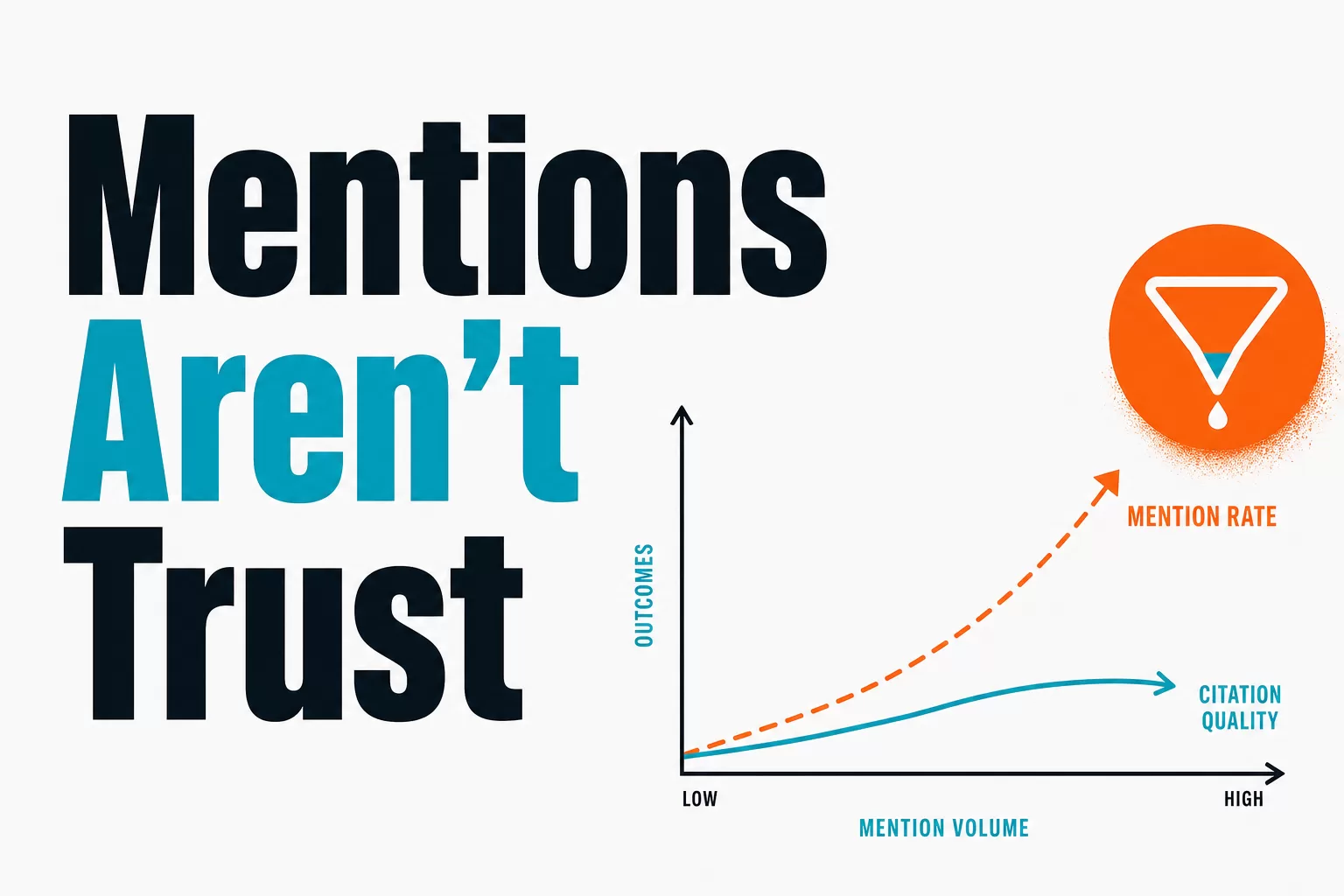
Teams should also remember that AI visibility is not a single metric. Mention rate and citation rate can rise while trust stays flat or even declines. In other words, a brand can look more visible in the short term while becoming less credible in the long term.
That is why modern SEO and GEO planning should be evaluated against durability, not just immediate surface-level exposure.
What brands should do instead
The safer path is to treat GEO as a trust-building discipline. That means aligning AI visibility work with the same standards that make SEO resilient: relevance, editorial quality, and reputation. The goal is not to collect mentions at any cost. The goal is to earn mentions that actually support authority.
Brands should start by auditing every off-site opportunity through three lenses: relevance, trust, and reputation. If a placement fails any one of those tests, it is usually not worth the spend.
relevance and authority checks
- Does the page cover topics that are closely related to your category?
- Does the source have a real audience and a credible editorial footprint?
- Would the mention make sense to a human reader without explanation?
- Does the surrounding content reinforce expertise or dilute it?
These checks sound simple, but they are often skipped when a team is focused on scaling visibility. Relevance should be non-negotiable. A mention that is technically indexed but contextually weak is unlikely to help your AI search profile in a meaningful way.
vendor red flags
- Promising guaranteed AI citations or fixed placement outcomes
- Using vague language like “distribution,” “network,” or “partnership” without source details
- Prioritizing volume over source quality
- Refusing to explain why each placement is relevant
- Bundling publisher fees into retainers without transparency
When vendors avoid specifics, the safest assumption is that the offer is weaker than it sounds. Ask for exact URLs, topical fit, publication standards, and the reason each placement should matter to your audience or your category.
safer GEO/AEO alternatives
- Digital PR: earn coverage through genuinely newsworthy angles and expert commentary.
- Topical content depth: build pages that answer questions thoroughly enough to be cited.
- Structured data: strengthen machine-readable context for entities, products, and expertise.
- Authority pages: publish clear proof points, bios, and brand signals that support trust.
- Reputation monitoring: track how the brand appears across the web, not just in your own site.
For brands exploring a more principled approach to AI visibility, our Generative Engine Optimization (GEO) service framework is built around relevance and trust, not manufactured volume. That distinction matters because the future of AI search will likely reward brands that behave like credible sources, not brands that look artificially popular.
In practice, the best GEO programs will resemble strong SEO programs: they will be measurable, transparent, and anchored in useful content and legitimate authority signals. The difference is that AI search raises the stakes. Low-quality off-site citations may still move a metric for a while, but they do not build the kind of reputation AI systems are likely to trust as the ecosystem matures.
Bottom line: if a mention would not help your brand’s credibility with a human editor, it is unlikely to be a wise investment for AI visibility either.