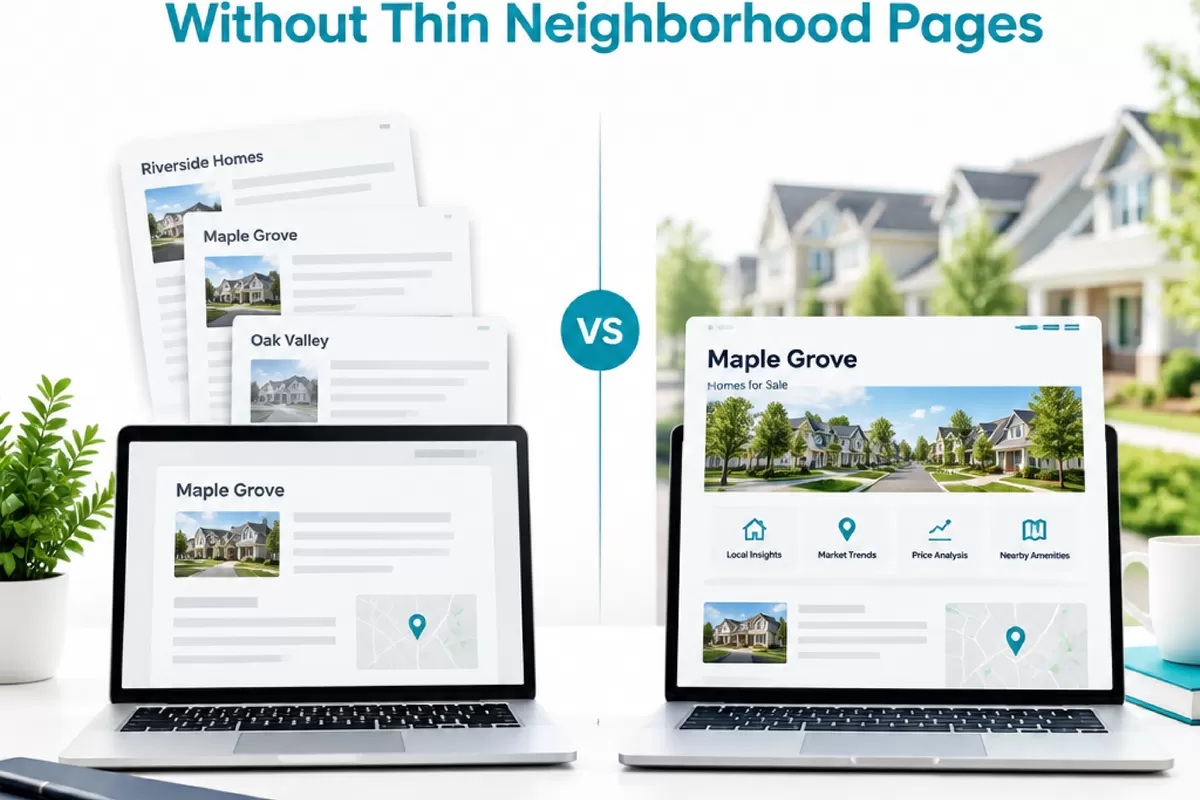
Neighborhood pages can help real estate businesses serve people searching in specific areas. But publishing a page for every neighborhood can backfire if each page repeats the same claims with only a place name changed. Visitors get little help, and the business has to maintain a large set of pages that do not reflect how it actually serves the market.
Effective real estate SEO services start with a narrower question: which locations can the business genuinely support, and what useful information can it provide about each one? A focused plan can connect neighborhood content with relevant listings and services, while local visibility work helps search engines and prospective clients understand where the business operates.
Why neighborhood pages need more than a location name

A neighborhood page is a landing page for people looking for real estate information or services in a particular area. Depending on the business, its purpose may be to introduce local buying or selling support, show available properties, or help visitors explore the area before making contact. The page should make that purpose clear from the start.
A weak page often has a broad headline, a few generic sentences about the local market, and a contact form. The same text appears across several pages, with neighborhood names swapped in. This approach may create a longer URL list, but it does not give a reader a reason to choose one page over another.
Useful pages answer questions the business can address accurately. A visitor might want to know:
- Does the business work with buyers, sellers, landlords, or more than one group in this neighborhood?
- Are there current listings or property types that are relevant to the area?
- What local details can the business explain without relying on broad, unsupported claims?
- How can someone ask a question or take the next step?
Each page does not need to cover every possible question. It does need a clear audience and a useful reason to exist. If the only unique element is the place name, the page is probably not ready to publish.
Choose neighborhoods based on real business coverage
Start by comparing search demand with the business’s actual service area and capacity. A location should not make the plan simply because it has a recognizable name or seems attractive as a keyword. The business needs a credible connection to the area and a way to serve people who arrive through that page.
Review practical evidence before selecting locations. Sales and service teams can identify where they currently work, where they can take on new clients, and which areas they understand well enough to discuss. Existing listings, past inquiries, and the locations named in service conversations can help inform that review. Search data can add another perspective, but it should not replace operational judgment.
A simple planning table can keep the decision grounded:
- Coverage: Can the business serve clients in this area now, and is that coverage likely to continue?
- Audience: Which real estate need does the page address, such as buying, selling, or finding a particular property type?
- Useful details: What accurate area-specific information, listings, or service guidance can the business provide?
- Maintenance: Who will review the page when services, listings, or local details change?
- Distinct purpose: Is this location meaningfully different from nearby areas in the way the business serves it?
These questions help decide whether to create a new page, improve an existing one, or leave the area off the site for now. It is reasonable to begin with a smaller set of locations where the business has the strongest coverage and knowledge. Expanding later is easier than maintaining many pages that never had enough substance to support them.
Also settle how the business will name locations. Neighborhood boundaries and labels may not be consistent across maps, local usage, and real estate listings. Use names people recognize, explain broader area relationships where helpful, and avoid implying that two distinct neighborhoods are interchangeable.
Make each neighborhood page useful and distinct
Build the page around a clear visitor need, not a template that demands a fixed number of paragraphs. A buyer-focused page might explain the business’s local buying support and connect to relevant properties. A seller-focused page could describe how the business handles a sale in that area and how a prospective client can discuss their property. Keep claims within what the team can verify and deliver.
Area details should help someone make sense of the location, not act as decorative filler. Depending on what the business can confirm, a page might describe the types of homes it handles, local service coverage, or how to browse current properties. If a detail could change or be misunderstood, verify it before publication and make a plan to review it.
Distinctiveness does not require every page to have a wholly different design. A consistent page structure can help visitors find information, provided the content within that structure reflects the specific location and audience. For example, an editor might use sections for local service coverage, relevant property information, and a contact next step, then include only the sections that the business can support for that area.
Before publishing, check the page from a prospective client’s point of view:
- Does the opening explain which location and real estate need the page covers?
- Can a reader find a relevant service or property path without searching through unrelated copy?
- Are local statements specific, accurate, and supported by current business knowledge?
- Does the page offer a sensible next step, such as asking about service in the area?
- Would the content still be useful if the neighborhood name were removed from the title?
The last question is a useful editing test. If the page becomes indistinguishable from several others when the location name is removed, it likely needs more local relevance or a narrower purpose. Do not add invented market trends or unsupported claims to make pages appear different. Clear limits build more trust than confident but unverified statements.
Connect neighborhood pages to properties and services
A neighborhood page should work as part of the site, not as an isolated search landing page. Link it to relevant real estate services and property information where those destinations genuinely help the visitor. For instance, someone researching a neighborhood may want to move from a local overview to available properties, or from a selling service explanation to a way to discuss their home.
Keep these connections direct and descriptive. Anchor text should tell readers what they will find, such as “homes for sale in the neighborhood” when the linked destination actually lists those homes. Avoid adding links just to create more internal connections. A link that leads to a broad page with no local relevance can interrupt the visitor rather than help them.
Internal links also help clarify how pages relate. A main service-area page can introduce the locations the business serves and link to its more specific neighborhood pages. Each neighborhood page can point back to the relevant service information. This structure gives visitors options to move between local and broader information without forcing every page to repeat the same explanations.
Check that the destination matches the anchor, works on mobile, and remains current. If a property listing is no longer available, the page should not leave visitors at a broken or misleading destination. Where listings change frequently, use a reliable way to keep the link or property feed current, and avoid writing page copy that depends on one temporary listing.
Plan local content with a real estate SEO services provider
A provider should help turn the location plan into a manageable publishing and review process. Ask how they will assess existing pages, decide which locations have enough value to warrant their own content, and prevent near-duplicate pages from accumulating. The discussion should include the business’s real coverage and what its team can verify, not only a list of search terms.
SEO Deep Insights describes its real estate work as integrated SEO, Answer Engine Optimization (AEO), and Generative Engine Optimization (GEO), alongside technical fixes, local visibility, content, ethical link building, and reporting. AEO focuses on making information useful and clear for direct-answer experiences. GEO considers how content may be understood and surfaced in generative search experiences. For a neighborhood-page project, the provider should explain how these capabilities relate to the site’s actual goals and what work is in scope. The real estate seo services guide outlines the service context.
Ask for a process you can inspect. A sound plan might include an inventory of current location pages, a map of real service coverage, page briefs tied to specific audiences, and review steps for local accuracy. It should also clarify who supplies property details, who approves service claims, and how often pages are checked. Those responsibilities matter because an SEO provider cannot independently verify every detail of a real estate business’s operations.
Local content also needs to coordinate with the business’s broader local visibility work. That means checking whether the website describes the same service areas consistently across relevant pages and whether the business’s local profiles and contact information are accurate. A page cannot compensate for conflicting business details or a location the company does not serve. Nor should a provider promise a particular ranking or lead volume; local search outcomes depend on factors beyond a single page and require ongoing review.
Measure page quality, avoid common mistakes, and improve
Publishing is the start of the work, not proof that the page is helping. Track whether the pages are indexed, whether visitors reach relevant property or service information, and whether inquiries indicate that people understand the business’s local coverage. Search visibility and traffic can provide useful context, but neither guarantees that a page is accurate or useful to a prospective client.
Review performance by page and by location rather than relying only on site-wide totals. If a page receives visits but no meaningful engagement, inspect the experience: Is the audience clear? Does the page meet the likely need? Is the next step easy to find? If a page is not appearing in search, check its indexability, internal links, and whether it offers enough distinct value. These checks help separate a technical issue from a content or coverage problem.
Common mistakes include publishing dozens of similar pages at once, leaving outdated listings in place, naming areas the business does not serve, and using broad statements that the team cannot substantiate. Another frequent problem is treating every neighborhood page as a separate campaign without considering the site structure. The result can be competing pages, confusing navigation, or maintenance work that no one owns.
A practical next-step sequence is straightforward:
- List current service areas and confirm them with the people who handle real estate inquiries.
- Inventory existing neighborhood pages, noting overlap, outdated information, and missing service links.
- Prioritize a small group of locations with clear coverage and enough verified information to support a distinct page.
- Write each page for a defined audience, then connect it to relevant listings and service information.
- Assign responsibility for accuracy checks and review the pages alongside local visibility and performance data.
Neighborhood coverage should grow only when the business has a real reason to serve another area and the capacity to maintain its information. That standard may produce fewer pages at first, but it gives each page a clearer purpose. For real estate businesses evaluating real estate SEO services, ask providers to show how their content plan protects that purpose while supporting technical health, local visibility, and useful reporting.