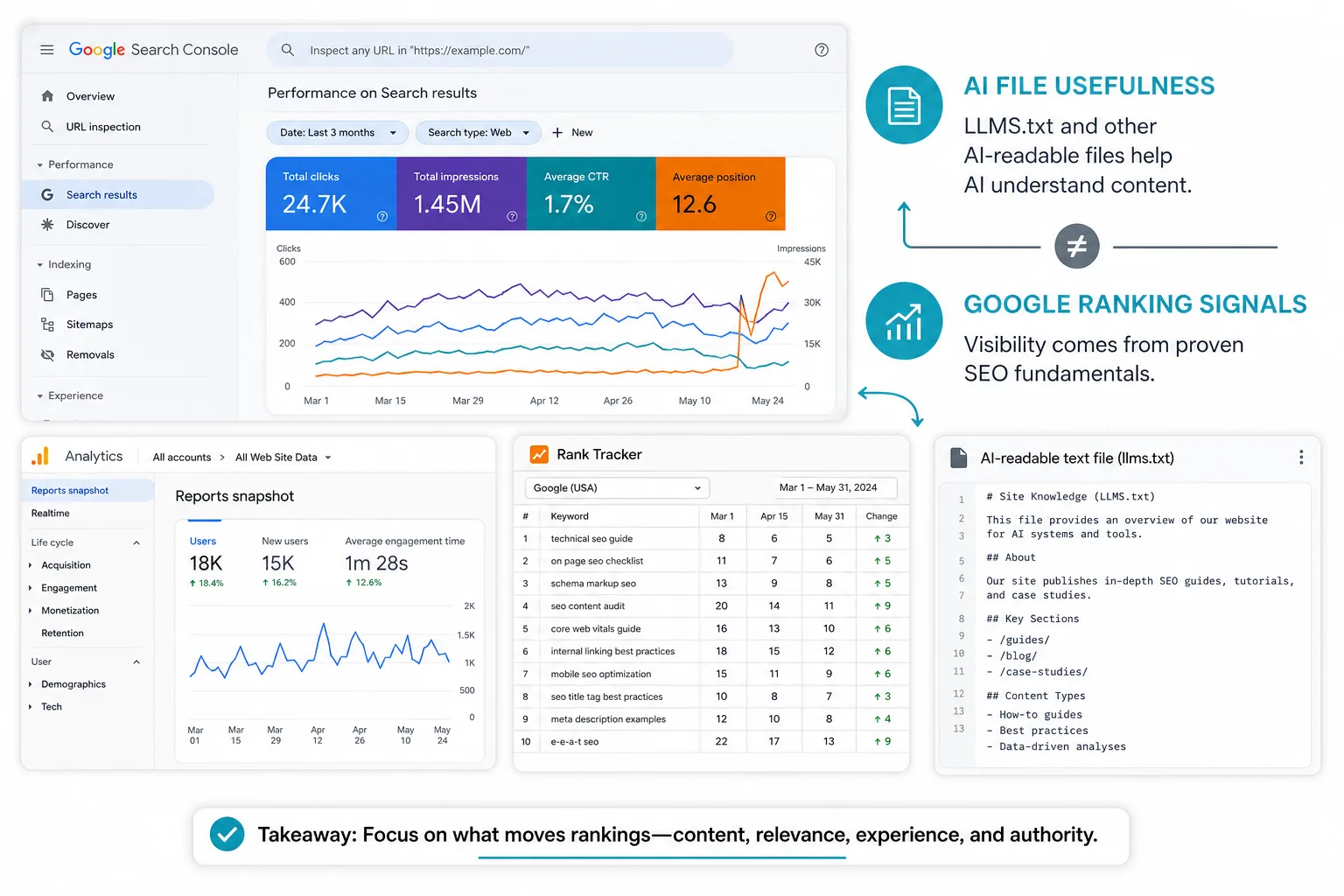
Google’s latest clarification should settle one of the most persistent debates in modern SEO: LLMS.txt files do not improve rankings in Google Search, and they do not create a penalty either. In other words, their presence is effectively neutral for Google visibility.
That matters because many site owners have been asking whether AI-readable files, Markdown pages, or other machine-readable formats are now required to show up in generative AI experiences. Google’s answer is simple: no new file format is needed to appear in Search, including AI-powered experiences built on Search infrastructure.
Key takeaway: LLMS.txt may help some AI systems that explicitly consume it, but it is not a Google ranking shortcut, and it is not a substitute for core SEO fundamentals.
For brands, agencies, and in-house teams, the real question is not whether to chase a new file format. It is whether the site is technically sound, easy to crawl, easy to index, and strong enough to earn relevance on the page itself.
What Google clarified
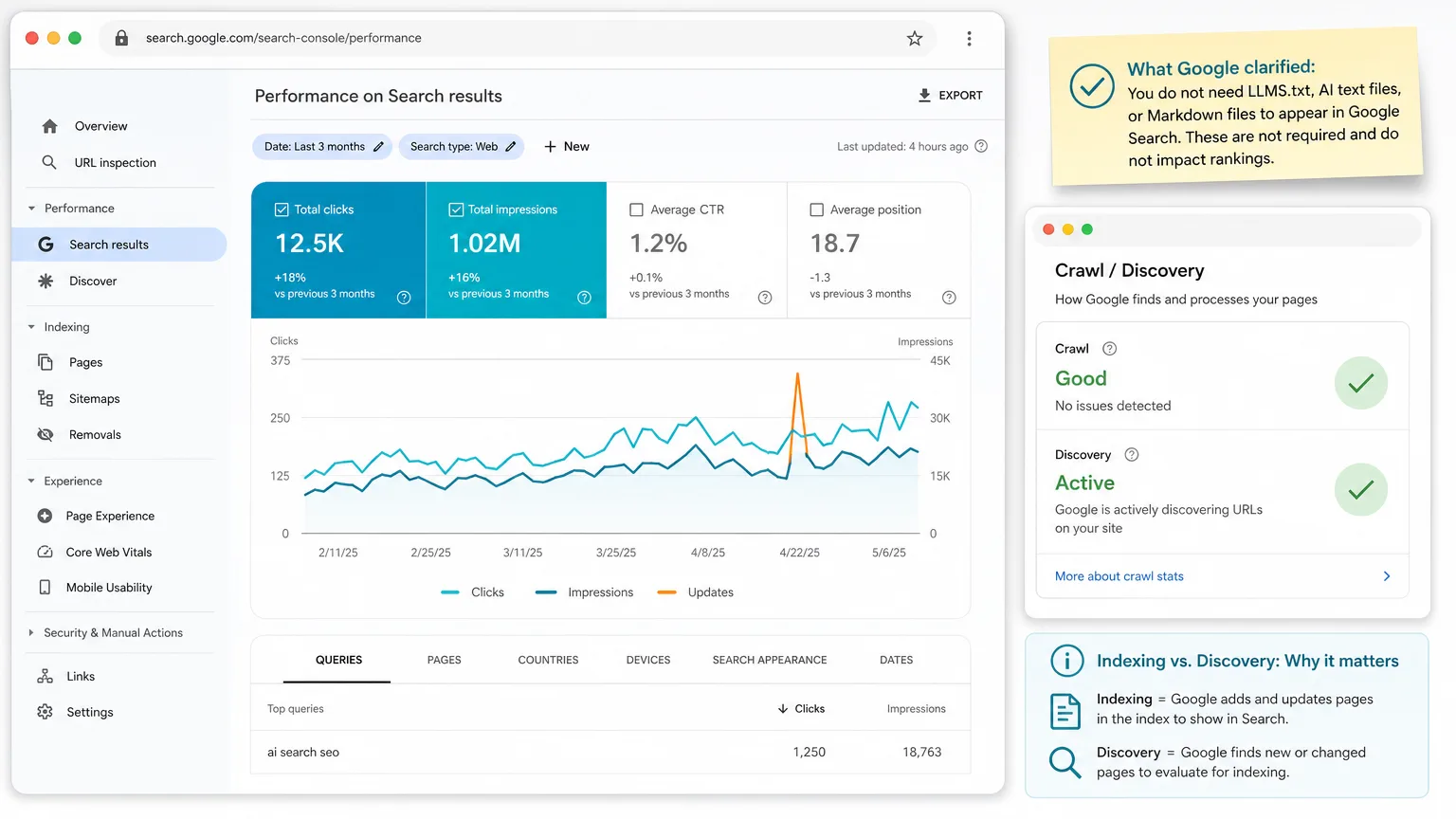
Google’s clarification cuts through a growing amount of confusion in the AI search conversation. The company stated that site owners do not need to create new machine-readable files, AI text files, special markup, or Markdown versions of pages in order to appear in Google Search.
That statement is important for two reasons. First, it confirms that Google Search is still built around its established understanding of content, links, structure, and relevance. Second, it separates AI readability from ranking influence. Those are related ideas, but they are not the same thing.
- Google may discover and crawl many non-HTML file types.
- Discovery does not equal ranking benefit.
- LLMS.txt is not required for Google Search visibility.
- Markdown is not a ranking hack simply because it is machine-readable.
This clarification also helps reduce a common misunderstanding: if Google can process a file, that does not mean the file carries special ranking weight. Search systems can read many formats without treating them as meaningful signals for position in results.
For teams managing content strategy, the message is straightforward: keep investing in the signals Google has consistently valued, rather than assuming a new AI file will change the game.
Why LLMS.txt does not affect rankings

LLMS.txt exists as a proposed way to help AI systems better understand a website’s content. That may be useful in some contexts, but Google Search does not treat it as a ranking factor.
The distinction is subtle but critical. A file can be useful without being influential for rankings. It can also be machine-readable without being algorithmically important.
Do not confuse crawlability with ranking value. Google can crawl non-HTML resources, but that does not mean those resources become special inputs into search rankings.
That is why the presence of LLMS.txt is neutral. It does not help you, but it does not hurt you either. The file may be valuable for other systems, internal documentation, or AI tools that choose to read it. However, that utility is separate from Google Search.
This is also where many AI search SEO discussions go off track. Some marketers assume that anything designed for AI must automatically matter for Google. In reality, Google’s ranking systems still prioritize page-level quality, crawlability, internal linking, content relevance, and technical health.
If you are trying to improve generative AI visibility, the answer is not to chase every new file format. It is to build content that is easy for both humans and systems to interpret, cite, and trust.
What site owners should do instead
Priority order matters: focus on the signals that consistently support search rankings before spending time on experimental AI-readable files.
If your goal is stronger search visibility, the right strategy is still rooted in technical SEO and content quality. That means making your site crawlable, indexable, and internally well-connected. It also means creating pages that answer real queries better than competitors do.
Here is the practical stack site owners should prioritize:
- High-quality HTML content that clearly matches user intent.
- Clean site architecture so important pages are easy to reach.
- Internal linking that distributes relevance and helps discovery.
- Structured data where it genuinely supports understanding.
- Fast, stable pages that provide a good user experience.
- Indexable content with no accidental blockers in robots directives or rendering.
For teams exploring AI search SEO, it can also be useful to study how content is summarized and cited across systems. Resources like Answer Engine Optimization (AEO): How to Win Featured Snippets, AI Answers, and Voice Search and Generative Engine Optimization (GEO): Get Cited in ChatGPT, Gemini, Perplexity, and AI Overviews can help frame that broader strategy. But even there, the foundation remains the same: content quality and technical clarity.
In short, if you have limited resources, do not spend them on speculative file-format optimization at the expense of core SEO work. The pages that rank are still the pages that are accessible, relevant, and useful.
Common misconceptions
The LLMS.txt conversation has produced several myths that deserve a direct response.
- Myth: LLMS.txt is required for Google Search visibility.
Reality: Google says it is not needed. - Myth: Markdown pages are automatically better for rankings.
Reality: Format alone does not create ranking advantage. - Myth: Any AI-readable file helps with Google’s generative experiences.
Reality: Google does not require new machine-readable files for those experiences. - Myth: If Google can crawl a file, it must influence rankings.
Reality: Crawling and ranking are different processes. - Myth: LLMS.txt replaces robots.txt or other technical SEO controls.
Reality: It serves a different purpose and is not a substitute.
These misconceptions are understandable because the industry is eager to find the next edge in AI search. But the fastest way to waste time is to assume every new standard is a ranking lever.
The smarter approach is to treat LLMS.txt as optional infrastructure for systems that may use it, while keeping Google-focused SEO grounded in proven signals. That balance is especially important for enterprise teams and agencies that need to explain priorities to stakeholders.
Practical SEO implications
The practical lesson is not that AI search is irrelevant. It is that AI search visibility and Google rankings are not solved by the same shortcut. Site owners should separate the question of whether a file is useful for AI systems from the question of whether it affects Google Search.
Here is the clearest comparison:
- Files intended for AI systems: LLMS.txt, Markdown exports, other machine-readable summaries.
- Signals that matter for Google rankings: content quality, internal links, crawlability, indexability, relevance, and technical performance.
That does not mean AI-oriented files have no value. They may support content consumption by external tools, internal workflows, or future integrations. But for Google Search, they are not the lever.
Site owners should also remember that Google Search can still discover and process many file types without giving them special treatment. That is why the safest strategy is to optimize the content itself, not just the wrapper around it.
Bottom line: LLMS.txt is not a ranking factor, not a penalty trigger, and not a replacement for SEO fundamentals. It may be useful elsewhere, but Google visibility still depends on the basics done well.
As AI search continues to evolve, the winners will likely be the brands that stay disciplined: they build strong pages, maintain clean architecture, and avoid mistaking novelty for strategy. In an era full of speculation, that restraint may be the most valuable optimization of all.