Why agency teams need an AI-powered second brain
Agency work is fragmented by design. Client communication lives in Gmail, Slack, and meeting notes. Sales context sits in a CRM. Delivery details hide in docs, tickets, and spreadsheets. By the time a strategist, account manager, or operator has reconstructed what happened yesterday, 45 minutes can disappear into pure context switching.
That is the real problem a second-brain system should solve. Not just capture. Not just search. Store information, retrieve it accurately, and act on it.
A second brain that only stores notes is incomplete. If it cannot surface the right context and convert that context into decisions, drafts, or actions, it becomes another place where work goes to wait.
This is why a traditional note app often fails agency teams. It accumulates information, but it does not reduce operational drag. The result is a passive archive instead of an active knowledge system. A better model is an AI-powered operating layer built around Claude Code, structured memory, searchable logs, MCP integrations, and workflow automation.
The goal is simple: turn scattered information into action while reducing the mental overhead of switching between tools, tabs, and threads.
Why second-brain systems fail
Most second-brain systems break down in three predictable ways:
- Passive storage: Notes are captured, but they remain inert. You still have to remember where they live and manually translate them into work.
- Context-switching tax: Even when you find the note, you must copy, paste, summarize, and re-prompt across tools to make it useful.
- No action layer: The system can remember, but it cannot draft, organize, or execute. That means the burden of turning knowledge into output stays on the human.
In agency environments, that failure shows up every day. You know a client preference exists somewhere. You remember a pricing decision was discussed last month. You are certain a sales objection was answered in a meeting, but you cannot find the exact wording. The information exists, but it is not operationally available.
The fix is not a bigger note vault. The fix is a system that treats knowledge as an executable asset.
Claude Code architecture
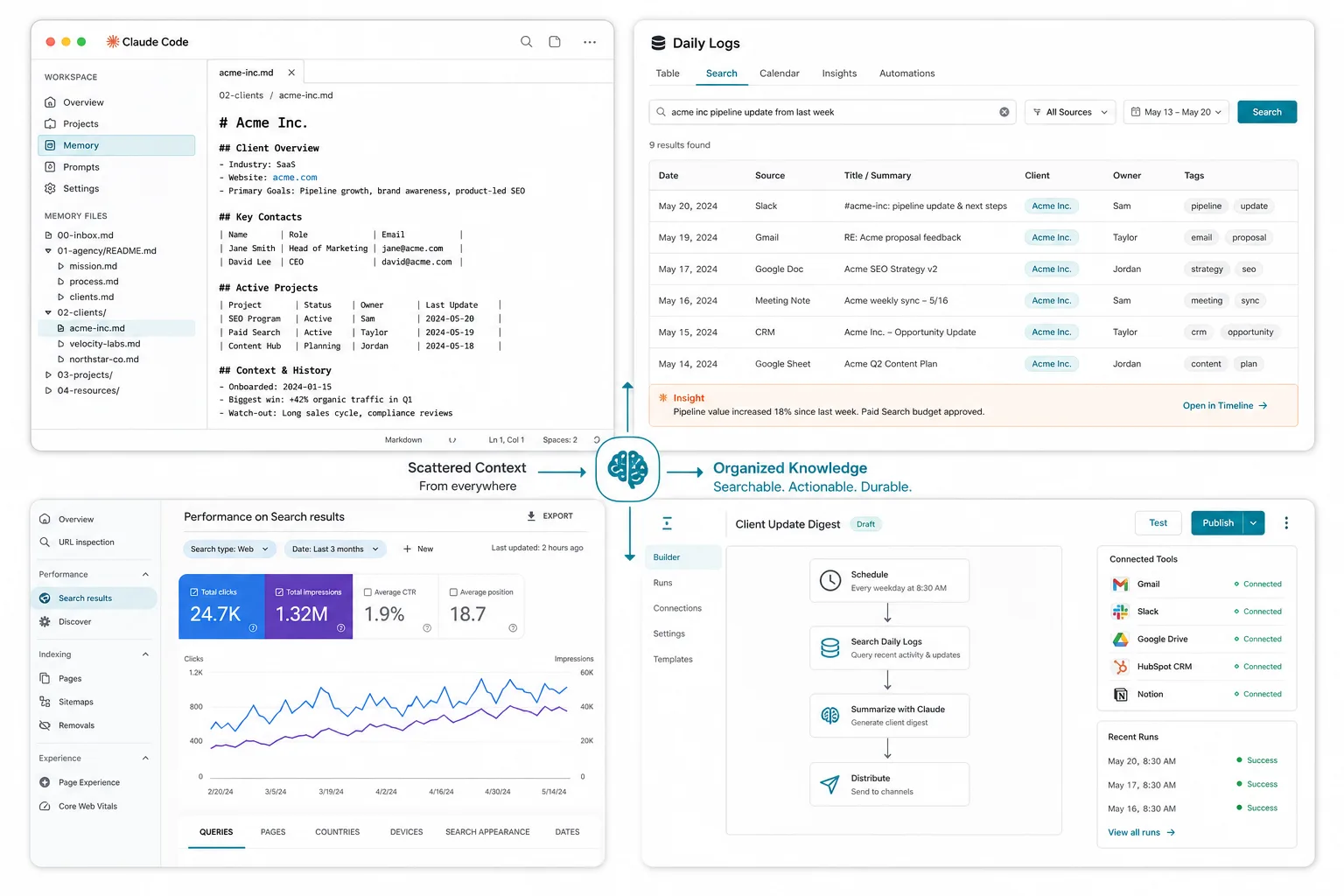
Claude Code works well as the orchestration engine for an AI second brain because it can operate inside a real project environment rather than acting like a disconnected chat box. It can read and write files, maintain structured memory in plain text, and connect to external systems through MCP integrations.
The architecture is intentionally layered:
- Memory layer for durable facts and working context
- Search layer for retrieving prior conversations and decisions
- Skills layer for repeatable outputs and transformations
- Integration layer for live business systems and workflow automation
This matters because each layer solves a different bottleneck. Memory prevents re-explaining context. Search makes history retrievable. Skills convert knowledge into output. Integrations connect the system to the tools where work already happens.
The most effective AI systems for agencies are not standalone assistants. They are workflow layers that sit between people, files, and business tools.
For teams that want a broader strategic foundation for search and AI workflows, it is worth pairing this approach with The Complete Guide to SEO in 2026: Strategy, Technical Foundations, and Measurement and Generative Engine Optimization (GEO): Get Cited in ChatGPT, Gemini, Perplexity, and AI Overviews. Together, they help connect internal knowledge operations with modern search visibility.
Memory layer
The memory layer is the foundation of the system. The key principle is to keep long-term memory small, curated, and durable while pushing detailed history into logs that can be searched later.
A practical setup uses a small set of Markdown files:
- Profile memory: Who the user is, what they do, how they work, and what matters most.
- Durable facts memory: Client preferences, pricing decisions, retainer structures, naming conventions, and recurring operational rules.
- Assistant behavior memory: The working style, tone, and expectations for how Claude Code should respond.
Everything else goes into daily logs. Every conversation is captured. Once per day, a scheduled process reviews those logs and promotes only the useful information into long-term memory. That keeps the memory clean and prevents the system from becoming bloated.
This design is powerful because it mirrors how strong operators actually work. You do not need every detail in your head. You need the right durable facts available instantly, and the rest should remain searchable.
Curated memory beats endless memory. A smaller, well-maintained memory layer is more accurate, more useful, and easier to trust than a massive pile of unfiltered notes.
For agencies, the memory layer should capture facts such as:
- client positioning preferences
- approved terminology and brand voice rules
- pricing thresholds and discount guardrails
- project scope boundaries
- recurring objections and approved responses
- internal operating procedures
Search layer
The search layer solves a common problem: you remember that something was discussed, but you do not remember where it was documented. That is a major source of friction in agency work because the answer is often buried in a meeting note, Slack thread, or log entry from weeks ago.
In a Claude Code second brain, every conversation is dumped into a daily log and indexed locally. That means the system can retrieve original context instead of forcing the user to rely on memory alone.
Search should support questions like:
- “What did we decide about the client’s retainer structure?”
- “When did we discuss the revised launch timeline?”
- “What objections came up in the last sales call?”
- “Which content angle did the team approve for this campaign?”
The value here is not just recall. It is precision. A searchable knowledge base should reduce ambiguity and return the original working context, not a vague summary stripped of nuance.
For agency teams, the search layer becomes a memory safety net. It ensures that even when a detail is not promoted into durable memory, it is still accessible when needed.
Skills and action layer
The skills layer is what turns a second brain into an execution system. If memory is what the system knows and search is what it can retrieve, skills are what it can do.
Think of skills as modular capabilities that transform stored knowledge into outputs. Examples include:
- drafting client updates from meeting logs
- summarizing a week of Slack and email activity
- preparing a proposal using approved pricing and scope rules
- generating internal SOPs from recurring workflows
- turning research notes into a briefing document
This is where the system stops being a reference tool and becomes a productivity multiplier. Instead of manually reconstructing context and then writing from scratch, the team can ask Claude Code to assemble the relevant material and produce the first useful version.
The real value of AI in agencies is not just answering questions. It is reducing the time between “I need context” and “I have something usable.”
A strong skills layer can support internal knowledge management as well. For example, it can convert repeated answers into a living SOP, turn project retrospectives into action items, or generate onboarding materials from a collection of historical notes.
MCP integrations
MCP integrations are what make the system feel connected to real agency operations. Instead of copying data into a new platform, Claude Code can connect to the tools where the work already lives.
Useful integrations may include:
- Gmail: pull relevant client threads, summarize decisions, draft replies
- Slack: capture internal discussions and surface unresolved action items
- Google Drive: read briefs, decks, and docs for context
- CRM platforms: retrieve deal history, notes, and follow-up tasks
- Project tools: sync task status and delivery context
For agencies, this is critical. The problem is not a lack of information. The problem is that the information is scattered across systems. MCP integrations let the AI layer work across that fragmentation without forcing a platform migration.
That also means less duplicate work. Instead of manually moving notes from one app to another, the system can pull, summarize, and act on information where it already exists.
Implementation steps
Building an AI-powered second brain does not require a massive rewrite of your stack. It requires a disciplined rollout.
1. Define the use cases first
Start with the highest-friction agency workflows. Good candidates include client communication, meeting synthesis, sales follow-up, proposal drafting, internal documentation, and knowledge retrieval.
2. Create a minimal memory schema
Keep durable memory intentionally small. Use a few structured Markdown files for profile context, persistent facts, and assistant behavior. Avoid dumping everything into long-term memory.
3. Log everything daily
Every conversation, meeting summary, and important thread should flow into a daily log. This creates the raw material for search and later memory promotion.
4. Add a daily curation job
Once per day, review logs and promote only high-value facts into durable memory. This is how the system becomes more accurate over time without becoming bloated.
5. Index the logs for search
Build a searchable layer over your daily logs so the team can ask precise questions and recover original context quickly. Precision matters more than volume.
6. Introduce skills gradually
Start with a few repeatable tasks: meeting summaries, client updates, proposal drafts, and SOP generation. Expand only after the team trusts the outputs.
7. Connect MCP integrations
Integrate the tools that contain the most important operational context. For most agencies, that means email, chat, docs, CRM, and project management.
8. Automate the handoff from knowledge to action
The final step is workflow automation. When a meeting ends, the summary should land in the log. When a decision is made, it should be promoted or task-created. When a recurring question appears, it should become part of the knowledge base.
The system should not just remember what happened. It should reduce follow-up work by turning decisions into drafts, tasks, and reusable knowledge.
Real-world use cases for agencies
Client work
An account manager can ask Claude Code to pull the latest client context, summarize the last three meetings, surface open decisions, and draft a follow-up email. That removes the need to manually reconstruct the account every morning.
Operations
An operations lead can use the system to turn repeated questions into SOPs, identify recurring bottlenecks in logs, and standardize internal processes. Over time, the second brain becomes an operational memory layer for the agency.
Sales and pricing
A founder or sales lead can retrieve prior pricing decisions, approved discount ranges, and objection-handling language before responding to a prospect. That reduces inconsistency and improves speed.
Internal knowledge management
Teams can search past discussions to answer questions like “How do we handle launch QA?” or “What was the approved messaging angle for this vertical?” Instead of asking three people, they query the system.
Content and strategy
Strategists can use the system to extract insights from research, meeting notes, and performance reviews, then turn those into outlines, briefs, or internal strategy docs. This is especially useful when a team needs to move from scattered inputs to a coherent plan quickly.
Risks and best practices
Any AI second brain can fail if it is overbuilt or poorly governed. The main risks are predictable:
- Memory bloat: If too much is promoted into long-term memory, the system becomes noisy and less trustworthy.
- Bad retrieval: If search is weak, the system cannot recover the right context when it matters.
- Automation without review: If the action layer is too aggressive, it can create errors at scale.
- Tool sprawl: If integrations are added without a clear purpose, the system becomes harder to maintain.
Best practices for agency teams include:
- keep durable memory small and curated
- log everything, but promote selectively
- design search for precision, not just volume
- start with low-risk automation before moving to client-facing workflows
- review outputs until the system earns trust
- treat AI as a force multiplier, not a replacement for judgment
AI should reduce cognitive load, not create another system to manage. If the second brain requires constant babysitting, it is not yet solving the right problem.
Conclusion: from scattered notes to operational continuity
The best AI second brain for agencies is not a prettier note app. It is an AI-enabled knowledge execution layer that captures context once, makes it searchable, and turns it into action through skills and integrations.
Claude Code is a strong foundation because it can work with files, maintain structured memory, connect to live systems, and automate repetitive knowledge work. When paired with a disciplined architecture, it can reduce context switching, preserve institutional knowledge, and dramatically speed up the path from information to output.
That is the real opportunity: not better note-taking, but better operational continuity. When the system can remember what matters, find what is missing, and act on what it learns, agency teams spend less time reconstructing context and more time doing the work that actually moves clients forward.