For HVAC companies in the United States, heat-pump questions change with the season, local weather, and the services a business actually offers. That makes seasonal content planning more than picking a few topics from a calendar. The challenge is publishing early enough to be useful without making claims about equipment, rebates, or service availability that do not fit your company.
A practical approach starts with questions customers already ask, then maps those questions to your service area, team expertise, and seasonal schedule. This gives owners and marketers a repeatable way to plan, check, and refresh heat-pump content without rushing out generic posts or promising work the company does not perform.
Why heat-pump content gets rushed or misses the mark
Heat pumps can raise different questions as conditions change. Before colder weather, a homeowner may want to understand what to expect when switching from cooling to heating. During a cold spell, they may ask why the system is running differently or when to call a technician. As temperatures rise, questions may shift toward cooling performance, maintenance, or planning a replacement. These are useful starting points, not assumptions about what every customer needs.
The problem is that seasonal publishing often begins too late. A post written after the first major weather change may not answer questions people had while preparing. A rushed article can also drift beyond the company’s actual services, repeat details from a manufacturer without context, or give broad advice that does not help a local reader decide what to do next.
Seasonal content should support real customer decisions and reflect the company’s work. Before assigning a topic, check:
- Does the question come up in calls, estimates, service visits, or conversations with the office team?
- Does the company offer the relevant inspection, repair, installation, or maintenance service?
- Can a subject-matter expert confirm the advice and explain its limits?
- Will the answer still be accurate for the equipment and conditions the article discusses?
If a topic fails one of those checks, revise it or choose a better fit. Publishing fewer, well-supported answers is more useful than filling a calendar with seasonal-sounding posts.
Collect real customer questions before choosing topics
Start with the people who hear customer questions directly. Ask dispatchers, call handlers, service technicians, comfort advisors, and installers what homeowners ask before and during heat-pump season. Look for repeated points of confusion, not just the most unusual question from one conversation.
Use a shared document or spreadsheet to record each question in the customer’s own words. Add a few practical details so the content lead can judge whether it is worth developing:
- Question: What did the customer ask, as closely as staff can recall?
- Context: Was the question about a symptom, seasonal preparation, a quote, or how a service visit works?
- Service fit: Which service the company offers could answer or address it?
- Needed reviewer: Which technician, installer, or manager can verify the answer?
- Location or equipment caveat: Does the answer depend on the service area, system type, or conditions?
Search data can help you explore how people phrase a question, but it should not replace what staff hear or what the business can credibly answer. Review Search Console queries and on-site search terms if available. Look at relevant calls and form submissions, too, while respecting your company’s privacy practices. A query may suggest a topic, but it does not prove the company provides the service or that a particular explanation applies to every system.
Group questions by intent. Some people want a basic explanation, others are trying to decide whether to book service, and some are comparing installation options. That distinction helps you choose the right format. A short explanation may work for a straightforward seasonal question. A more detailed service page or article may be needed when readers need to understand the process, limitations, and next step.
Build a seasonal calendar that starts before the weather changes
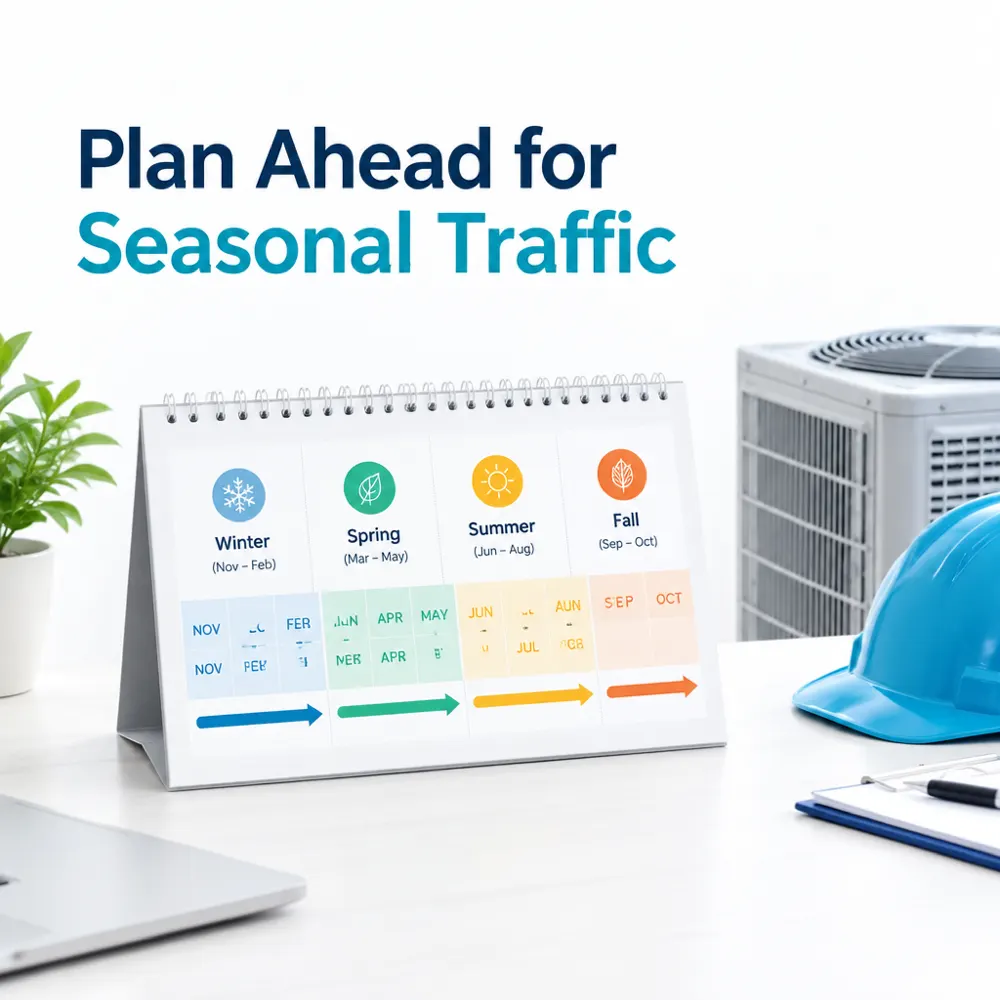
A useful editorial calendar connects the question, the season, the service, and a realistic publishing date. Work backward from the period when customers are likely to need the answer. Leave time for subject-matter review, revisions, and any updates to service details. The right lead time depends on your team’s capacity, so choose a schedule you can maintain instead of copying a publishing frequency from another company.
For each planned item, record the customer question, intended reader, content format, service connection, reviewer, draft deadline, publish date, and next review date. You can then see whether a topic is ready to write or still needs a technician’s input. A basic calendar might include:
- Before a seasonal transition: Answer preparation and planning questions that match the company’s offered services.
- At the start of a higher-demand period: Explain what a service appointment covers or how to request help, if that reflects the company’s process.
- During the season: Address recurring questions and correct misunderstandings that staff are hearing.
- After the main period: Review the content and note what needs updating before the next cycle.
Do not force every question into a seasonal slot. Some topics are useful all year and may belong on a core service page instead. If a post would simply repeat an existing page, improve the existing answer or link readers to it rather than creating a near-duplicate article.
Keep the calendar flexible. A sudden weather event, a change in the company’s schedule, or a new pattern in customer questions may change priorities. Note the reason for a change and adjust the plan. The calendar is there to make decisions easier, not to require publishing a topic that is no longer timely or accurate.
Keep equipment and service details accurate
Heat-pump content can become misleading when it treats all systems, homes, or operating conditions as the same. A general article can explain a concept, but it should not imply that one observation diagnoses a fault or that one maintenance step suits every model. Avoid giving detailed troubleshooting instructions unless a qualified person at the company has reviewed them and confirmed they are appropriate for the intended reader.
Build a review step into the writing process. Give the reviewer a focused checklist rather than asking only whether the article “looks right.” Check whether:
- Equipment terms are used correctly and consistently.
- The article distinguishes general information from advice that depends on a system or property.
- Any suggested action is within the company’s service scope and does not encourage unsafe work.
- Statements about appointments, inspections, installations, or availability match current operations.
- Manufacturer-specific or model-specific details are supported by an appropriate source and still current.
Be careful with incentive and rebate references. Programs and eligibility rules can change, and they may depend on location, equipment, timing, or other requirements. Do not publish a specific amount or promise eligibility unless the business has verified the information with a reliable, current source. When the details are uncertain, explain that readers should confirm current requirements before making a purchase decision.
Also make the next step clear without turning an educational article into a sales pitch. If the company can assess a system, say what a reader can ask about when contacting the team. If the article only offers general information, say so. That distinction helps readers understand what the page can and cannot tell them.
Make seasonal content relevant to your U.S. service area
In the United States, a seasonal topic does not become locally useful just because a city name is added to the headline. Service areas can include places with different weather patterns, housing types, and customer concerns. Consider the actual communities the company serves and the questions its staff hear there. Use a regional detail only when it changes the answer or helps readers understand whether the content applies to them.
For local SEO, keep the business’s name, address, and phone number consistent wherever they appear. Maintain an accurate Google Business Profile, including service information and service areas that reflect current operations. A complete profile can help people evaluate a local business in Google Search and Maps, but it does not guarantee map-pack visibility. Reviews can provide useful local proof when they are genuine. Invite feedback in a way that follows the platform’s rules, and respond professionally without sharing private customer details.
Create a location-specific page only when the company has enough distinct information to make it useful. A strong page might explain which services are available there, how customers in that place arrange an appointment, and any verified details that genuinely differ from the main service-area page. Do not publish a stack of pages that swaps city names while repeating the same text. Thin location pages give readers little help and may misrepresent where the company works.
Use local references carefully. A neighborhood or community example should be relevant to the company’s real service footprint, not inserted just to capture a “near me” search. Mention nearby areas only when the business actually serves them. Check that service-area pages, the Google Business Profile, and contact details tell the same story, then review them when coverage or operations change.
Fit seasonal content into an HVAC SEO plan, then review it
Seasonal articles work best as part of a wider SEO for HVAC companies plan, not as isolated posts. Check how each topic supports the company’s core services, whether readers can reach the relevant service page, and whether the technical setup makes the article easy to find and use. Content planning can sit alongside technical fixes, local visibility, ethical link building, and reporting tied to leads and revenue. To see how these parts can fit together, learn more.
Before the next heat-pump season, review existing pages rather than assuming every old post needs a new URL. Check the publication and review dates, service details, staff names or processes if mentioned, equipment statements, links to relevant services, and any time-sensitive claims. Confirm that the page still serves a distinct purpose. If two articles answer the same question, decide whether to combine them, revise one, or make their different purposes clearer.
Use available performance data as a diagnostic, not as a verdict on quality. Search Console can show queries and pages receiving search impressions or clicks. Analytics or call tracking, where properly configured, may help you understand whether visitors take a relevant next step. Compare results over a meaningful period and account for seasonal changes. A quiet period does not automatically mean content is poor, and a rise in visits does not by itself show that the article attracts the right customers.
After publishing or updating, verify the page on a phone and desktop. Check headings, links, contact details, and whether the answer appears near the top. Ask a technician to confirm that the final version still matches current practice. Then set a review date before the next seasonal planning cycle.
A reliable process is simple: collect genuine questions, select topics that match real services, schedule them early enough for review, localize only where the information is meaningfully different, and revisit the pages before they become outdated. That gives HVAC owners and marketers a practical way to plan heat-pump content around customer needs while keeping the advice grounded in what the business can actually do.