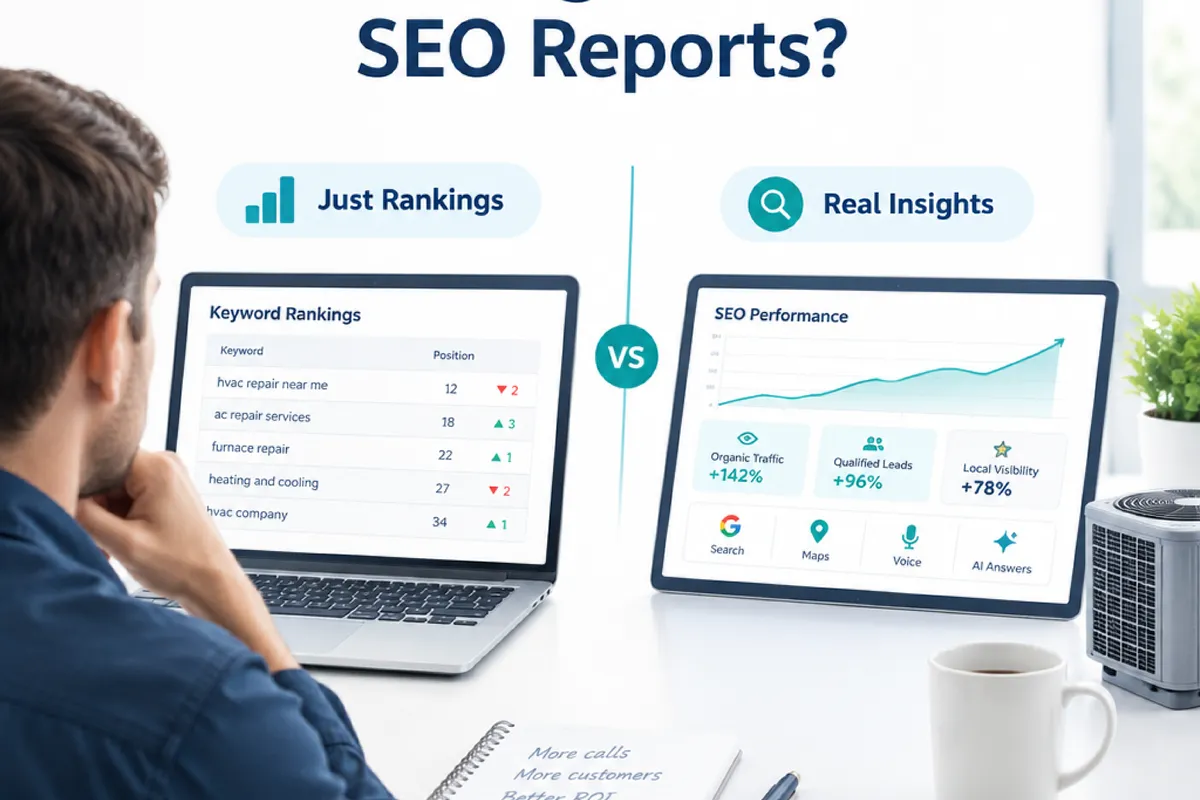
If your HVAC company receives monthly SEO reports but you still cannot tell whether the work is helping the business, you are not alone. A list of keyword positions is only one piece of the picture. It does not tell you by itself whether homeowners in the United States are finding your company, contacting you, or booking the kinds of jobs you want.
To judge SEO progress, look at the path from search visibility to website visits, qualified inquiries, and business outcomes. Each step has different measurements and limitations. This guide explains what to look for, what to ask your SEO provider, and how to discuss leads and revenue without assuming SEO caused every sale.
Why HVAC SEO reports can feel disconnected from the business

SEO changes how a company appears in unpaid search results over time. That work may include fixing technical issues on the website, improving local visibility, publishing useful service content, and earning relevant links. Those tasks can affect different parts of the customer journey, so a report that lists activity without explaining its purpose is hard to assess.
Rankings are often the most visible metric. They can also be misleading on their own. A position for a broad phrase may not attract homeowners who are in your service area or ready to schedule. Meanwhile, a page that earns fewer visits could still matter if it helps a potential customer understand your repair or installation service before calling.
A useful report connects three kinds of information:
- Work completed: For example, website fixes, updates to service pages, or improvements to local business information.
- Search response: Whether people see your pages, visit them, and take relevant actions.
- Business context: Whether calls or form submissions appear to be qualified, and what other factors may have influenced them.
There may be a delay between making a website change and seeing a change in search activity. Seasonal demand, weather, advertising, staffing, and service availability can also affect calls. A report should make these factors easier to discuss, not hide them behind a single score or a promise of quick results.
Impressions, clicks, and engagement measure different steps
Search Console data is useful for understanding how a website appears in Google Search. Three terms often cause confusion: impressions, clicks, and engagement. They describe separate actions, so a change in one does not automatically mean the same change in the others.
- Impressions are instances when a page appears in search results. More impressions can mean the page is showing for more searches, or appearing more often for searches it already reached. Impressions do not confirm that the searcher noticed the listing or was looking for a service you provide.
- Clicks count visits from a search result to your website. A click shows that someone chose your listing, but not whether the visitor was nearby, needed the work you offer, or contacted the company.
- Engagement describes what visitors do after arriving. Depending on the analytics setup, this might include viewing service information, tapping a phone number, submitting a form, or spending time on a page. Engagement measurements need clear definitions because tools can count actions differently.
Read these measurements together. If impressions rise while clicks stay flat, ask which queries and pages gained visibility, and whether the title and description match the searcher's need. If clicks rise but calls and forms do not, review whether the landing page makes the next step clear and whether it reflects the service advertised in search.
Also check the date range, device, landing page, and search query when available. An increase across the whole website may hide a decline on a key heating repair page. A month-to-month comparison can be useful, but for HVAC businesses, comparing similar seasons can offer better context because demand changes through the year. Treat these figures as clues to investigate, not proof of revenue growth.
How local SEO works for HVAC companies in the United States
Many HVAC searches have a local intent. A homeowner may search for a service plus a city, look for options “near me,” or use Google Maps to compare businesses. For these searches, website rankings are only part of the customer’s experience. Your Google Business Profile and other local business information can affect how people discover and evaluate the company.
Review whether the profile is accurate and useful. The business name, phone number, hours, service details, and website link should reflect how the company actually operates. Keep the service area realistic, especially if your technicians do not cover every nearby town. The goal is to help searchers understand where you work, not to suggest coverage you cannot provide.
NAP consistency means keeping your company name, address, and phone number consistent across business listings. If the business has a public location, check that its address is current. If it serves customers at their homes without receiving visitors at the listed address, follow Google’s profile rules for service-area businesses rather than publishing an address that could confuse customers.
Reviews are another part of local visibility and customer decision-making. Ask customers for honest feedback through a straightforward process, and respond professionally. Do not pressure customers to leave only positive reviews or offer incentives in exchange for a particular rating. Reviews can provide useful signals to potential customers, but they do not replace clear service information or reliable follow-up.
Local landing pages can help explain service coverage when they contain genuinely useful details. A page for a city or neighborhood should describe the services available there and give a customer a clear way to contact you. Duplicating one generic page across many place names, or naming locations you do not serve, can weaken trust and create a poor experience.
Ask about qualified inquiries and revenue without overstating SEO’s role
For an owner, a qualified inquiry is usually more useful than a raw website visit. The meaning depends on your business. It might be a call from someone inside your service area asking about a service you offer, or a form submission that includes enough information for your team to respond. Agree on the definition with your provider and whoever handles calls or sales.
Ask how the company tracks calls, forms, and other contact actions. Find out whether a phone-number tracking system is in use, whether it changes the number shown to visitors, and how calls are classified. A missed call, a supplier call, and a homeowner requesting a repair should not all be treated as the same kind of lead. Form tracking should also be checked so that test submissions and spam do not inflate totals.
Then connect inquiry records to your own business process. Your CRM, booking system, or call log may show whether a lead was answered, qualified, scheduled, and completed. If those systems are not connected to website analytics, a report may not be able to follow a search visit all the way to a paid job. That is a measurement limitation to state plainly, not a reason to guess.
SEO can contribute to a customer’s path without being the only influence. Someone may first find the business through an organic search, return later through a direct visit, and call after seeing a review or an advertisement. Attribution reports assign credit according to a tracking method, but they cannot always establish exactly what caused a purchase.
Ask your provider to separate observed data from interpretation. For example: how many tracked calls came from organic search, how many were judged qualified, and what definition was used? If the provider cannot verify completed revenue, the report should say so. You can still review lead quality and booked work alongside search data without claiming every sale came from SEO.
What to discuss with an SEO service for HVAC companies
When comparing providers, look for a clear explanation of both the work and the measurement plan. SEO Deep Insights describes its HVAC work as covering technical fixes, local visibility, content that ranks, ethical link building, and reporting tied to leads and revenue. The useful question is how those elements would apply to your website, service area, tracking setup, and business goals.
Use this seo for hvac companies guide as a starting point for a conversation, then ask for specifics that fit your operation. A provider should be able to explain proposed work in plain language and show how it will be reviewed.
- What will you measure? Ask for definitions of impressions, clicks, website actions, calls, and qualified inquiries. Confirm which tools provide each number.
- What work is planned and why? Ask which technical issues, local pages, or content gaps matter most, and how the work supports the services you want to sell.
- How will local visibility be assessed? Discuss the Google Business Profile, service area, important local searches, and accurate business listings. Ask how the provider will report changes without implying that one ranking represents every searcher’s view.
- How will lead quality be checked? Agree on what counts as qualified, how spam and missed calls are handled, and who will compare inquiry records with bookings.
- What can’t the report prove? Ask whether the provider can connect organic visits to completed jobs. If not, ask what data is available and where the gaps are.
Be cautious if a provider focuses only on a few ranking screenshots, reports traffic without explaining its relevance, or claims that every new customer can be credited to SEO. Clear reporting should include uncertainties and practical next steps, not just favorable numbers.
A monthly review that turns SEO data into useful decisions
You do not need to become an analytics specialist to review a report. A consistent check-in can help you spot changes, ask better questions, and give your provider information that search data cannot show. Use the same core questions each month, then look more closely when something changes.
- Confirm what period and pages the report covers. Check whether it is comparing the same number of days and whether key service pages are included.
- Review visibility and clicks together. Ask which searches or pages changed, and whether those searches match the services and locations the business serves.
- Check the next action on the website. Make sure visitors can find a phone number, request service, and understand what happens after they contact you. Test forms and phone links on a mobile device.
- Compare tracked inquiries with business records. Review whether calls were answered, whether inquiries were in the service area, and whether they became appointments or jobs.
- Agree on one or two next steps. These might be fixing a tracking gap, improving a page that receives relevant visits but few inquiries, or updating inaccurate local information.
Common reporting mistakes include treating every impression as a potential customer, comparing unrelated seasons without context, and counting all calls as leads. Another is changing several parts of the website at once and then assuming one change caused the result. Keep notes on major edits, promotions, staffing changes, and unusual weather so the discussion reflects what was happening in the business.
SEO progress is clearer when the report shows how search visibility connects to customer actions, while acknowledging what cannot be measured. Rankings can help diagnose visibility, but they are not the final business outcome. Ask for the evidence behind each conclusion, verify inquiry quality with your own records, and agree on practical changes to review next.