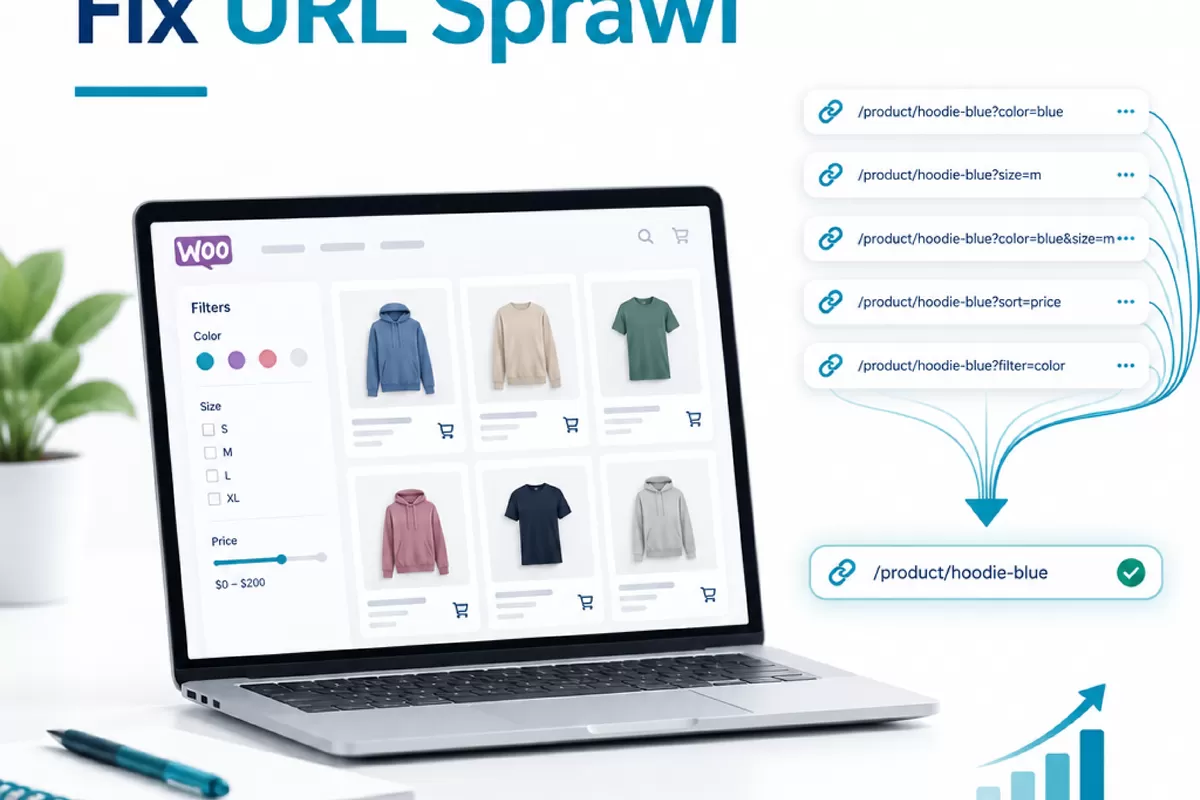
Product variations and filter options can create many URLs that look useful to shoppers but may not deserve separate search results. The challenge is knowing which URLs are real landing pages, which are duplicate or low-value variations, and which should simply help people browse.
A capable woocommerce seo agency should start by mapping how those URLs are created, then assess them against search value, technical behavior, and the store’s setup. The result should be a prioritized implementation plan, not a blanket rule to block every variation or filter. Here is what that workflow should include, and what to ask before work begins.
Why variation and filter URLs need a closer look
Product variations are choices such as size, color, or material that belong to a product. Depending on how a store is configured, selecting a variation may change the URL, the page content, or both. Filter URLs are different: they represent combinations shoppers select to narrow a product listing, such as a category filtered by color or size. The exact behavior depends on the store’s technical setup, so an agency should inspect the actual URLs rather than assume how they work.
Some of these URLs can be useful search landing pages. A shopper may look for a distinct product type that corresponds to a category or filter combination, and a well-maintained page could meet that need. Other URLs may show nearly identical content, create a large number of crawlable combinations, or offer little value outside the filtering experience. Crawlability means search engines can access and follow a URL. Indexability means a page is eligible to appear in search results. A URL can be crawlable without being worth indexing.
The risk is not simply that a store has many URLs. The concern is whether search engines and shoppers are being sent toward pages that are redundant, hard to maintain, or less useful than the main product and category pages. Treating all variations as duplicates can hide useful distinctions. Letting every possible filter combination become an indexable page can create an unwieldy set of pages to manage. The right answer depends on evidence from the store.
How a WooCommerce SEO agency maps URLs into an implementation plan
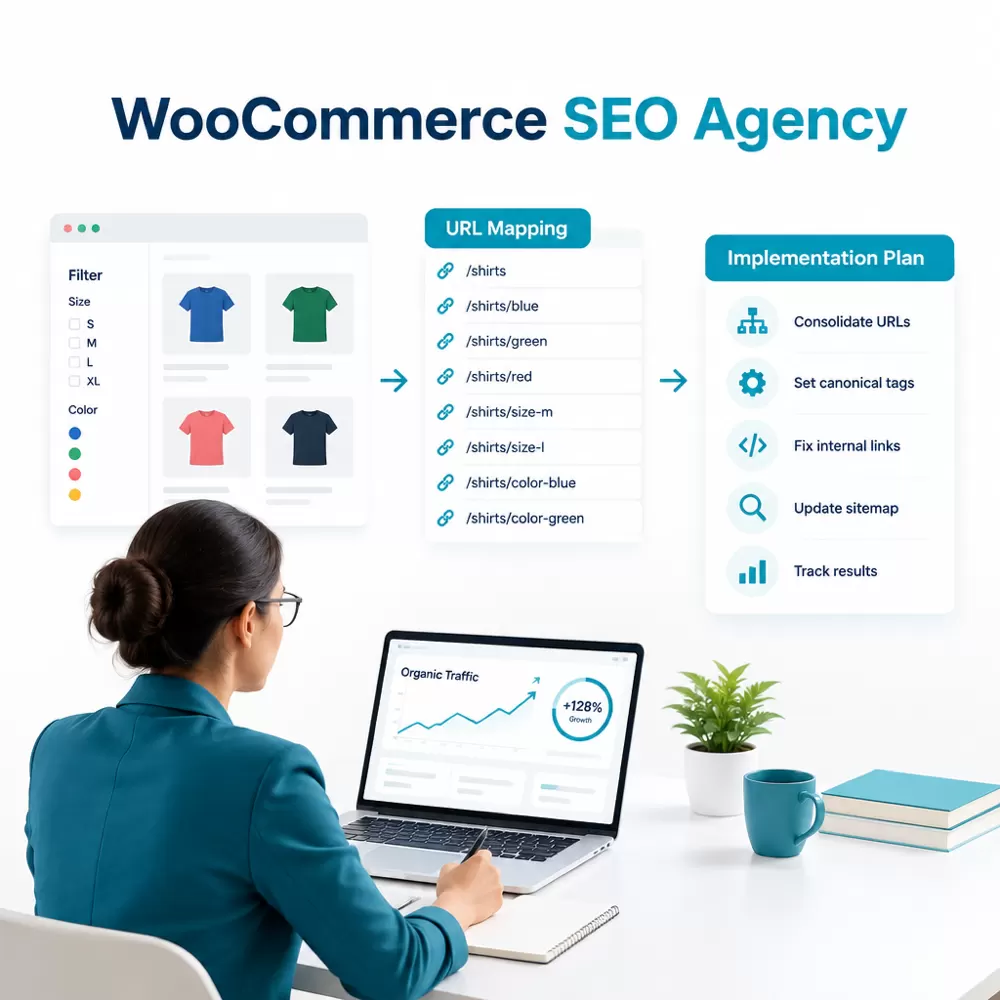
A sound workflow begins with discovery. The agency collects representative product, category, variation, and filtered URLs, then groups them by pattern. The goal is to understand what changes between URLs and what stays the same. A variation might add a parameter or path element, while a filter might add one or more selected attributes. Those are general examples, not assumptions about how a particular store is built.
Next, the agency compares URL patterns with what the pages actually present. Useful checks include whether the page has distinct products or content, whether the selected option remains visible after loading, whether internal links point to the URL, and whether the URL appears in the sitemap or search data available to the store team. Search performance and indexing signals can inform the review, but they do not replace a human assessment of the page’s purpose.
The findings should become a URL decision matrix. A practical version might include:
- URL pattern: Which product, category, variation, or filter combination creates it?
- Page purpose: Is it a meaningful destination for shoppers or mainly a browsing state?
- Search value: Is there a clear reason for this page to appear independently in search?
- Current signals: Is it linked internally, included in a sitemap, or appearing in search data?
- Recommended action: Keep eligible, consolidate, prevent indexing, or investigate further.
- Owner and validation: Who will implement the change, and how will it be checked?
From there, the agency prioritizes work. A pattern affecting many URLs or an important product group may need attention before a small set of obscure combinations. The plan should state why each pattern is being changed, which URLs are in scope, what should happen after implementation, and what would count as a successful technical check. This gives store owners and developers a shared reference point before changes begin.
How to decide which URLs deserve search visibility
Every URL group needs a decision based on its purpose, not just its format. A product variation may be a distinct offering with its own information and demand, or it may be one choice within a single product page. A filtered category may help shoppers find a valuable subset of products, or it may be one of many combinations that differ only slightly. The agency should explain the reasoning for each group and flag cases where the available evidence is not conclusive.
For pages intended to serve as search landing pages, check whether they offer a clear, stable destination. Do the products match the page’s implied topic? Is the selection likely to remain useful as inventory changes? Is there enough distinct information to avoid creating a thin or near-identical page? A page should not be made indexable simply because a URL can be generated for it.
For URLs that do not need independent search visibility, the implementation may involve consolidating signals or limiting their eligibility for indexing. Which approach is appropriate depends on how the site creates and links to the URLs. Canonical tags, for example, indicate a preferred version among similar pages. They are not a substitute for deciding which page should exist as a useful destination, and they do not guarantee that a search engine will follow a preferred choice.
There are trade-offs. Restricting a URL too aggressively can make it harder for search engines to discover useful products or categories. Leaving every combination open can make it harder to focus attention on the store’s best pages. Agencies should identify those risks before recommending a change, especially when the store’s existing search data is limited. Findings about which option is right for a particular site require inspecting that site’s URLs, content, and technical configuration.
How the plan should fit the store’s technical setup
SEO recommendations need to match how the store generates URLs and serves pages. Before implementation, the agency should coordinate with whoever manages the technical setup and agree on the patterns being changed. That means documenting example URLs, expected page behavior, the proposed action, and any exceptions. Clear examples reduce the chance that a broad rule affects an important product or category page by mistake.
The team should also check how the change connects to existing signals. Internal links, sitemap entries, canonical tags, indexing directives, and redirects can all affect how URLs are discovered or interpreted. These controls do different jobs. A sitemap helps indicate URLs a site wants considered for crawling; it does not make a page valuable. A noindex directive asks search engines not to include a page in results, while blocking crawling can prevent them from seeing page-level instructions. The correct combination depends on the situation and should be planned, not guessed.
Store owners should ask for a staged plan where the scale or risk of the change warrants one. That might mean reviewing a small set of representative URLs first, confirming the intended behavior, then applying the agreed rule more broadly. The agency and technical team should also decide who owns deployment, how exceptions will be handled, and how to reverse or adjust a change if checks reveal an unexpected effect. Specific implementation steps cannot be prescribed without inspecting the store and its configuration.
This coordination is one reason a workflow matters. An SEO recommendation that is technically plausible but poorly scoped can cause confusion, duplicate work, or unwanted changes. The agency should explain what it needs from the store team and keep recommendations tied to the documented URL patterns.
How to verify changes after implementation
Implementation is not the finish line. After a change goes live, the team should revisit the representative URLs from the original inventory. Confirm that important pages still load, that the selected product or filter state behaves as intended, and that the page presents the expected canonical and indexing signals. Also check that the sitemap and internal links reflect the plan where relevant.
Verification should cover both the intended change and possible side effects. For example, if a group of filter URLs was meant to stop appearing as independent search pages, check that the relevant directives or consolidation signals are present and that the main category page remains accessible. If a set of variation pages was meant to remain eligible, confirm that those pages still provide the distinct content and navigation the plan relied on.
Keep a record of the URL samples tested, the date of the change, the expected result, and any issues found. Then monitor available indexing and search performance data over time. Search engines may take time to process changes, and a short-term report is not enough to prove that a strategy succeeded or failed. The agency should separate technical confirmation, such as whether the implementation matches the specification, from later performance review, such as whether qualified organic visits or leads change.
Reporting should connect technical work to business goals without promising a particular ranking outcome. SEO Deep Insights’ WooCommerce service includes SEO, AEO, and GEO, technical fixes, local visibility, content that ranks, ethical link building, and reporting tied to leads and revenue. For this URL workflow, ask how the agency will show the work completed, the signals reviewed, and the business measures used to evaluate progress.
What to ask a WooCommerce SEO agency about this workflow
When comparing providers, ask for a clear explanation of how they move from URL discovery to a decision and then to verification. A useful conversation should reveal how the agency handles uncertainty, works with technical teams, and reports on changes. The service page for a woocommerce seo agency outlines SEO, AEO, and GEO support alongside technical fixes and reporting tied to leads and revenue.
- How will you find and group variation and filter URL patterns? Listen for a process that compares actual URLs and page behavior, rather than a recommendation based on assumptions about every store.
- What criteria determine whether a URL should be eligible for search? The answer should cover shopper purpose, distinct page value, current signals, and the risk of duplication or low-value pages.
- How will you document exceptions? Ask how the plan distinguishes useful landing pages from combinations that should not be treated as separate search destinations.
- Who will coordinate implementation? Confirm how the agency will communicate with the people responsible for the store’s technical setup and what information they will provide.
- How will you check the work? Expect a plan to revisit representative URLs and verify behavior, indexing signals, internal links, and relevant sitemap entries.
- How will you report progress? Ask the agency to separate completed technical work from later search visibility, lead, and revenue measures. Results depend on the store and should not be guaranteed in advance.
Before choosing an agency, prepare a few example URLs that represent the concern, such as a product with several options and a category with multiple filters. You do not need to diagnose the issue yourself. These examples give the agency a starting point for explaining what it would inspect and what information it would need next.
A sensible first step is to request a scoped review of URL patterns and a written decision plan. It should identify what is known, what requires closer inspection, which changes are proposed, who needs to approve them, and how the team will verify implementation. That makes the work easier to evaluate and keeps the focus on useful search pages, sound technical decisions, and measurable business outcomes.