AI has changed the speed of SEO experimentation. A workflow that once needed engineering support can now be prototyped with a prompt, a model, and a few connected data sources. That is a real advantage — but it also creates a new trap: fast to build is not the same as safe to own.
For SEO teams, the build-versus-buy decision is no longer just about software cost. It now includes maintenance, security reviews, data access, internal capability, workflow fit, and long-term reliability. If you are evaluating AI SEO tools, custom workflows, or SaaS SEO tools, the right question is not “Can we build this?” It is “Should we build this, and can we maintain it six months from now?”
That shift matters because AI lowers the barrier to creating assistants, automations, and even lightweight agents. But prototyping is not ownership. And in SEO operations, ownership is where the hidden work begins.
Key takeaway: AI makes custom systems easier to launch, but it does not make them easier to support, secure, or scale.
Why AI changed build-vs-buy decisions
For hands-on help with this topic, explore SEO Services for SaaS & Software.
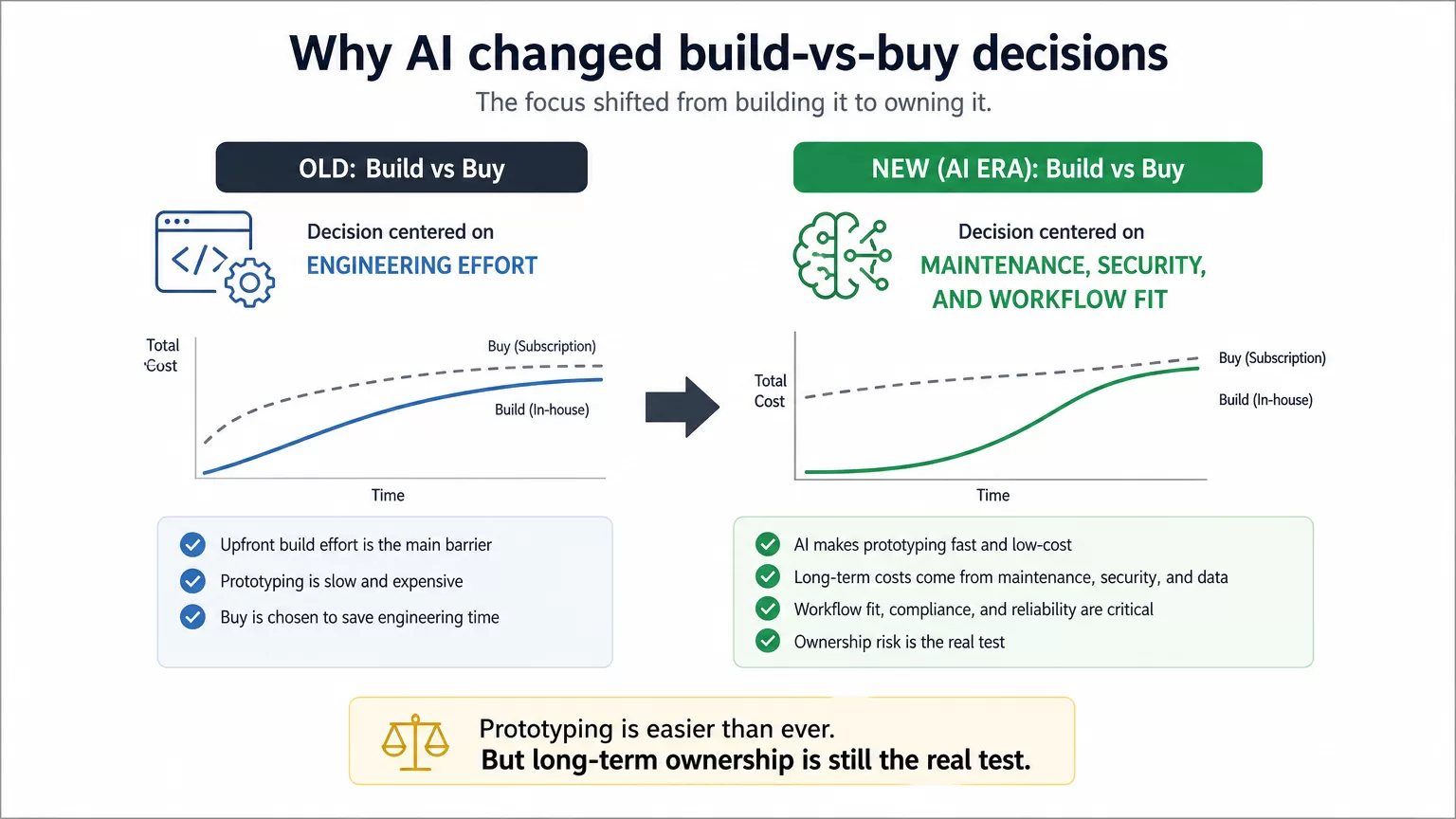
Before generative AI, building internal SEO tooling usually required a clear engineering case. The effort was visible, the cost was obvious, and the approval process naturally filtered out many ideas. AI changed that. Today, SEO teams can draft logic, generate scripts, assemble prompts, and connect workflows with far less friction.
That new ease of experimentation is valuable, but it also blurs the line between a quick prototype and a production-ready system. A custom GPT, a reporting automation, a custom layer on top of SaaS, and a true autonomous agent are not interchangeable. They differ in complexity, risk, and maintenance burden.
This is where many teams misread the opportunity. If a workflow can be assembled quickly, it may feel like a low-risk internal win. In practice, the real costs often appear later:
- Token usage and API calls that scale with adoption
- Infrastructure costs for hosting, orchestration, or storage
- Engineering time to debug, update, and extend the system
- Security reviews for access, permissions, and data handling
- Ongoing maintenance when APIs, prompts, or business rules change
In other words, AI makes experimentation cheaper, but it can make operational sprawl easier too. That is why build-versus-buy now needs a budgeting lens as much as a technical one.
If your team is formalizing this process, it helps to anchor the decision in broader SEO strategy and measurement. Our The Complete Guide to SEO in 2026: Strategy, Technical Foundations, and Measurement covers the foundations that should guide any automation investment.
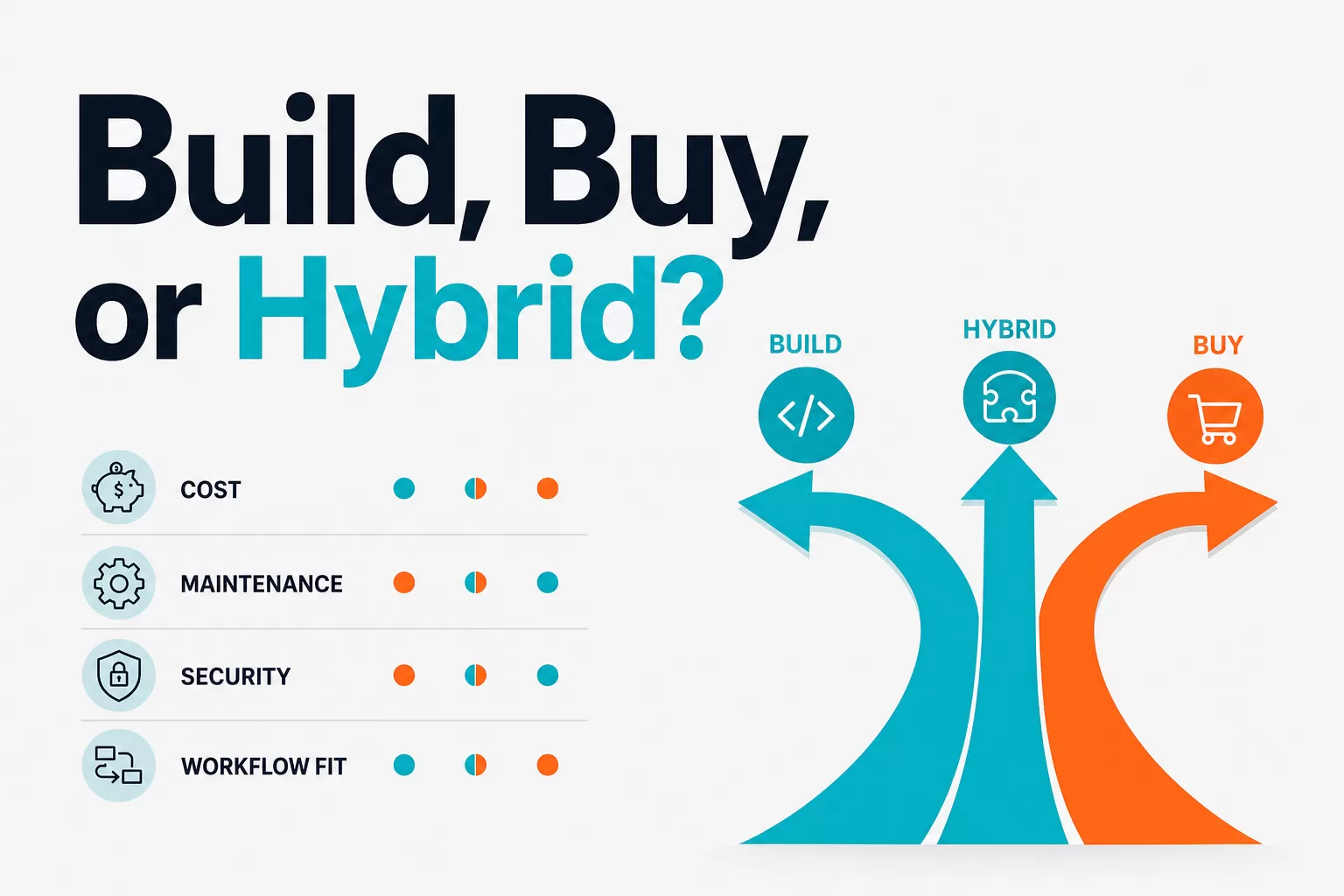
What to build vs buy vs hybrid
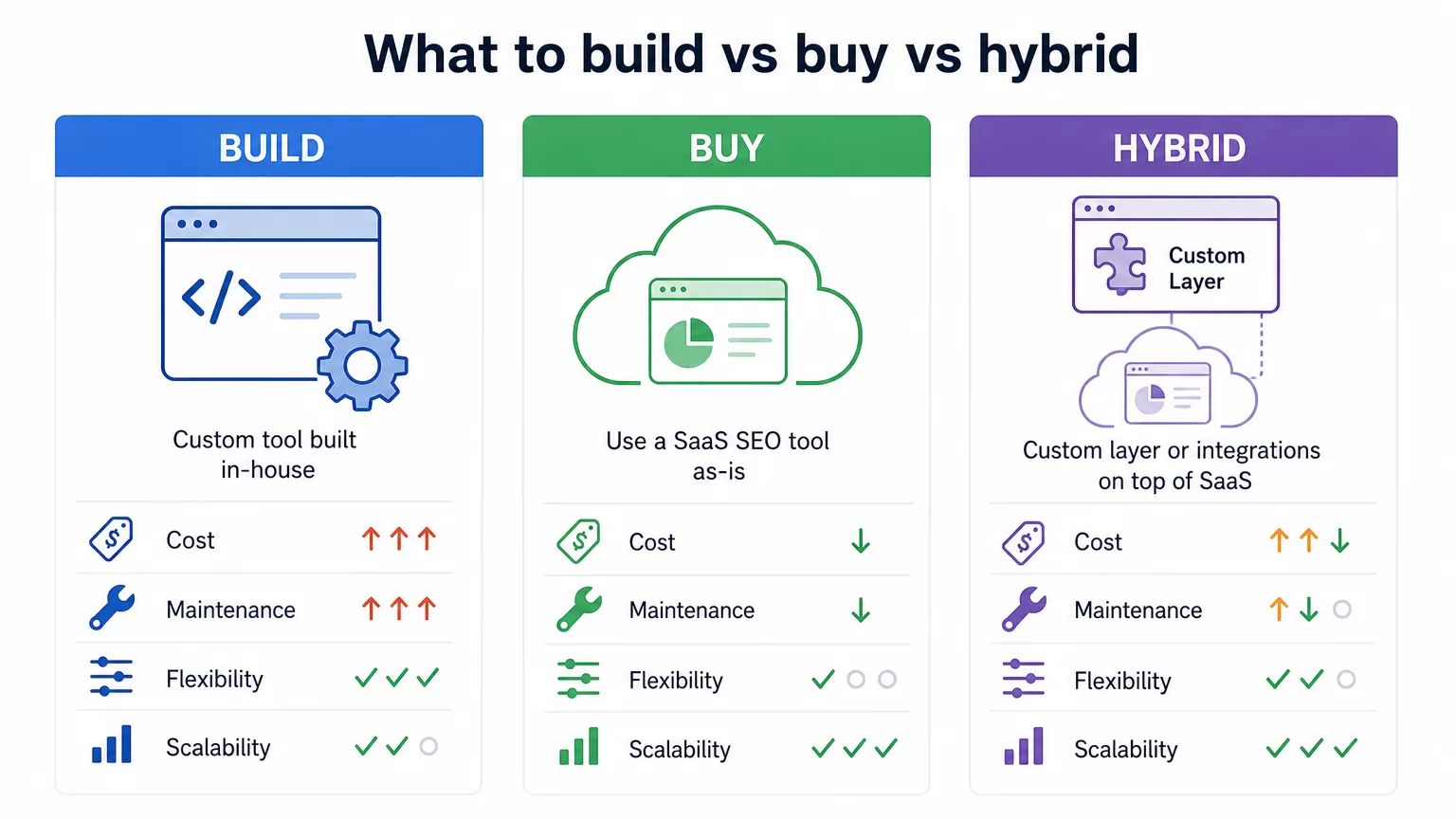
The smartest SEO teams do not treat build and buy as a binary choice. They use a portfolio approach:
- Buy for stable, commodity functions
- Build for high-value differentiators
- Hybrid when internal context matters, but full ownership would be expensive
This distinction is important because many teams say they want a “custom tool” when what they actually need is a custom workflow. Those are not the same thing. A custom workflow might use SaaS data, AI summarization, and a simple approval step. A custom tool might require its own interface, permissions model, logging, and support process. A true AI agent adds another layer of autonomy and risk.
That means pricing and planning should reflect the actual category, not the hype label.
When a custom workflow makes sense
A custom workflow is often the best option when the task is repetitive, context-rich, and valuable enough to improve — but not so core that the business needs a fully productized system.
Good examples include:
- Summarizing recurring reports from Search Console, analytics, and rank tracking
- Classifying content against personas, search intent, or pain points
- Identifying pages that need editorial review before publishing
- Turning meeting notes into SEO tasks or content briefs
- Flagging potentially generic copy for human review
These workflows benefit from AI because they involve synthesis and pattern recognition. They do not require full autonomy. In most cases, the best result is an augmentation layer that reduces manual work while keeping human judgment in the loop.
When SaaS is better
SaaS SEO tools usually win when the use case is common, the vendor absorbs maintenance, and the team needs reliability over experimentation. This is especially true for functions that are easy to standardize and hard to differentiate internally.
SaaS is often the better fit when you need:
- Predictable support and uptime
- Regular feature updates without internal engineering work
- Security controls and compliance documentation already in place
- Fast onboarding for multiple users
- Clear cost forecasting
For most teams, this is the safer route for foundational operational needs. It reduces the burden on SEO, engineering, and security stakeholders, and it avoids turning a routine capability into a maintenance project.
When teams need deeper implementation help, especially around crawling, rendering, log analysis, or complex data pipelines, it may be more effective to work with Technical SEO Services rather than trying to create and maintain every layer internally.
How to avoid over-automation
AI can make teams eager to automate everything. That is usually a mistake.
The goal is not to remove human review from SEO operations. The goal is to remove friction from the parts that are repetitive, structured, and easy to verify. Over-automation becomes risky when teams let AI make decisions that require editorial nuance, business context, or accountability.
Rule of thumb: automate the repetitive layer, not the strategic judgment.
Use AI to surface options, summarize patterns, and accelerate preparation. Keep humans responsible for prioritization, quality control, and final approval. That balance is especially important when the output affects rankings, content quality, or brand trust.
Hidden costs of internal tools
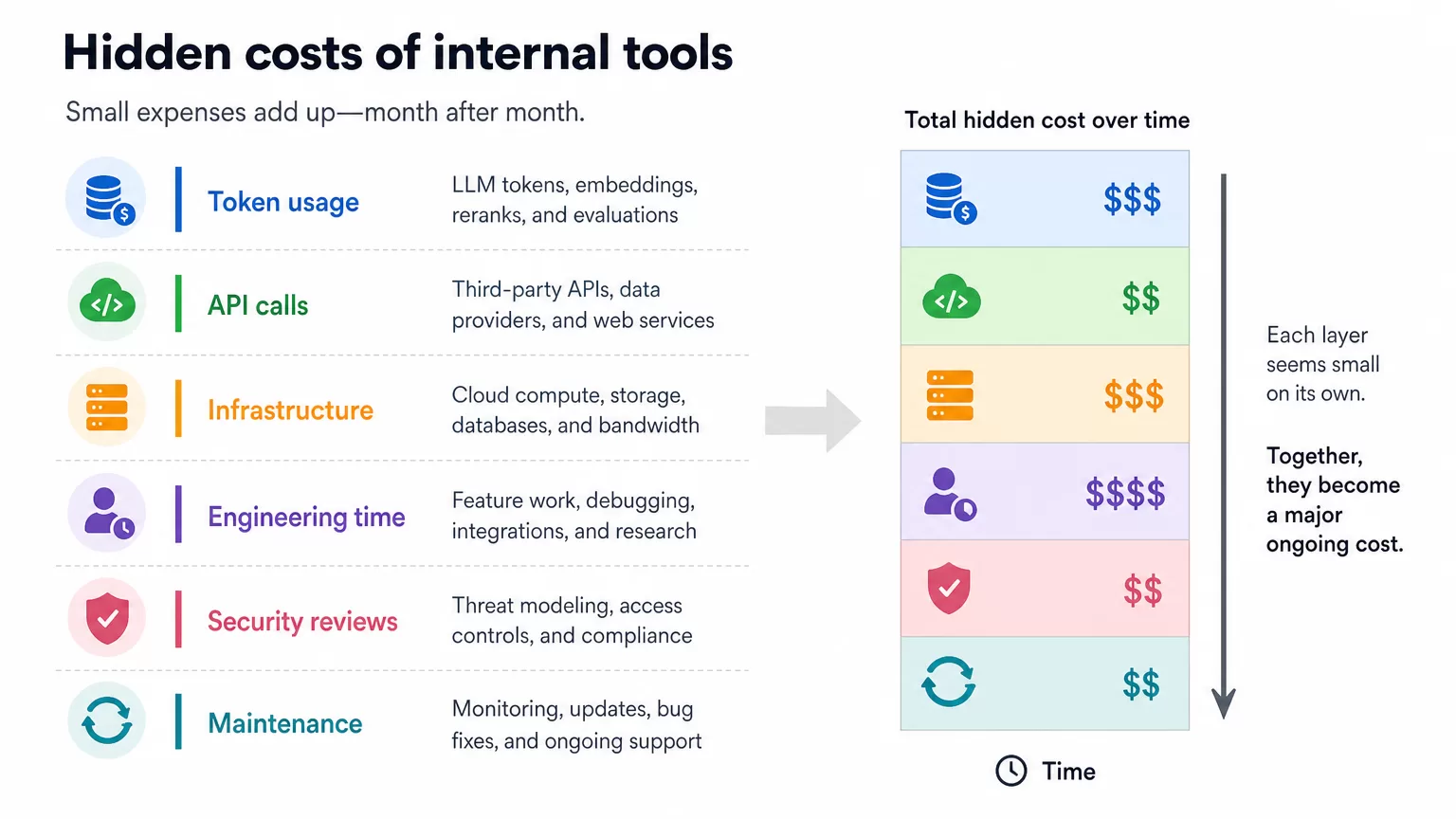
Internal tools often look cheaper than they are because the bill is fragmented. No single line item tells the full story. Instead, the true cost is spread across usage, support, and governance.
Here is the most common hidden-cost stack SEO teams underestimate:
- Usage-based AI spend that grows with adoption
- Infrastructure and integration work to keep data flowing
- Prompt maintenance when model behavior changes
- Security reviews for access, permissions, and data handling
- Documentation and training so the tool does not depend on one person
- Replacement risk if the original builder leaves the team
This is why “free” internal tools are rarely free. A workflow that saves time for one analyst can become expensive once it is used daily across a larger team. The question is not whether it works in a demo. The question is whether it still works when it becomes part of the operating rhythm.
There is also a strategic cost to consider: every internal system competes for attention. If a custom workflow is consuming engineering cycles, security review time, and operational oversight, it should be delivering measurable value — not just novelty.
Repetitive tasks that are good candidates
Not every SEO task should be automated, but many repetitive tasks are strong candidates for AI-assisted workflows. The best ones share three traits:
- They happen often
- They follow recognizable patterns
- They benefit from synthesis, not creativity alone
That makes them ideal for AI augmentation. Common candidates include:
- Weekly or monthly reporting summaries
- Meeting recap generation across multiple sources
- Content gap clustering and prioritization
- Detecting generic or off-brief content
- Translating content for localization workflows
- Surfacing missed tasks from project management systems
These are practical wins because they reduce repetitive labor without asking the model to make final strategic calls. In SEO operations, that distinction matters. The best AI workflows save time on preparation so humans can spend more time on interpretation.
To put it simply: if a task is boring, repetitive, and easy to verify, it may be a strong candidate. If it is high-stakes, ambiguous, or brand-sensitive, it probably needs more human oversight.
Decision framework for SEO teams
Before choosing build, buy, or hybrid, define the actual need. Too many teams start with the solution and work backward. A better process is to document the problem first.
Use this framework:
- Frequency: Is this a daily task, weekly summary, or occasional project?
- Complexity: Does the workflow require simple classification or multi-step reasoning?
- Data access: Where does the data live, and who can access it?
- Security risk: Does the workflow touch sensitive information or permissions?
- Maintenance owner: Who supports it when something breaks?
- Business value: Will this save enough time or improve enough outcomes to justify the effort?
- Longevity: Will this still matter six months from now, and over the next few years?
If the answer to several of those questions is unclear, the safest move is usually to avoid full custom build. Start smaller. Prove value with a narrow workflow, then expand only if the result is stable and measurable.
When a custom workflow makes sense
A custom workflow makes sense when the task is frequent, context-heavy, and tied to your team’s internal process. For example, if your SEO team has a specific way of triaging content opportunities, an AI layer can help sort inputs and speed up the first pass.
Custom workflows are especially useful when:
- You need internal context that SaaS cannot capture well
- You already have reliable data sources and clear inputs
- The workflow is important, but not mission-critical enough to justify a full platform build
This is the sweet spot for augmentation. The system supports the team; it does not replace the team.
When SaaS is better
SaaS is better when the function is stable, broadly available, and not a key differentiator for your organization. It is also the better choice when security and maintenance overhead would outweigh the gains from customization.
Choose SaaS when you need:
- Speed to deployment
- Vendor-managed updates and reliability
- Clear support paths
- Lower operational burden
This is often the right answer for teams that want to scale without creating a shadow engineering function inside marketing.
How to avoid over-automation
Over-automation usually starts with a good intention: save time. But if the workflow removes too much human review, it can create bad decisions at scale.
To stay disciplined:
- Keep a human approval step for anything customer-facing
- Limit automation scope to one clear task at a time
- Audit outputs regularly for drift and quality issues
- Measure time saved and error rate instead of assuming value
The best AI use cases in SEO are not the flashiest. They are the ones that reduce friction, improve prioritization, and preserve human judgment where it matters most.
That is the real build-versus-buy lesson in the AI era: choose the path that gives you durable value, not just a quick prototype. If a workflow is easy to create but costly to maintain, it may be the wrong thing to build. If a SaaS tool solves the problem with less risk, buy it. If the best answer is a hybrid layer that blends internal context with vendor reliability, use that. The goal is not to automate everything. The goal is to build an SEO operating system that is secure, scalable, and actually maintainable.