What Apple Announced
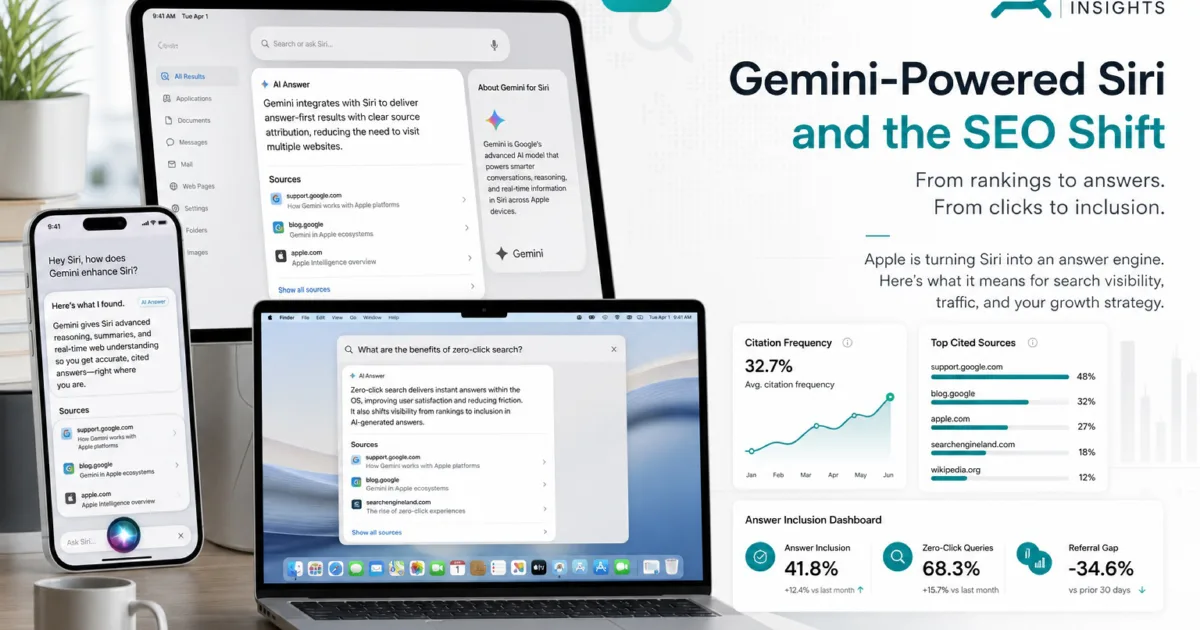
The biggest shift in Apple’s AI direction is not simply that Siri is getting smarter. It is that Siri is evolving into a web-connected answer engine embedded directly into the Apple experience. On iPhone, iPad, and Mac, that means users may increasingly receive synthesized answers inside the operating system itself rather than moving into a browser first.
That matters because Apple devices already sit at the center of daily intent. When a user asks a question through Siri, opens Spotlight search, or interacts with Visual Intelligence, they are not just searching. They are entering an interface that can intercept informational demand before a traditional search session begins.
Key takeaway: Siri is no longer just a command layer. If Gemini-powered capabilities are woven into Apple Intelligence, Siri becomes a default information destination with the power to reduce clicks, reshape discovery, and influence which sources users ever see.
The strategic significance extends beyond the voice assistant itself. Apple is distributing AI across system surfaces such as Spotlight on iPad and Mac, making the experience feel native, trusted, and immediate. That is a major reason this development should be viewed through the lens of search visibility, not just product innovation.
- Voice prompts may become direct answer requests.
- Spotlight queries may surface AI-generated summaries before a browser opens.
- Visual Intelligence may expand discovery to objects, files, and on-screen text.
In other words, Apple is not just adding AI features. It is building a new layer of search behavior into the operating system.
Why This Matters for SEO
For SEO teams, the immediate question is not whether AI answers will exist. It is whether they will replace the click. A Gemini-powered Siri could dramatically increase zero-click searches by answering informational queries directly inside Apple’s UI. That creates a familiar but more distributed challenge: users get what they need without ever reaching a publisher’s page.
This is a major departure from classic organic search. In a traditional SERP, even when a user does not click, the page still earns a visible ranking position. In an assistant-first environment, the page may influence the answer but never receive a measurable impression, referral, or session. That is the visibility problem many teams are underestimating.
Visibility without traffic may become the defining SEO problem of the Apple AI era.
That shift also changes how brands should think about content quality. AI systems favor material that is easy to parse, summarize, and trust. Pages that offer concise definitions, structured explanations, and clear topical authority are better positioned to be selected as sources for AI answers.
For publishers, the risk is not only traffic loss. It is the possibility of being used as a source while remaining invisible in analytics. For SEO teams, that means ranking reports alone will not tell the full story. Success will increasingly depend on answer inclusion, citation frequency, and presence across assistant-driven workflows.
This is exactly where modern Answer Engine Optimization (AEO): How to Win Featured Snippets, AI Answers, and Voice Search becomes essential. The goal is no longer just to rank. It is to be selected, summarized, and trusted by the systems that answer first.
How Source Links May Work
The most important unknown is not whether Siri will answer questions. It is how source attribution will work. If Apple chooses to include links, will they appear consistently? Will the assistant cite one source or several? Will source selection favor authority, freshness, structured data, or some opaque combination of signals?
At this stage, source-link behavior remains unclear. That opacity is a serious measurement challenge because attribution is what makes AI visibility partially observable. Without it, a publisher may know that its content informed an answer only indirectly, if at all.
There are several likely scenarios:
- Single-source citation for concise factual answers.
- Multi-source attribution for broader topics or comparative queries.
- No visible citation when the assistant synthesizes information without exposing the underlying sources.
- Contextual links that appear only for follow-up exploration or deeper reading.
That last point is crucial. If source links only appear selectively, then publishers may see a growing gap between influence and measurable referral traffic. The content may still be shaping the answer, but the user may never leave the assistant interface. This is why source attribution is not a side issue; it is the core SEO signal in an AI answer environment.
Apple’s integration of AI into Spotlight search makes this even more consequential. Spotlight is already a high-trust utility layer, and adding answer generation there gives AI responses a privileged place in the user journey. That means source links may be seen less like search results and more like optional citations inside a workflow.
For teams preparing for this future, it is smart to study Generative Engine Optimization (GEO): Get Cited in ChatGPT, Gemini, Perplexity, and AI Overviews. The same principles that improve citation likelihood in generative search also apply when assistants become the front door to information discovery.
Measurement Challenges
Traditional analytics are not built for AI-mediated search visibility. If Siri answers a question using your content, but the user never clicks, then standard reports may show nothing at all. That creates a blind spot for publishers, brands, and agencies trying to prove value.
The problem is compounded by the fact that Apple’s assistant experience spans multiple surfaces:
- Siri voice interactions
- Spotlight search on iPad and Mac
- Systemwide contextual prompts
- Visual Intelligence inputs tied to images, objects, and on-screen content
Each surface can produce information discovery without a conventional referral path. That means measurement frameworks must move beyond sessions and clicks. Teams should begin tracking the signals that better reflect AI-era exposure:
- Citation presence in AI answers
- Brand mention frequency across answer surfaces
- Query classes that trigger assistant responses
- Assisted discovery that later converts through another channel
- Content reuse patterns in summaries, snippets, and follow-up prompts
In practical terms, this means SEO teams need a broader dashboard. Organic traffic still matters, but it is no longer sufficient. The new question is whether your content is being used to power answers, even when the user journey never reaches your site.
Measurement is moving from “Did we get the click?” to “Did we shape the answer?”
That shift also affects publishers. A site may become more influential without becoming more visited. In some cases, that could improve brand authority over time. But it also raises hard questions about monetization, attribution, and the long-term value exchange between content creators and answer engines.
Practical SEO Responses
SEO teams should not wait for perfect visibility data before adapting. The best response is to optimize for answer inclusion now, while building new measurement habits in parallel. The goal is to make content easier for AI systems to understand, trust, and cite.
Here are the most practical moves:
- Write for direct extraction. Use clear definitions, short explanatory blocks, and answer-first formatting.
- Strengthen entity clarity. Make sure people, products, brands, and concepts are unambiguous throughout the page.
- Use structured content. Headings, lists, tables, and schema markup can improve machine readability.
- Build topical authority. Cover a subject comprehensively so the page is more likely to be viewed as a trustworthy source.
- Optimize for follow-up questions. Assistants are conversational, so content should anticipate related queries.
- Monitor AI visibility signals. Track citations, mentions, and emerging referral patterns, not just rankings.
It is also wise to expand beyond classic search intent. Siri’s AI integration into Apple devices means your content may be surfaced in contexts that are not purely text-based. Visual Intelligence suggests that image, file, and on-screen text discovery may become increasingly important. That opens the door for richer content ecosystems, including visuals, concise explainers, and context-aware support material.
For many organizations, the best response will be a hybrid strategy:
- SEO for rankings
- AEO for answer surfaces
- GEO for generative citations
That is the new stack. Search visibility is no longer one channel; it is a network of surfaces, assistants, and summaries. Apple’s move, especially if powered by Gemini capabilities behind the scenes, makes that reality harder to ignore.
Bottom line: A Gemini-powered Siri could turn Apple devices into answer-first environments where source attribution matters as much as rankings. The brands that win will be the ones that optimize for citations, not just clicks.
In the near term, publishers and SEO teams should focus on clarity, authority, and machine-readable structure. Over time, they will need a measurement framework that values visibility inside AI answers as much as traffic from traditional search. That is the real strategic shift Apple’s AI direction is forcing across the industry.