What happened this week
Google search ranking volatility remained unusually active during the June 8–12 window, extending the sense that the core update aftermath is still being felt across the search landscape. The key takeaway is not simply that rankings moved, but that the movement appeared uneven, delayed, and difficult to pin down. Some site owners reported sharp drops, others saw partial rebounds, and a few described traffic returning in short bursts before disappearing again.
This is what makes the current moment worth watching: the instability did not look like a clean one-day event tied neatly to the end of the May 2026 core update. Instead, the turbulence appeared to continue after the official rollout completed on June 2, with additional swings showing up over the following weekend and into the next week. That pattern suggests the system may still be recalibrating rather than settling into a stable post-update state.
Bottom line: when Google ranking volatility lingers after a core update, the real story is often not a single drop or recovery, but a prolonged reshuffling of visibility across queries, page types, and verticals.
For SEOs tracking organic traffic trends, the most important lesson is to avoid overreacting to any single day. A site that looks down on Monday may rebound on Wednesday. Another may recover a portion of lost visibility only to lose it again by the weekend. This is classic SERP instability: noisy, nonlinear, and hard to interpret in real time.
Why community chatter matters
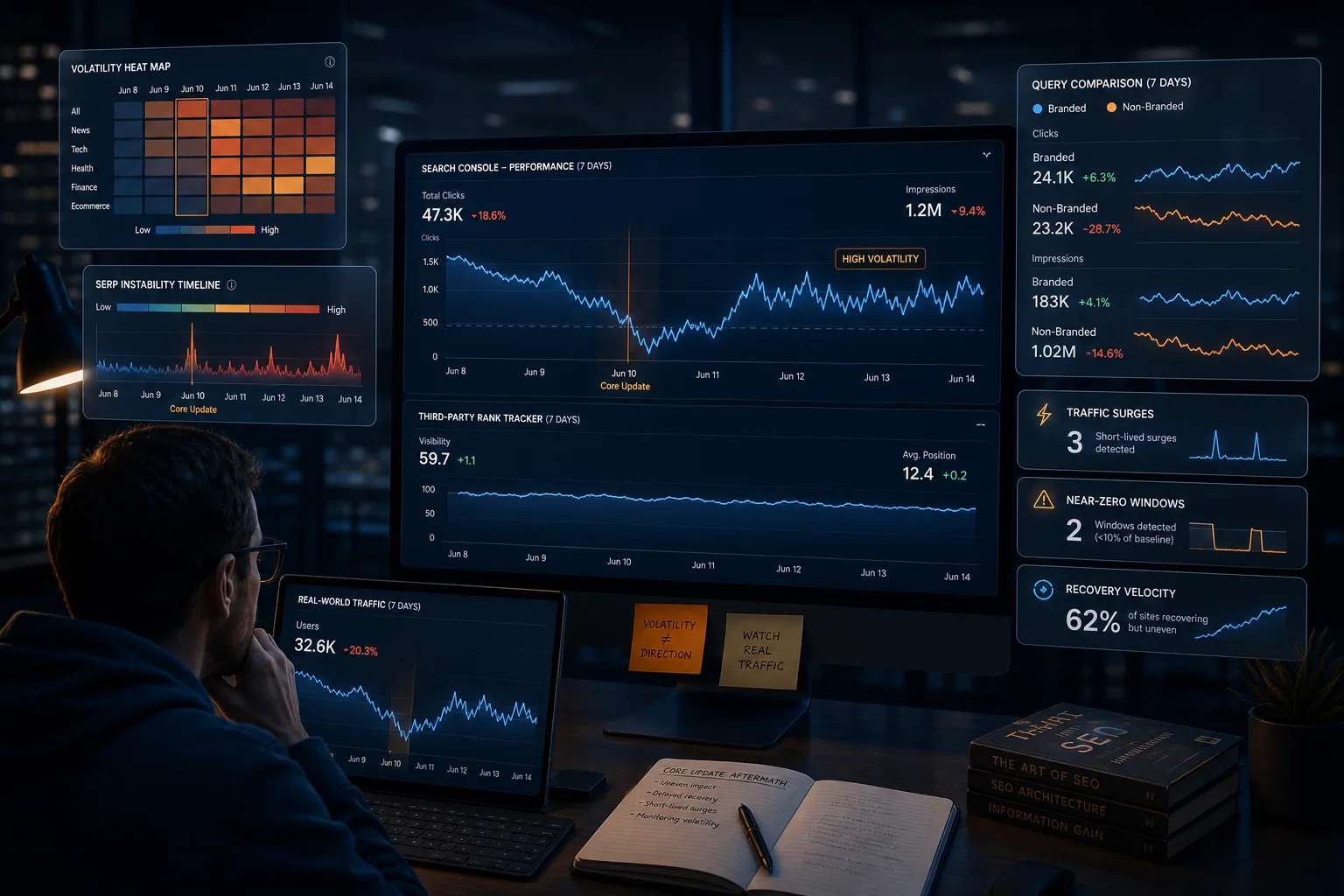
One of the clearest signals during volatile periods is not a dashboard but the SEO chatter happening across forums, comment threads, and private communities. In this case, practitioners were describing the same kinds of symptoms repeatedly: traffic surges lasting only a couple of hours, near-zero traffic windows lasting one to three hours, and sudden keyword movement that did not align with the broader calm shown in tools.
That kind of crowd-sourced reporting matters because it can reveal changes before they are obvious in automated systems. Community reports are especially useful when volatility is:
- localized to specific industries or page types,
- query-specific rather than sitewide,
- geographically uneven, or
- spread across multiple days instead of concentrated in one spike.
In practice, this means the community can function as an early warning system. If many site owners report the same pattern—losses followed by temporary recoveries, or branded pages behaving differently from non-branded pages—that is meaningful even before any tool confirms the trend.
Why this matters: community chatter is not proof of a new update, but it is often the first place where search turbulence becomes visible in the real world.
That said, anecdotal reports should be treated as signal, not certainty. The value comes from pattern recognition. When multiple independent reports point in the same direction, the odds increase that something systemic is happening beneath the surface.
Why tools may not match reality
The mismatch between community reports and third-party tracking tools is one of the most important observations in this volatility cycle. While SEOs were describing serious movement, many rank trackers appeared relatively calm. That does not necessarily mean the tools were wrong; it may mean they were measuring a different slice of reality.
There are several reasons why dashboards can diverge from lived experience:
- Keyword sets are limited. A tracker may monitor a narrow group of terms that misses the queries actually moving.
- Data is averaged. Short spikes and dips can be smoothed out in daily reporting.
- Volatility is uneven. Changes may affect some verticals, countries, devices, or SERP types far more than others.
- Query intent shifts. Branded, non-branded, product, and informational searches may not move in the same way.
- SERP features distort visibility. A page can lose clicks without losing rank if featured snippets, marketplaces, or platform-heavy results expand.
This is why visibility fluctuations can feel dramatic to publishers while tools look muted. If the tracked keywords are stable but the actual business-driving queries are not, the dashboard will understate the problem. Conversely, a tool may show a minor wobble while revenue or traffic suffers far more sharply.
One report described a site that was down roughly 50% over several days, while another described traffic arriving in bursts for about two hours before disappearing for one to three hours. Those patterns are difficult for standard trackers to represent cleanly, especially if the movement is intermittent rather than sustained.
Important warning: do not treat third-party rank tracking as the sole source of truth during periods of algorithm update monitoring. Use it alongside Search Console and analytics, not instead of them.
For a deeper framework on evaluating search changes beyond surface-level rank checks, see The Complete Guide to SEO in 2026: Strategy, Technical Foundations, and Measurement. It is especially relevant when rankings move in ways that are not immediately visible in a single dashboard.
Patterns seen after core updates
The current volatility fits a pattern that often appears after major core updates: the update ends, but the search environment keeps moving. That lag is important. It suggests that Google may have completed the formal rollout while the ecosystem continues to rebalance based on new weighting, re-evaluation, or delayed propagation across data centers and query classes.
Several patterns stand out in this aftermath:
1. Recovery and decline can happen at the same time
Some sites are regaining visibility while others are losing more ground. That means the ecosystem is not simply “better” or “worse” overall; it is redistributing visibility. A site seeing a 24-hour rebound may simply be clawing back traffic lost earlier, not entering a durable recovery.
2. Short-term gains can be misleading
Reports of traffic up over the last 48 hours, or visibility returning within 24 hours, need context. A temporary bounce may reflect a re-ranking burst rather than a true restoration. This is especially true when the previous pattern included dramatic losses, such as nearly 100% visibility loss or the disappearance of all keywords in an earlier update.
3. Some page types appear more exposed than others
Community commentary pointed to branded versus non-branded product pages, low-content pages, and platform-heavy SERPs as especially sensitive. That does not prove a universal rule, but it does suggest that intent matching, authority signals, and SERP composition may be interacting in complex ways.
4. The aftermath can be delayed
One of the most useful observations is that the strongest turbulence did not necessarily occur during the update’s most obvious window. Instead, volatility appeared on the final day of the update, then again on the weekend, then again the following week. That sequence is a reminder that algorithmic shifts can produce aftershocks rather than a single clean break.
Interpretation: if your site was affected by a prior update, the next wave of movement may not be the final outcome. Delayed turbulence is common, and the search landscape may continue to reprice pages for days or weeks.
This is also where HCU recovery conversations become relevant. Sites that were previously hit may show partial returns, but those gains can be fragile. A weak recovery can be followed by renewed loss, especially if Google continues testing different combinations of authority, usefulness, and intent satisfaction.
For context on how Google evaluates the broader ecosystem of tools and claims around changes like these, review Google’s Stance on Third-Party SEO, AEO, and GEO Tools: How to Filter the Noise in 2026. It is particularly useful when the market is flooded with interpretations but the data remains messy.
What SEOs should monitor next
When rankings and traffic fluctuate week to week, the right response is disciplined observation, not panic. The goal is to determine whether you are seeing a temporary wobble, a query-level reshuffle, or a broader sitewide issue. That requires a wider lens than daily rank checks alone.
Here is what site owners should monitor closely:
- Google Search Console impressions and clicks by page type, query class, and country.
- Organic traffic trends in analytics over 7-day, 14-day, and 28-day windows.
- Branded vs. non-branded performance to detect intent-specific movement.
- Landing page groups such as product pages, category pages, informational content, and low-content templates.
- SERP feature changes including snippets, video blocks, forums, shopping units, and marketplace placements.
- Device and geography splits to identify whether the volatility is concentrated in one segment.
- Recovery velocity, meaning whether gains persist for multiple days or fade quickly.
It is also smart to compare your own data against community reports. If your site is down but the broader community is calm, the issue may be site-specific. If your site is stable while many others are reporting turbulence, the change may be unfolding in a segment you have not yet been exposed to. Either way, the comparison helps separate isolated noise from broader algorithm update monitoring signals.
Practical rule: do not make major content or technical changes based on one bad day. Look for multi-day patterns, cross-check Search Console, and wait for a clearer trend before drawing conclusions.
In periods like this, the best operators combine data sources rather than relying on a single metric. Search Console, analytics, rank trackers, and community intelligence each tell part of the story. Together, they can reveal whether you are seeing a temporary SERP shuffle, a delayed post-update correction, or a more durable change in how Google is valuing your pages.
The current message from the field is clear: Google ranking volatility has not fully settled, and the gap between what communities report and what tools display is itself a signal. Until the search environment stabilizes, the smartest move is to stay measured, monitor longer windows, and focus on the data that reflects real user demand—not just a weekly ranking snapshot.