
AI-generated spam is no longer just a problem of bad phrasing or obvious keyword stuffing. The more interesting shift is happening under the hood: search engines may be learning to spot systems of abuse, not just isolated pages. That changes the game for SEO, content operations, and anyone trying to scale with generative AI.
Recent anti-spam research points toward a future where text embeddings, shared narrative patterns, and cluster-level behavior matter more than surface-level polish. In other words, a page can read smoothly and still be part of a detectable spam network. For legitimate publishers, that is a reminder that quality is no longer only about grammar or tone. It is about originality, intent, and structural differentiation.
Key shift: search engines may increasingly judge the production system behind content, not just the content itself.
What Google’s research reveals about AI spam detection
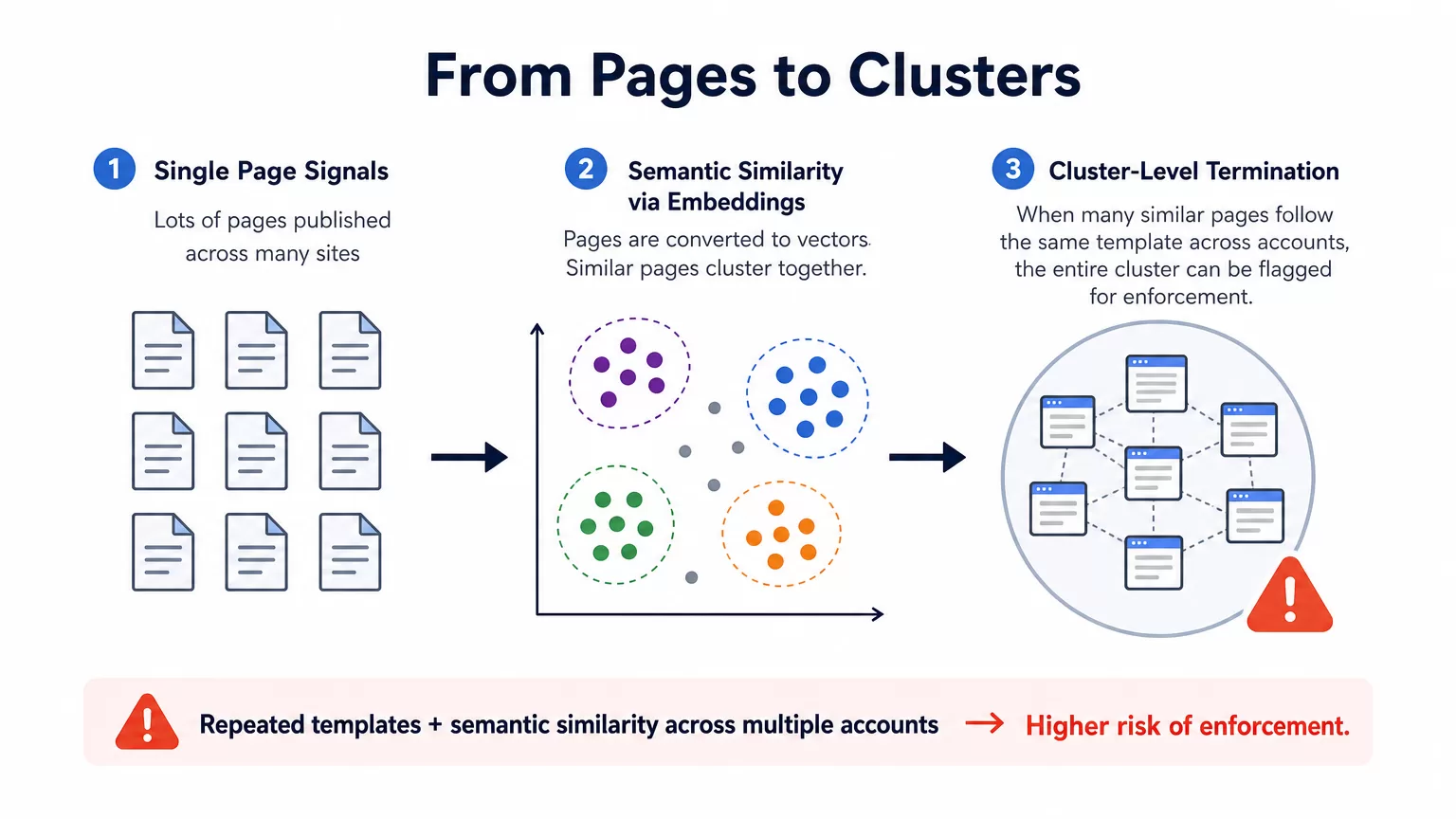
The most important takeaway from modern anti-spam research is that detection is becoming cluster-aware. Instead of treating each post, page, or account as a standalone object, systems can map relationships across many assets and identify coordinated abuse. That means a large-scale generative AI spam campaign may be exposed by its shared structure, even if individual outputs look different on the surface.
This matters because AI makes spam cheaper to produce and easier to vary. A bad actor can generate hundreds of pages with slightly different wording, but the underlying template may remain the same. Search engines do not need to catch every sentence. They only need enough evidence that the operation is repeating a synthetic pattern across an infrastructure cluster.
- Page-level checks look at one asset at a time.
- Cluster-level checks look for coordinated reuse across many assets.
- Infrastructure-level checks can connect accounts, templates, and distribution behavior.
That distinction is crucial for SEO spam prevention. If a content system relies on the same prompt, the same structure, and the same narrative skeleton across dozens of pages, it may be visible long before manual review would catch it.
Why embeddings matter more than surface-level text
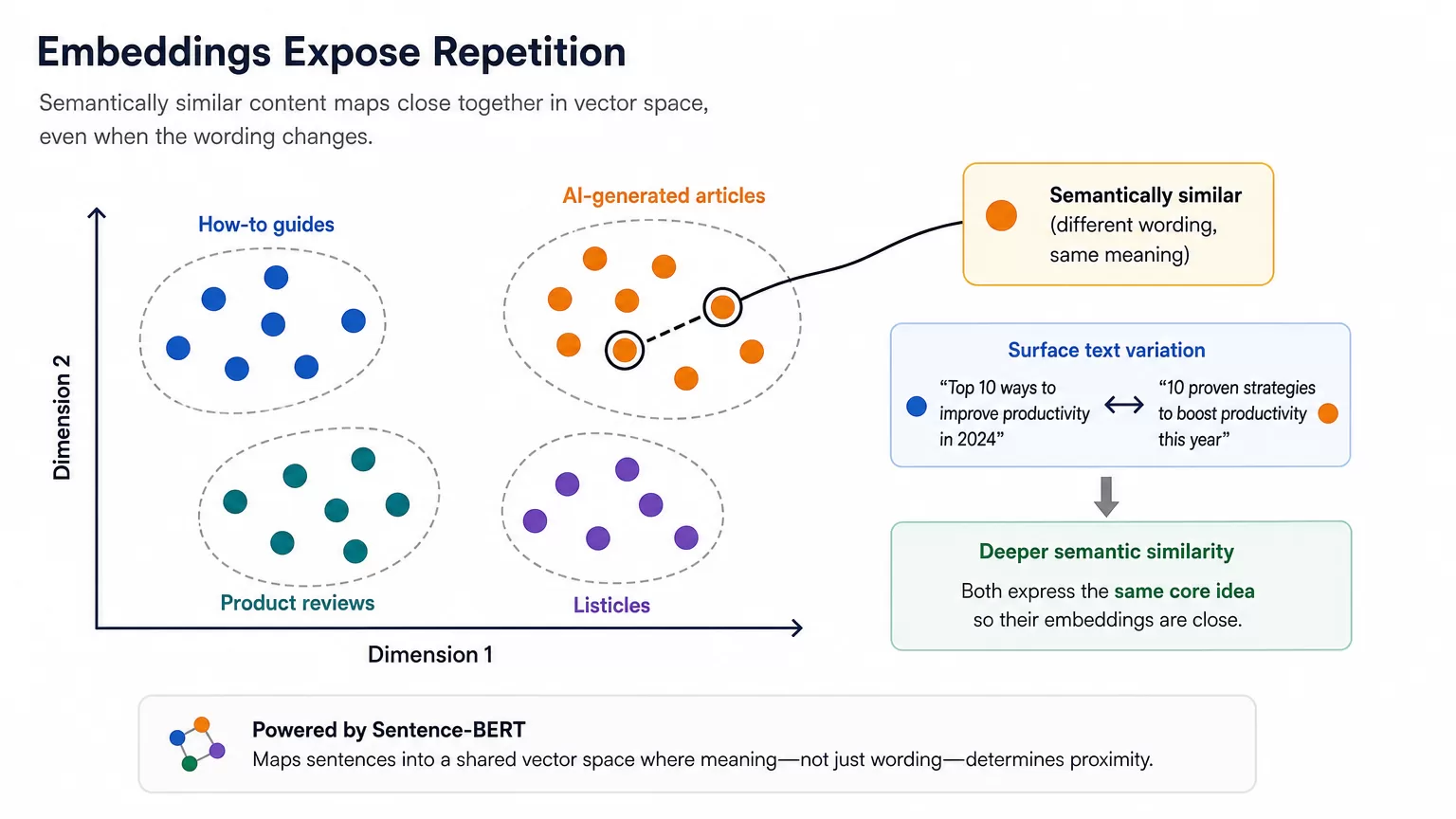
Embeddings are one of the most important concepts to understand here. In simple terms, they turn text into vectors that preserve meaning. If two sentences are semantically similar, their vectors sit close together in embedding space. That allows systems to detect meaning-level repetition even when the wording changes.
This is where models like Sentence-BERT become relevant. Sentence-BERT is designed to produce sentence representations that make similarity search much faster and more practical at scale. A common benchmark example shows why that matters: comparing many sentences with older transformer methods can be extremely slow, while embedding-based approaches can reduce the task dramatically without losing much semantic accuracy.
Contrarian lesson: making AI text “sound human” is not the same as making it meaningfully original.
For marketers, this creates a new standard for content quality filters. Search engines may not care whether a paragraph is grammatically clean if it still maps to the same semantic footprint as thousands of other pages. That is especially true when prompts are optimized for efficiency rather than editorial uniqueness.
To stay on the right side of that line, teams should think beyond rewrite level changes and focus on:
- Distinct angles that change the core framing of a topic
- Unique evidence drawn from real workflows, not recycled summaries
- Varying information architecture across pages and templates
- Human editorial judgment on what deserves to be published at all
In practice, this is where a disciplined workflow around Keyword Research & Analysis and Technical SEO Services becomes more valuable. Strong technical foundations help search engines crawl and understand your site, but they also support content systems that avoid repetitive, low-value scaling.
How cluster-based termination changes the game
One of the most consequential ideas in modern anti-spam defense is cluster termination. Instead of punishing one suspicious account or one questionable page, a platform can assess whether a large share of a connected cluster is using the same AI-generated templates. If the threshold is high enough, the entire cluster can be terminated.
That is a major escalation because it moves the enforcement target from the content artifact to the abuse network. In practical terms, it means search engines may be less interested in proving that one page is bad and more interested in proving that a campaign is coordinated.
What this means for SEO: scaled content operations are safer when they are genuinely differentiated, not merely mass-produced.
This also explains why repetitive AI workflows can become risky even when they appear efficient. If one prompt structure produces dozens of near-equivalent articles, the system may be leaving a clear mathematical trail. Search engines can potentially cluster those outputs by meaning, style, and distribution behavior, then treat them as one abuse pattern rather than many independent pages.
That is why quality control cannot stop at grammar checks. Teams need content governance that asks:
- Does this page add new information, or only repackage existing text?
- Are we publishing multiple assets with the same narrative skeleton?
- Would this content still be useful if every similar page disappeared?
These are not just editorial questions. They are anti-spam questions.
What LoRA and APO mean for adaptive defenses
Search engines also appear to be getting better at adapting quickly. Techniques like LoRA (Low-Rank Adaptation) and APO (Automatic Prompt Optimization)
suggest a future where anti-spam systems do not need to retrain massive models from scratch every time attackers change tactics. Instead, they can tune detection layers more efficiently and respond to new generative patterns faster.
That matters because spam operators often depend on model churn. When one generation of AI content gets caught, they move to a newer model or a slightly altered prompt strategy. Adaptive defenses reduce that advantage. If the detection system can be updated quickly, the moving target becomes much less useful.
In SEO terms, the implication is straightforward: prompt optimization for scale is not the same as prompt optimization for safety. A prompt that makes content faster to produce may also make it easier to cluster, easier to classify, and easier to terminate.
For teams building with generative AI, the better question is not, “How do we make this output sound different?” It is, “How do we make this content genuinely distinct in purpose, evidence, and structure?”
SEO implications and contrarian takeaways
The biggest SEO lesson is that AI spam detection is becoming a systems problem. Search engines may not need perfect certainty on any single page if they can identify a repeated production pattern across many pages, accounts, or media types. That is where multimodal defense becomes important: text, images, metadata, and infrastructure signals can all reinforce one another.
For legitimate publishers, this creates a contrarian opportunity. The answer to AI-driven competition is not necessarily to publish more. It is to publish more distinctively. The web does not need another hundred pages that say the same thing in slightly different words. It needs fewer, better pages that demonstrate real editorial intent.
- Do not rely on near-duplicate templates at scale.
- Do vary the angle, evidence, and structure of each important page.
- Do use human review where topical nuance matters.
- Do monitor performance in Search Console, rankings, and crawl behavior for signs of quality decay.
This is also where broader AI search strategy comes into play. As search evolves, visibility depends not just on classic ranking signals, but on how well your content can survive semantic comparison and quality filtering. If your team is exploring this intersection, Generative Engine Optimization (GEO) is becoming increasingly relevant alongside traditional SEO workflows.
Bottom line: the future of anti-spam is less about spotting bad text and more about spotting bad systems.
That is the real strategic shift. Marketers who understand embeddings, clustering, and adaptive defenses will be better prepared for a search landscape where originality is measured mathematically, not just stylistically. The safest content strategy is no longer the one that produces the most pages. It is the one that produces the strongest evidence of human judgment.