The old SEO bargain was simple: publish useful content, earn rankings, and let search traffic do the rest. That model still exists, but it no longer describes the full game. In an AI-mediated search environment, the value of content is increasingly separated from the click that used to validate it.
That shift matters because it changes the question from “How do we make great content?” to “What can we create that AI cannot easily summarize, extract, or replicate?” For marketers, that is a much harder and more useful question. It forces a move from content quality alone to content defensibility.
For teams building modern visibility strategies, this is also where SEO starts to overlap with broader content marketing and platform distribution. If you are rethinking your approach, our Content Marketing SEO services page is a good place to see how content systems can be structured around demand, not just publishing volume.
Key shift: AI is not just changing how content is produced. It is changing which marketing assets still deserve attention, trust, and clicks.
The new pressure on content marketing
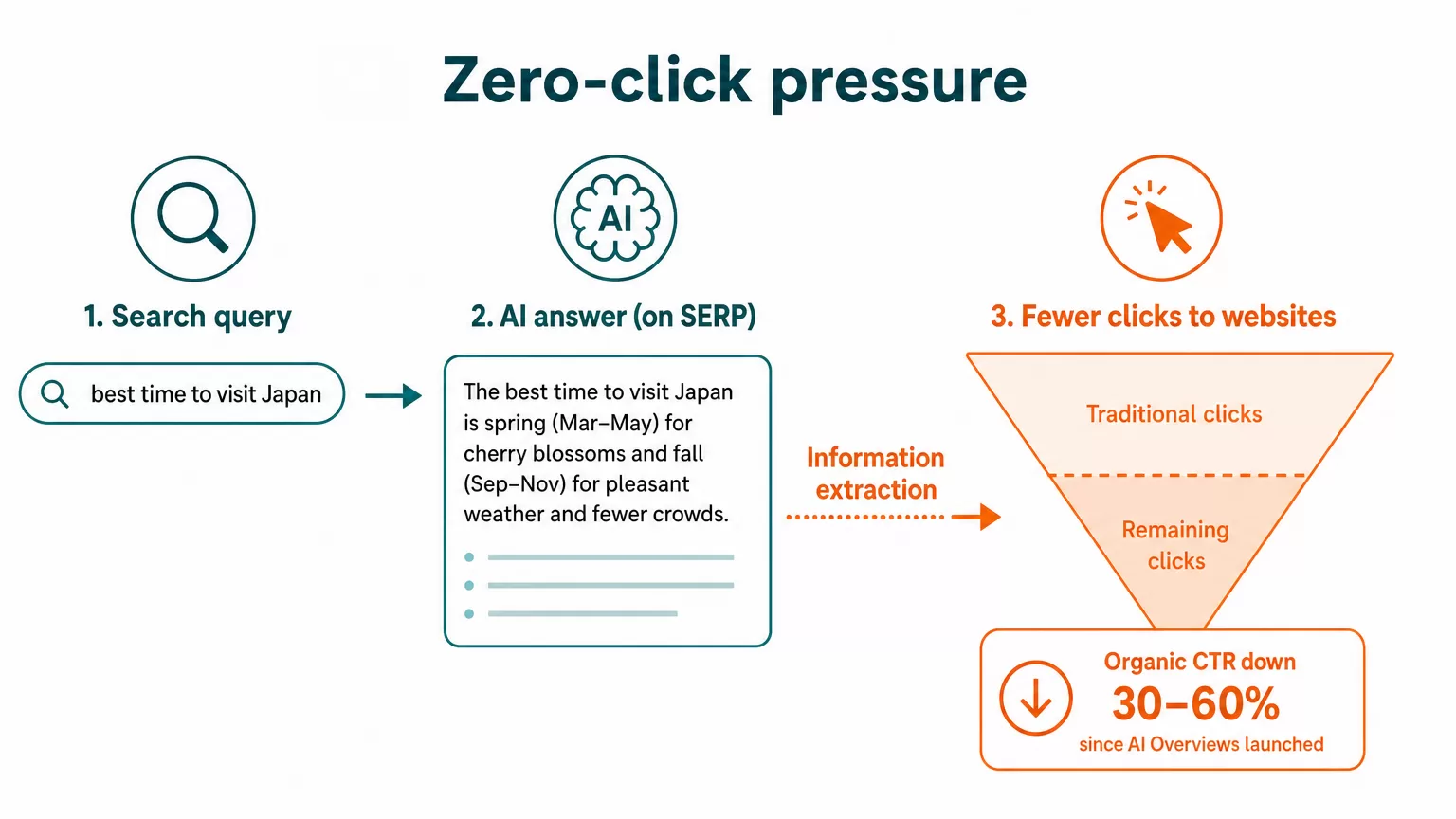
Content marketing is under pressure from two directions at once. First, search results are becoming more answer-rich, which means users often get what they need without leaving the results page. Second, AI tools can now generate summaries, comparisons, and explanations that once required a publisher’s original article.
That creates a zero-click ecosystem where the informational layer is increasingly detached from the source. The content still exists, but the publisher does not always capture the visit. For brands that built their growth model around organic traffic alone, this is a structural problem, not a temporary fluctuation.
What makes this more urgent is that the tasks behind content production are also exposed to automation. Market research, outline generation, competitor analysis, topic clustering, and first-draft writing are all increasingly assisted by AI. In other words, the same workflow that powered traditional SEO is becoming easier to replicate at scale.
- Search discovery is less linear than it used to be.
- Clicks are no longer guaranteed even when visibility is strong.
- Generic informational content is easier to summarize and commoditize.
- Distribution now matters as much as production.
The practical implication is uncomfortable but clear: if your content can be neatly reduced to a machine-generated answer, you may be competing in a category with shrinking economic value.
What AI can already do
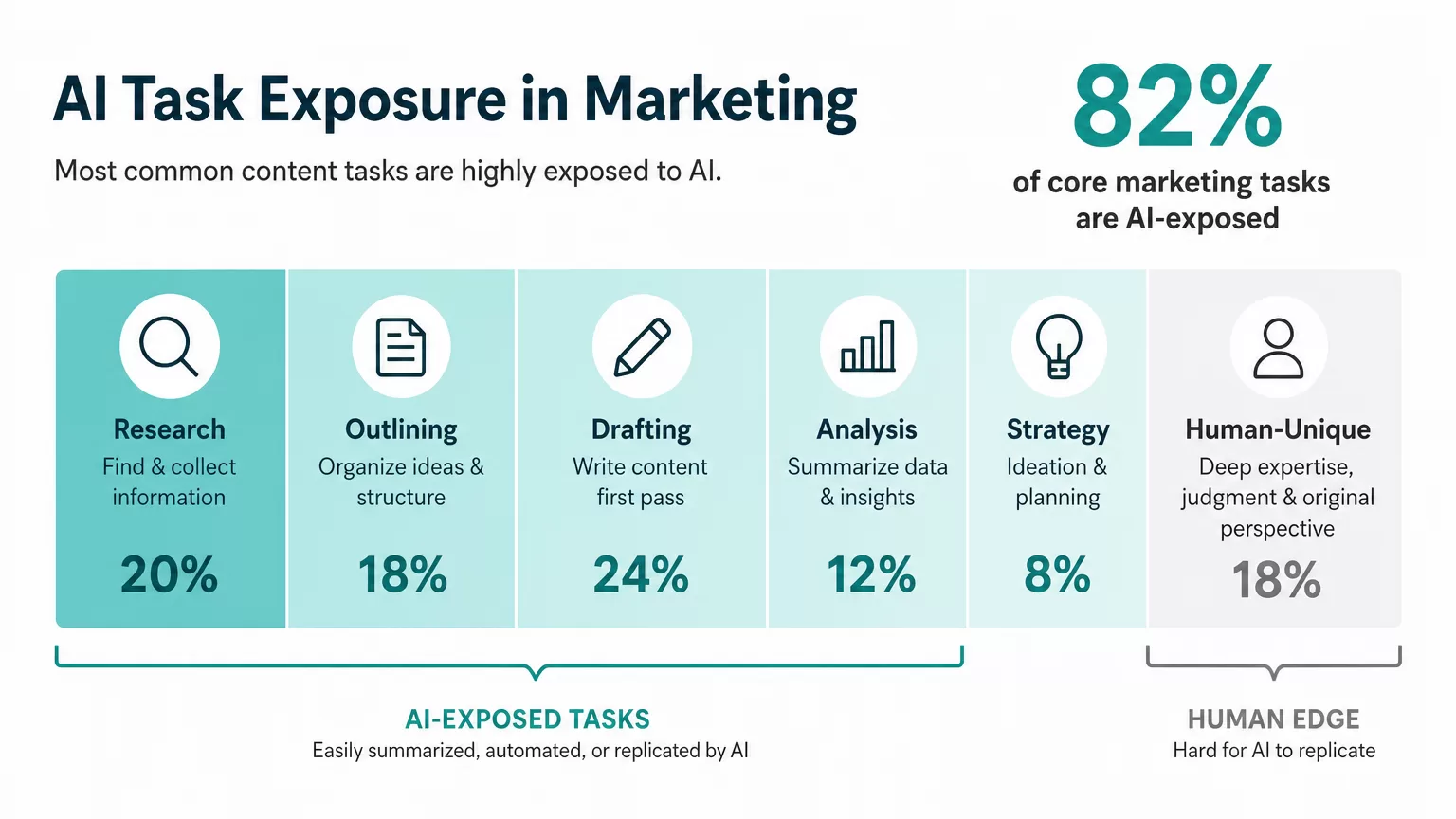
AI is already capable of handling a surprisingly large share of marketing work. Task-level research suggests that about 65% of a marketing specialist’s work is exposed to current AI systems in some form. That does not mean 65% of jobs disappear overnight. It does mean that many of the tasks SEO and content teams rely on are now easier to automate, accelerate, or standardize.
This is where the conversation needs to move beyond job titles. AI does not replace “the SEO manager” or “the content strategist” in one clean sweep. It replaces specific tasks:
- summarizing source material
- drafting content outlines
- grouping keywords by intent
- generating metadata
- spotting patterns in competitor pages
- creating first-pass content variations
That task-level exposure is the real signal. It tells us that the core operating system of content marketing is being compressed. The more a deliverable depends on repeatable information assembly, the easier it is for AI to participate.
Warning: If your strategy depends on producing more informational pages faster, AI may help your team today but weaken your differentiation tomorrow.
This is why the future of SEO cannot be defined only by efficiency. Efficiency is now table stakes. The strategic advantage comes from what remains after efficiency is stripped away: original insight, proprietary context, trusted voice, and distribution that compounds.
Why great content is no longer enough
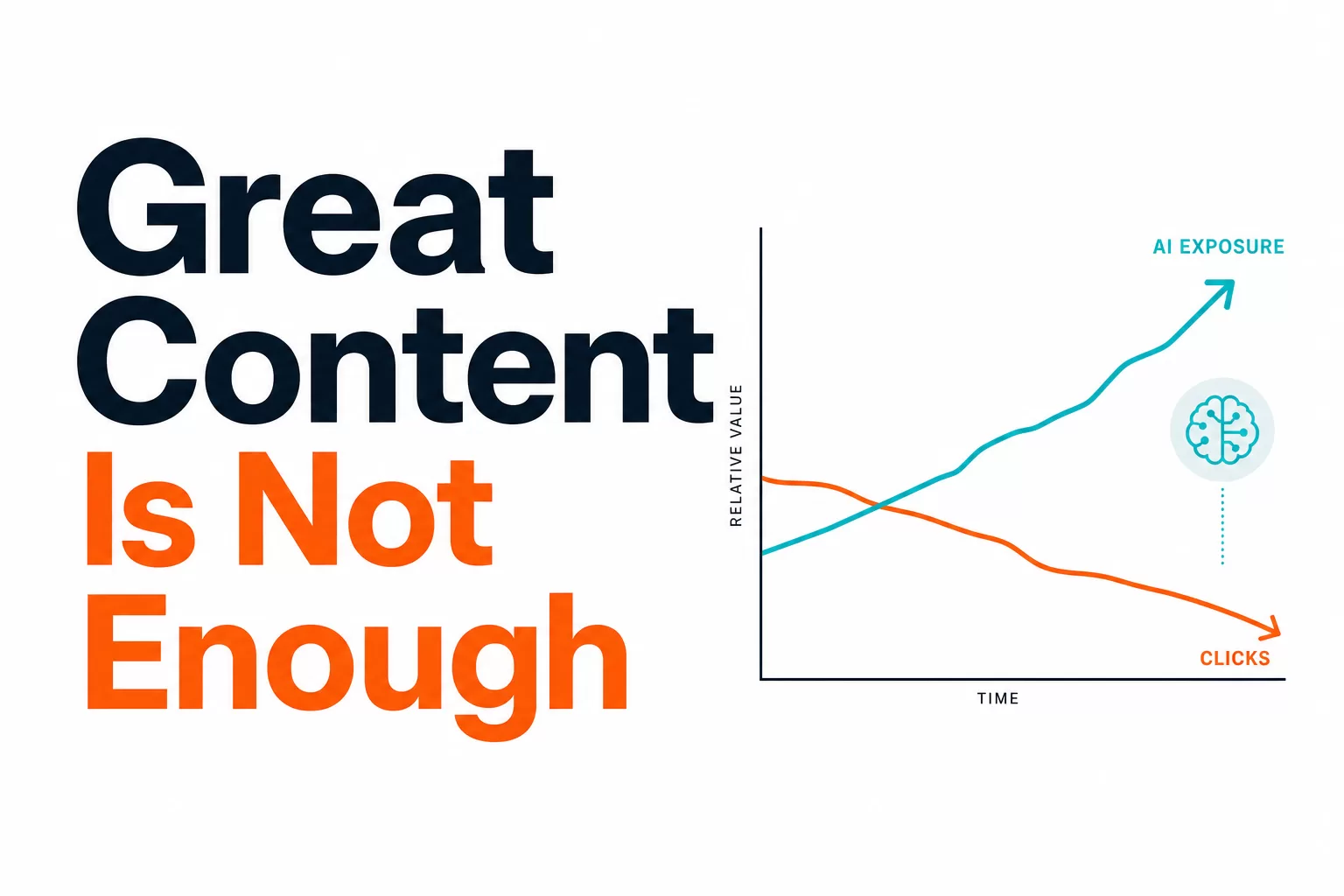
“Great content” used to be the safest advice in SEO because quality and usefulness usually translated into rankings and traffic. That advice is not wrong, but it is incomplete in an AI search world. Great content can still win visibility, but it may not win the full value of that visibility.
The problem is that content quality is no longer the same thing as content defensibility. If a page can be summarized in a search feature, paraphrased by a chatbot, or recomposed from existing sources, then the informational value is easier to extract than to reward.
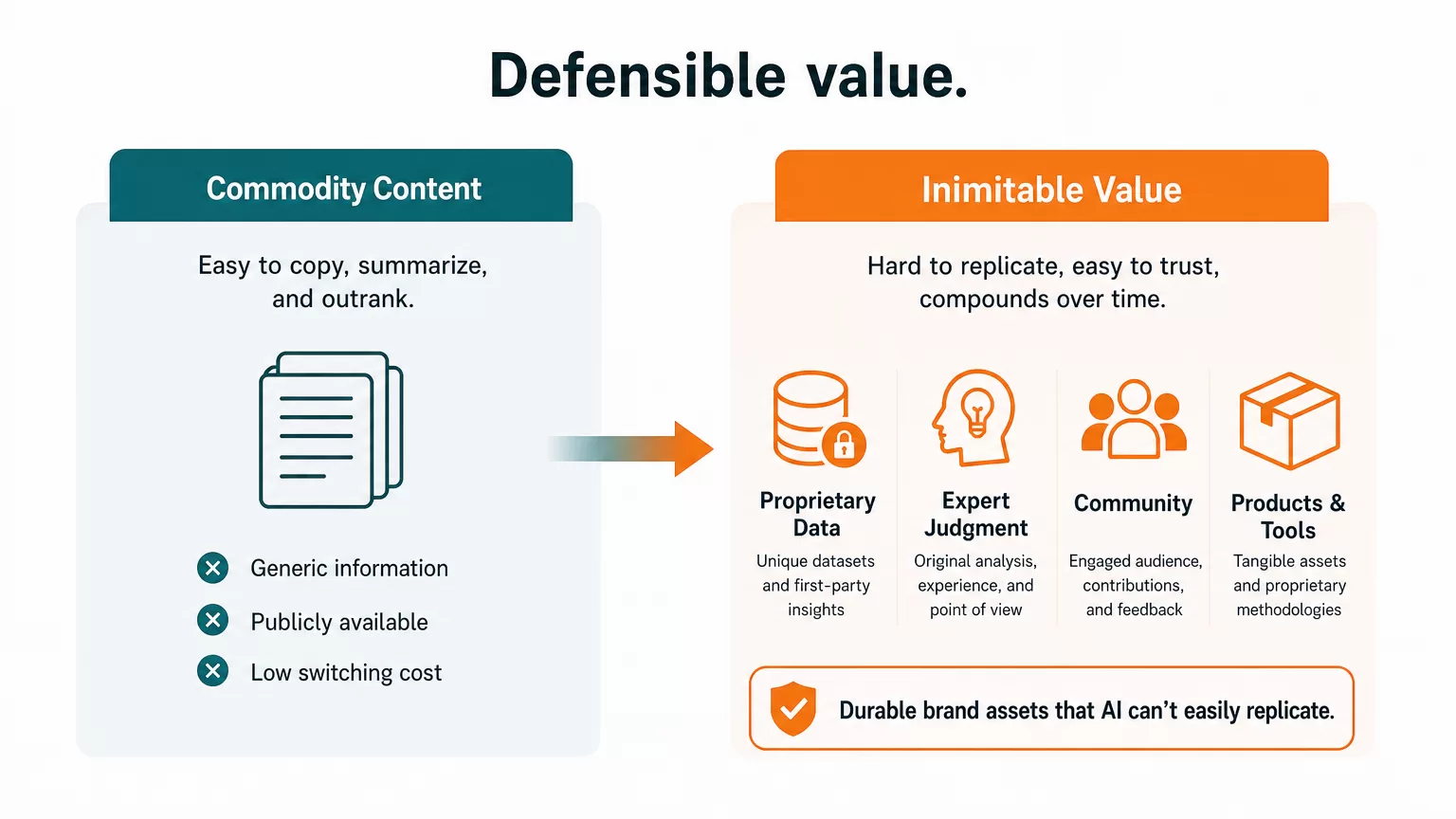
This is why the real moat is moving away from the article itself and toward the things AI cannot flatten as easily:
- proprietary data that is not widely available
- unique methodology that reflects a brand’s point of view
- expert judgment that requires human context
- community access that cannot be scraped
- product experience that creates repeat use
- brand trust that reduces substitution
Think of the difference between a generic article about premium knives and a knife that is prized for craftsmanship, balance, and materials. Or between a standard suit guide and a custom-tailored suit. The value is not just in the information about the item; it is in the thing itself, the process, and the experience around it. Digital marketing needs a similar shift.
That is why inimitable products matter. If your brand can offer something AI cannot easily imitate—whether that is a tool, a dataset, a service layer, a community, or a distinctive point of view—content becomes a distribution mechanism for a deeper asset, not the asset itself.
The two strategic responses
There are really two broad responses to this shift. The first is collective action: publishers and creators pushing back against extraction, negotiating the rules of content use, and trying to preserve referral economics. That may matter at the industry level, but it is not the most practical path for most agencies, consultants, or smaller brands.
The second response is more immediately actionable: build something AI cannot easily copy. That means moving from generic informational publishing to inimitable value.
Building inimitable value
Inimitable value is the combination of assets that make your brand harder to replace. It is not about being louder. It is about being more difficult to commoditize.
Practical examples include:
- original research based on your own data
- branded frameworks that shape how the market thinks
- expert-led content with real judgment, not recycled summaries
- tools and calculators that solve a recurring problem
- service depth that connects content to implementation
- community and events that create ongoing participation
This is where a modern SEO strategy becomes a value strategy. Content should not just answer questions; it should reinforce a reason to choose you. If your editorial engine exists only to target keywords, it is vulnerable. If it supports a product, service, or belief system that has real differentiation, it becomes much more resilient.
Audience building on borrowed platforms
The other strategic response is distribution. If organic search traffic is less predictable, then audience building cannot live on your own site alone. Marketers need to show up where attention already concentrates: social platforms, newsletters, communities, video, podcasts, and professional networks.
This does not mean abandoning owned media. It means recognizing that influence is the new traffic. Brand presence, trust, and repeated exposure now play a larger role in discovery than a single ranking ever did.
That is why platform-led audience building matters. Great marketing on borrowed platforms can create demand that search alone may never capture. It also builds familiarity before the click, which is increasingly important in a world where users may consume your ideas without visiting your site at all.
For teams thinking about the overlap between answer engines and search visibility, it is worth pairing this article with our analysis of AEO vs SEO: How to Win Both. The strategic takeaway is similar: visibility is no longer confined to the blue-link era.
How SEO teams should adapt
SEO teams do not need to abandon content. They need to redesign the role content plays inside the growth system. The best teams will treat AI as both a production layer and a strategic warning signal.
Start with a task audit. Break your workflow into components and ask three questions:
- What can AI already do well?
- What still requires human judgment?
- What can become a differentiator if we invest in it?
That simple exercise often reveals that the most valuable parts of the workflow are not the most visible ones. Original research, editorial perspective, technical interpretation, and distribution strategy usually matter more than another round of standardized content briefs.
Next, look at your content inventory through the lens of defensibility. Which pages are easy to summarize? Which assets are tied to proprietary insight? Which pieces support a product, service, or community that cannot be duplicated by a prompt?
Finally, connect SEO to a broader audience strategy. Search should remain a major channel, but it should not be the only one. The future belongs to brands that can combine search visibility with platform-native reach and a clear reason to be remembered.
Practical next steps
- Audit content by task, not title. Identify where AI can assist and where humans must lead.
- Replace generic pages with defensible assets. Prioritize original data, proprietary frameworks, and expert interpretation.
- Build distribution beyond search. Use platforms, newsletters, and communities to create demand before the click.
- Map content to a real moat. Ask what each page supports: product, service, expertise, or trust.
- Measure influence, not just traffic. Track brand searches, assisted conversions, and audience growth alongside rankings.
Bottom line: The SEO future belongs to brands that can pair AI-assisted efficiency with unmistakably human differentiation.
“Great content” is still necessary. It is just no longer sufficient on its own. In an AI exposure world, the winning strategy is not to produce more of the same. It is to build something more defensible, more recognizable, and harder to automate away.