E-E-A-T is one of the most misunderstood concepts in modern SEO. Too often, it gets reduced to a checklist: add an author bio, cite a source, publish a few updates, and assume trust will follow. That approach misses the point.
E-E-A-T is not a direct ranking factor. It is a quality framework used in Google’s search evaluation system, and it reflects something much bigger than a single optimization tactic: whether a page deserves to be trusted by real people.
For brands trying to win durable visibility in organic search, answer engine optimization, and AI search, that distinction matters. The sites that perform best are rarely the ones that simply “mention” experience or expertise. They are the ones that operationalize credibility across the entire content system.
Trust is the core signal. Experience, expertise, and authority matter because they help users believe the content is accurate, useful, and safe.
Below, we’ll break down what E-E-A-T means today, why trust is the central pillar, and how to turn abstract quality guidance into measurable site-wide trust signals.
What E-E-A-T means today
For hands-on help with this topic, explore SEO Services for Financial Services.
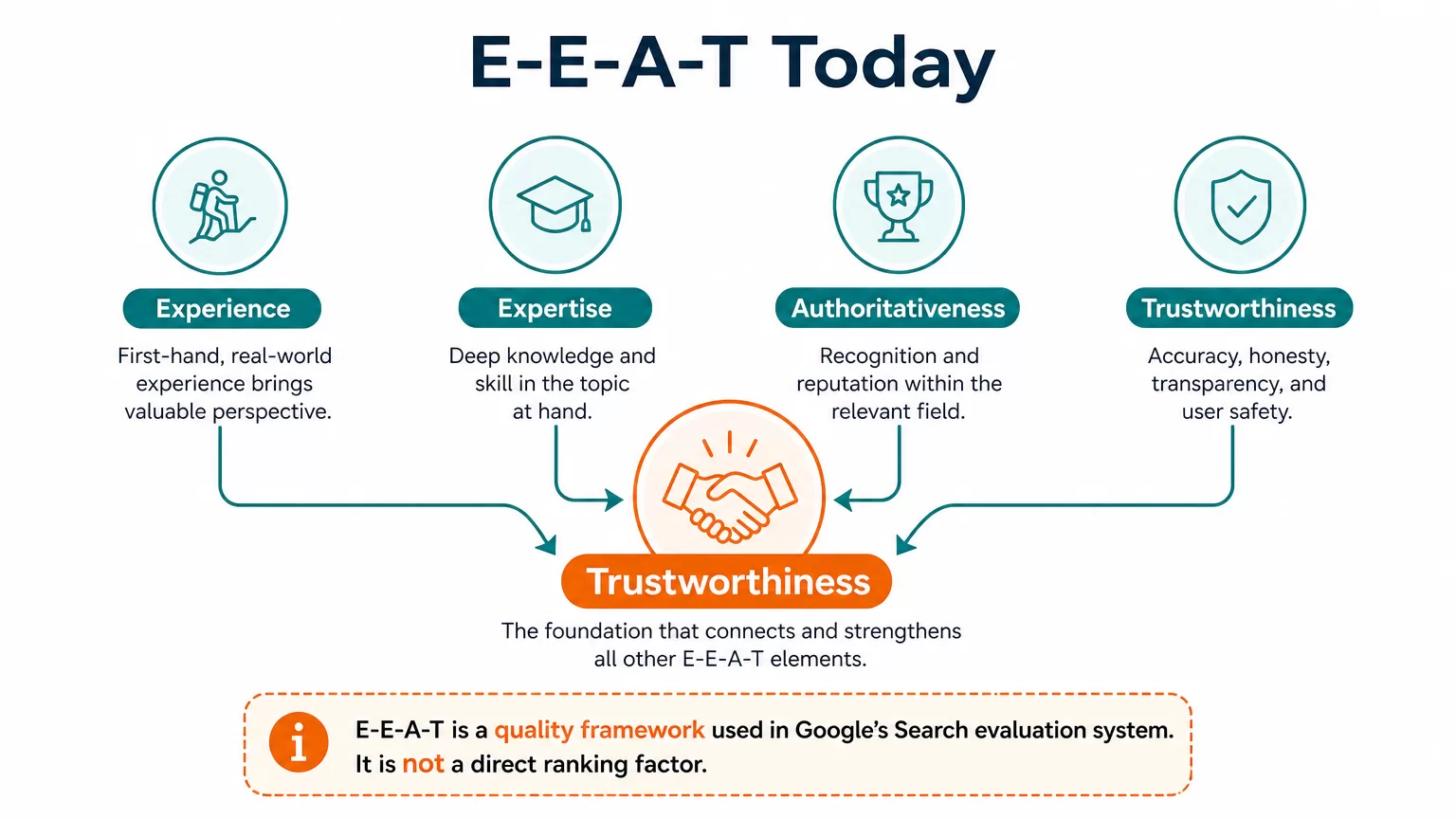
E-E-A-T stands for Experience, Expertise, Authoritativeness, and Trustworthiness. Google’s quality guidelines use these concepts to help human reviewers evaluate whether search results are genuinely helpful. That doesn’t mean E-E-A-T is a mechanical scoring system. It means search quality is judged through a lens of credibility, usefulness, and risk.
The most important shift is the addition of experience. That extra “E” changed the conversation. Content is stronger when it shows first-hand involvement, original testing, or direct observation—not just a summary of what others already said.
In practical SEO terms, E-E-A-T is best understood as a set of evidence signals:
- Experience: Has the creator actually used, tested, or observed the subject?
- Expertise: Does the content show subject-matter knowledge and accuracy?
- Authoritativeness: Is the brand or author recognized as a credible source?
- Trustworthiness: Can users rely on the page, the author, and the site as a whole?
That last item is the one that ties everything together. A page can look polished and still fail if it feels thin, misleading, or disconnected from real-world evidence. For SEO Deep Insights readers, the strategic takeaway is simple: E-E-A-T should be built into your editorial system, not layered on top at the end.
Why trust is the core signal
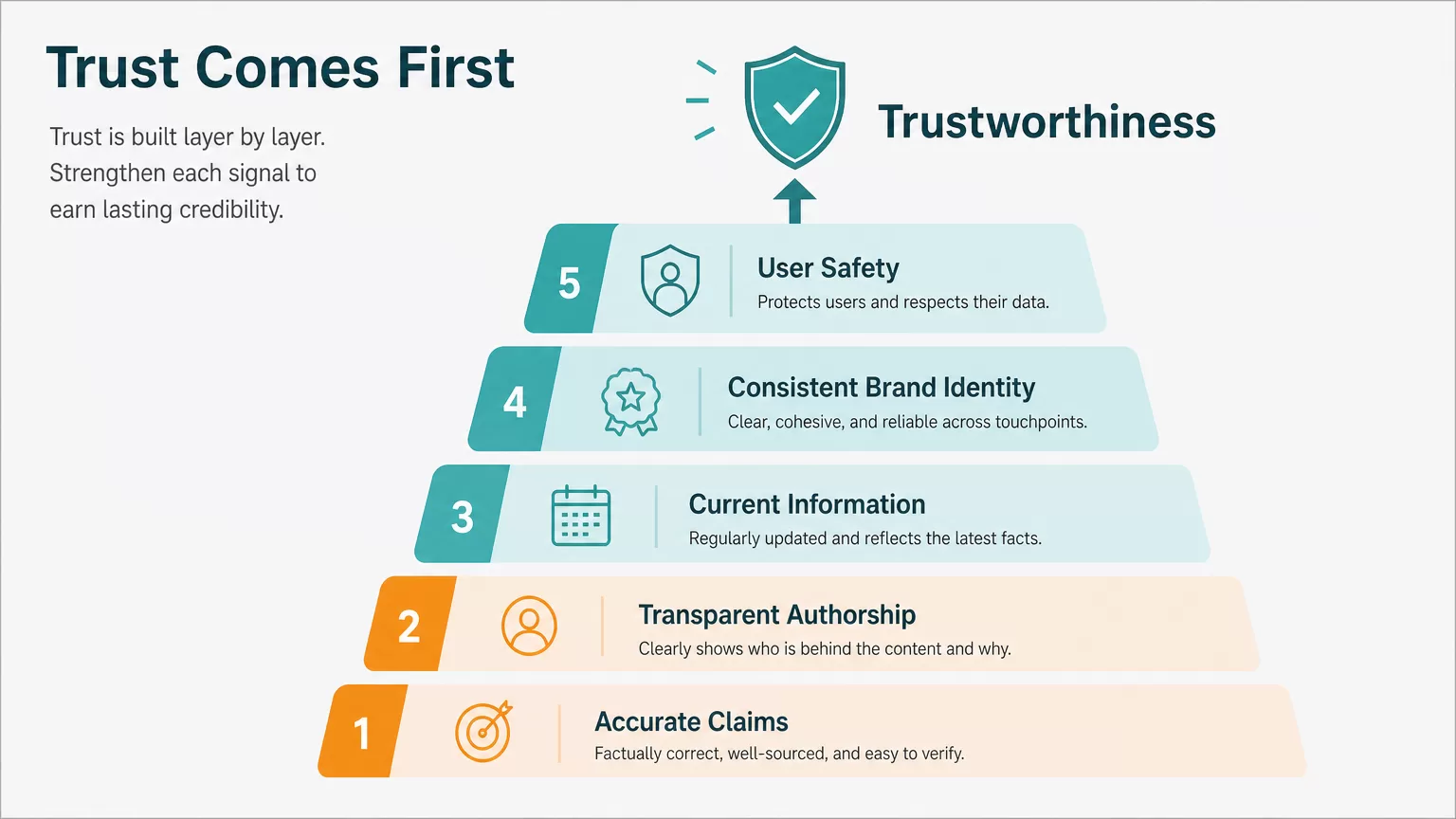
Among all four components, trustworthiness is the foundation. If users do not trust the content, the page does not deserve to influence decisions—especially for topics where bad advice can cause harm.
This is why trust matters so much in SEO, AEO, and AI search visibility. Search systems are designed to reduce risk for users. They favor content that is accurate, transparent, and aligned with intent. If a page overstates claims, hides its authorship, or recycles generic advice, it becomes harder to trust.
Trust is not a decorative signal. It is the editorial proof that your content is safe to surface.
Trust is built through a combination of site-wide and page-level signals:
- Transparent authorship with relevant bios and clear roles
- Accurate sourcing and citations that support claims
- Freshness for topics that change over time
- Consistent brand identity across content, about pages, and policies
- Clear disclosures when content is based on testing, opinions, or commercial relationships
For AI search visibility, this matters even more. Answer engines and generative systems often prefer content that is easy to interpret, internally consistent, and backed by credible signals. In other words, the same trust-building work that improves traditional SEO can also improve your odds of being cited or summarized in AI-generated answers.
If your content strategy includes educational hubs, comparison pages, or guidance content, pairing trust with strong topical coverage is essential. Teams building these systems often benefit from a structured approach like Content Marketing SEO, where content quality, internal linking, and authority-building are planned together rather than treated as separate tasks.
Experience vs expertise
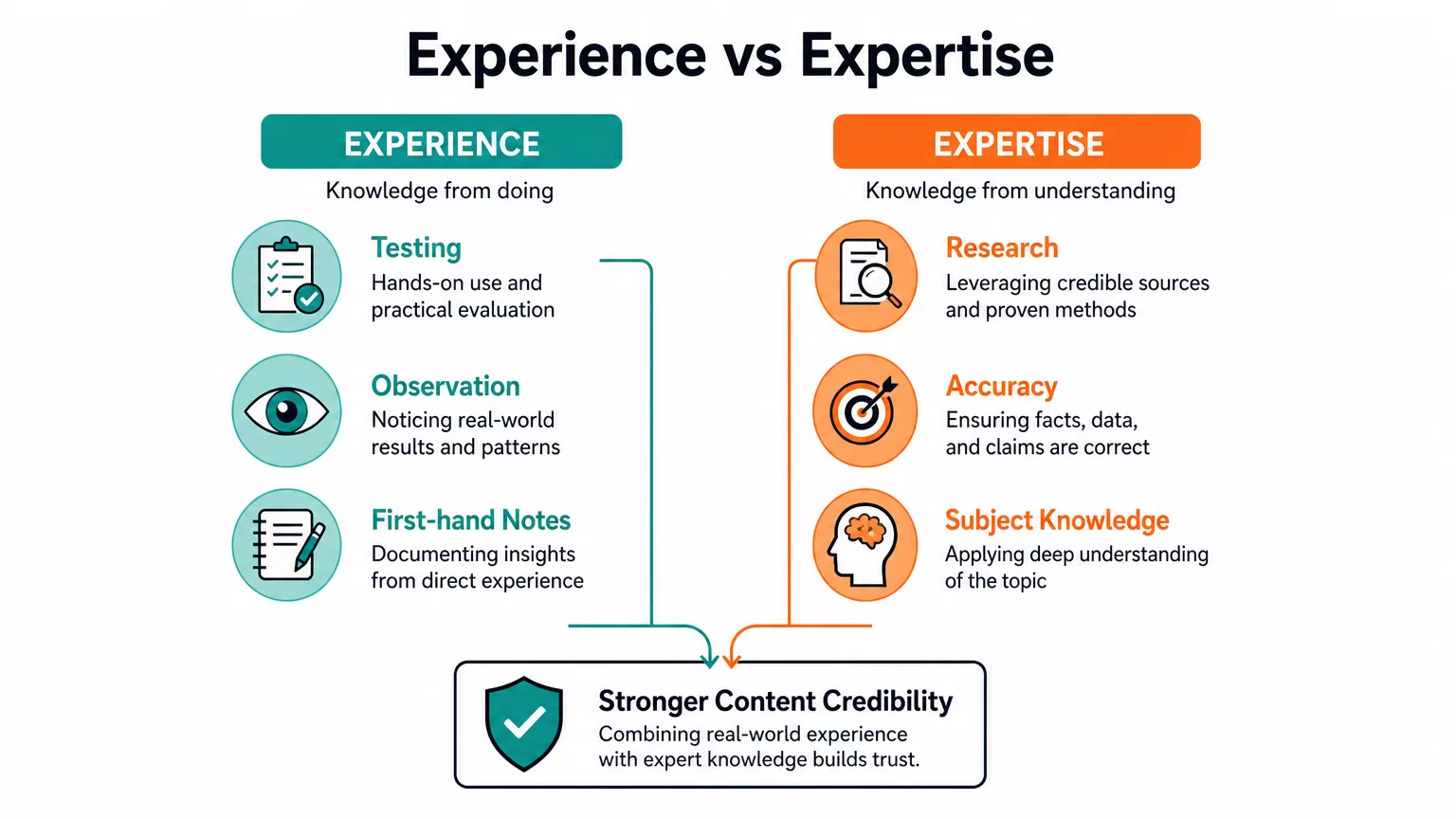
The addition of experience changed how content should be produced. Before, many SEO teams focused almost entirely on proving expertise through credentials, citations, and polished writing. Those still matter. But experience adds a different layer: proof that the creator has actually done the thing.
That distinction is especially important for tutorials, product reviews, comparisons, and how-to content. A generic article can explain a concept. A credible article shows what happened when the process was tested, used, or applied in practice.
How experience shows up in content
- Original screenshots, photos, or visuals from real use
- First-hand observations and implementation notes
- Specific outcomes from testing, audits, or workflow changes
- Tradeoffs, limitations, and mistakes learned along the way
Expertise, on the other hand, is about depth and correctness. It answers the question: Does this content reflect real understanding of the topic? In non-YMYL categories, formal credentials may not be necessary. But the page still needs to demonstrate familiarity, nuance, and accuracy.
The best content usually combines both. Experience makes the article harder to fake. Expertise makes it more complete and reliable. Together, they create a stronger signal than either one alone.
Generic content is easy to publish. Credible content is harder to copy.
This is where topical authority enters the picture. When a site consistently publishes accurate, useful, and experience-backed content within a defined subject area, it becomes easier for search systems and users to recognize it as a trusted source. That recognition supports both organic search performance and broader AI search visibility.
E-E-A-T for YMYL pages
Not all pages are held to the same standard. YMYL—“Your Money or Your Life”—topics face much stricter scrutiny because poor advice can create real-world harm. Health, finance, legal matters, and safety content must meet a much higher bar for accuracy, transparency, and accountability.
For YMYL SEO, E-E-A-T is not optional. It is the editorial baseline.
That means the content process should be more rigorous than it is for general informational pages:
- Qualified authors or reviewers should be involved where the topic demands it
- Claims should be sourced from reliable, current references
- Advice should be precise and avoid vague or overconfident language
- Updates should be scheduled to keep sensitive information current
- Disclaimers and context should be used where appropriate
For example, a finance article should not read like a casual opinion piece if it is advising users on a consequential decision. A health page should not rely on thin summaries or recycled definitions. The higher the risk, the more important it becomes to prove trustworthiness through editorial process, sourcing, and review.
This is also where the difference between theoretical guidance and measurable trust signals becomes obvious. A team can say it values E-E-A-T, but the site only earns trust when the signals are visible in practice: accurate authorship, robust review workflows, page-level citations, and content that remains current.
How to operationalize E-E-A-T
Operationalizing E-E-A-T means turning a broad quality framework into repeatable workflows. The goal is not to “optimize for E-E-A-T” in a superficial sense. The goal is to create a content system that consistently produces trustworthy pages.
Build author credibility into the workflow
- Use bylines that reflect real subject-matter relevance
- Write bios that explain why the author is qualified to cover the topic
- Include reviewer notes when content is checked by an editor or expert
- Link to author pages that show publishing history and focus areas
Use original evidence whenever possible
- Add firsthand testing notes, screenshots, or field observations
- Document what was measured, changed, or verified
- Distinguish clearly between opinion, interpretation, and fact
Strengthen your editorial quality system
- Require fact-checking before publication
- Set review cycles for fast-changing content
- Audit outdated claims and broken references
- Maintain consistency in naming, terminology, and tone
Reinforce authority with internal and external signals
- Build topic clusters around core subject areas
- Link related pages to show depth and coverage
- Earn reputable backlinks that reflect real recognition
- Align content with the questions users actually ask
For teams focused on answer engine optimization, these practices are especially valuable because AI systems tend to favor content that is well-structured, specific, and trustworthy. If you want a deeper tactical framework for that layer, our guide to Answer Engine Optimization (AEO): How to Win Featured Snippets, AI Answers, and Voice Search shows how clarity and credibility work together in answer-driven search.
One practical way to think about this is to treat E-E-A-T like a content operations standard. Every page should answer a few simple questions before it ships:
- Who created this, and why should the audience trust them?
- What first-hand evidence supports the claims?
- Is the information current and complete enough for the topic?
- Would a cautious human reviewer feel comfortable surfacing this page?
Measuring impact
E-E-A-T itself is not something you can track with a single metric. But you can measure the signals that usually improve when trust improves. That is how SEO teams move from theory to evidence.
Useful measurement layers include:
- Search Console performance: impressions, clicks, and query coverage for topic clusters
- Rank tracking: movement for pages that were updated with stronger sourcing or author context
- Engagement metrics: time on page, scroll depth, and return visits
- Content freshness audits: how often key pages are reviewed and updated
- Backlink quality: whether authoritative sites are referencing your work
For YMYL or high-stakes content, also watch for signs of trust friction: high bounce rates on critical pages, low conversion confidence, or inconsistent performance after updates. Those patterns can indicate that the page is not answering the user’s real concern with enough clarity or authority.
Measure the outcomes of trust-building work, not just the presence of trust-related elements.
That distinction is important. An author bio alone does not prove expertise. A citation list alone does not prove trustworthiness. A refreshed page alone does not prove authority. What matters is whether the full system produces better quality signals over time: stronger rankings, better query alignment, more citations, and more confidence from users and machines alike.
In modern search, E-E-A-T is no longer a philosophical concept tucked inside quality guidelines. It is a practical operating model for brands that want lasting visibility. Sites that invest in first-hand experience, real expertise, editorial discipline, and transparent trust signals are better positioned to earn attention across SEO, AEO, and AI search.
That is the real shift: not from keywords to quality, but from content production to credibility engineering.