Google Local Finder appears to be undergoing a notable interface change: the familiar pagination bar may be gone, replaced by an infinite scroll experience. On the surface, that sounds like a simple usability tweak. In practice, it could reshape how users browse local businesses, how often they keep exploring, and how SEOs interpret visibility beyond the first set of results.
That matters because Local Finder is not just a visual extension of the map pack. It is where users often go when they want to compare businesses, check profiles, and move deeper into local results. When the navigation model changes, the measurement model often needs to change with it.
Key takeaway: even if rankings do not change, a Local Finder interface shift can change how far users browse, which listings get seen, and how local visibility should be audited.
What changed in Local Finder?
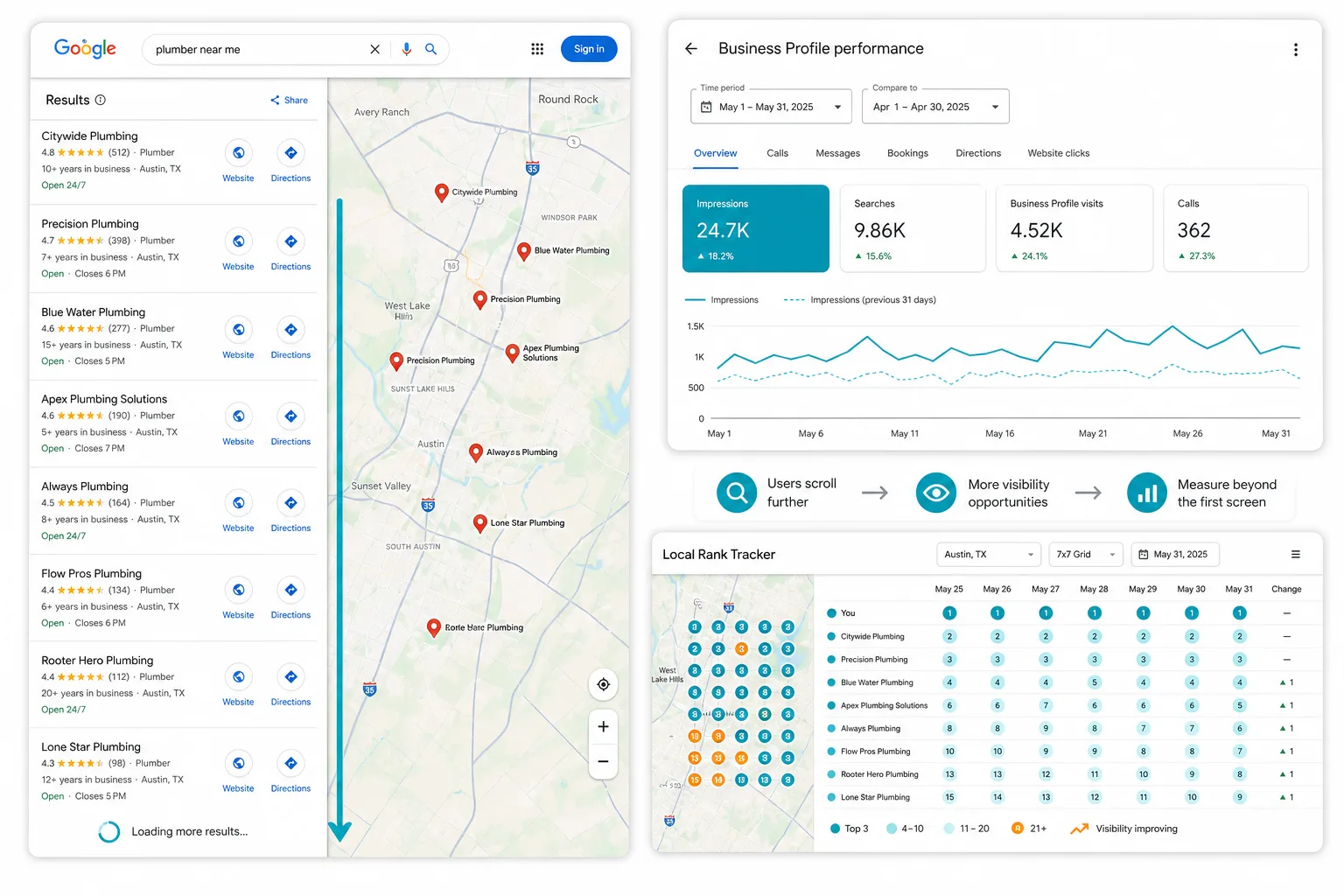
Reports from real-world local searches suggest that Google Local Finder has dropped its traditional page controls and now behaves more like a continuous feed. Instead of clicking through discrete pages, users can keep scrolling to load more business profiles. The change was observed in a practical local query environment, not just in a lab-style test, which makes it especially relevant for working SEOs.
This is a meaningful departure from the old structure. Pagination created a clear endpoint and a visible sense of depth: page 1, page 2, page 3, and so on. Infinite scroll removes that hard boundary. Users may now explore more listings with less friction, but they lose the sense of where they are in the result set.
- Before: users clicked between pages to see more local businesses.
- Now: users may scroll continuously without a visible page break.
- Result: the browsing experience feels smoother, but less transparent.
For local search practitioners, that transparency gap matters. If there is no obvious “page 2,” it becomes harder to reason about how many businesses are actually being surfaced and where a listing sits relative to competitors.
Why this matters for local SEO
This is not just a UX note. It has direct consequences for local SEO, especially when teams are trying to understand visibility in expanded local results. A business may still rank in the local pack, but the way users encounter it after expanding into Local Finder could be very different.
Infinite scroll can reduce friction and encourage deeper browsing. That could increase the odds that users compare more businesses before clicking. But it may also make visibility less predictable, since the old “page-based” mental model no longer applies cleanly.
Important: if users scroll deeper before deciding, then “being present” in Local Finder may matter more than ever, even when the map pack itself looks unchanged.
There is also a measurement challenge. Many local SEO workflows still assume a page structure that can be counted, logged, and compared. When that structure disappears, teams need to rethink how they assess:
- Expanded local result exposure
- Profile discovery depth
- Relative placement beyond the first visible set
- Potential changes in click behavior
This also connects to broader search volatility. Local interfaces can shift without a formal announcement, and those shifts can alter user behavior even when rankings appear stable. For teams already watching Google Ranking Volatility Keeps SEOs on Edge, Local Finder is another reminder that volatility is not always algorithmic. Sometimes it is structural.
Possible bug vs feature
At this stage, the safest interpretation is uncertainty. The change may be an intentional product update, or it may be a temporary bug. That distinction matters because SEOs should not overreact to a single observed shift, but they also should not dismiss it if the pattern repeats across multiple searches, devices, and locations.
There is precedent for this kind of instability. A similar Local Finder issue was reportedly seen previously, which raises the possibility that Google is either testing the interface or dealing with recurring behavior in the local results experience. Community discussion has also played a major role in surfacing the change, which is typical in search marketing: practitioners often notice interface drift before documentation catches up.
From an operational standpoint, the right response is not speculation. It is verification.
- Check multiple local queries across different categories.
- Compare desktop and mobile behavior.
- Test from different locations when possible.
- Watch whether the change persists over time or reverts.
If the interface is stable, it may signal a broader product direction. If it is inconsistent, it may be a bug that temporarily changes how users browse local results. Either way, the impact on local search workflows is real.
Workflow implications for SEOs
Local SEO teams should assume that the old page-based model may no longer be enough for reporting and analysis. If Local Finder now behaves like an infinite scroll surface, then local visibility audits need to become more session-aware and less dependent on page numbers.
That means adjusting workflows in a few practical ways:
- Document interface behavior during audits, not just ranking positions.
- Track expanded-result exposure alongside map pack visibility.
- Review Google Business Profile performance in context, not in isolation.
- Compare result depth across searches, devices, and geographies.
- Note user journey changes when the page break disappears.
This is where local search UX and measurement intersect. If users can keep scrolling, they may browse more businesses before making a decision. That could influence how often a profile gets seen, how many competitors are compared, and where users ultimately click.
It also reinforces a larger strategic point: local search visibility is not only about the initial pack. If your business appears after the first visible set in Local Finder, the interface design now affects whether that exposure is easy or difficult to reach.
How to monitor local results now
To adapt, teams should monitor local results with a more flexible framework. Search Console, analytics, rank tracking, and manual SERP checks all still matter, but they need to be interpreted with the Local Finder experience in mind.
Practical rule: do not treat “page 1 only” as the full local visibility story if the interface no longer shows a clear page structure.
A stronger workflow would include:
- Regular manual checks for key local queries
- Screenshot documentation of interface changes over time
- GBP performance review for impressions, clicks, and actions
- Rank tracking snapshots that note whether the local finder expands via scroll
- Trend analysis across weeks, not just single-day observations
For teams building around Zero-Click Google Searches in 2026: What SEO Must Change, this is another reminder that interface design can shape behavior just as much as ranking systems do. In local search, the path to a click is often defined by how Google presents the results, not only by where a listing ranks.
Bottom line: if Local Finder has moved to infinite scroll, local SEO practitioners should treat it as a meaningful workflow shift until proven otherwise. The change may seem small, but it can affect how users explore businesses, how visibility is perceived, and how teams measure success in local search.