The June 2026 Google spam update is rolling out globally, across all languages, and it’s already prompting the same question teams ask after every major search event: Is this a temporary wobble, or a real signal?
In this case, the answer depends on how you read the update. This is a spam update, not a broad core update. That distinction matters because spam updates are designed to improve Google’s automated systems for detecting manipulative behavior, while core updates revisit broader ranking systems and content evaluation signals.
Bottom line: if rankings or traffic shift in the coming days, don’t rush to rewrite your strategy. First, determine whether you’re seeing rollout noise, spam-policy enforcement, or a separate issue entirely.
Below, we’ll break down what changed, how spam updates differ from core updates, what Google’s SpamBrain guidance implies for recovery, and how to monitor the right signals in Search Console without overreacting to short-term volatility.
What happened in the June 2026 spam update
For hands-on help with this topic, explore Keyword Research & Analysis.
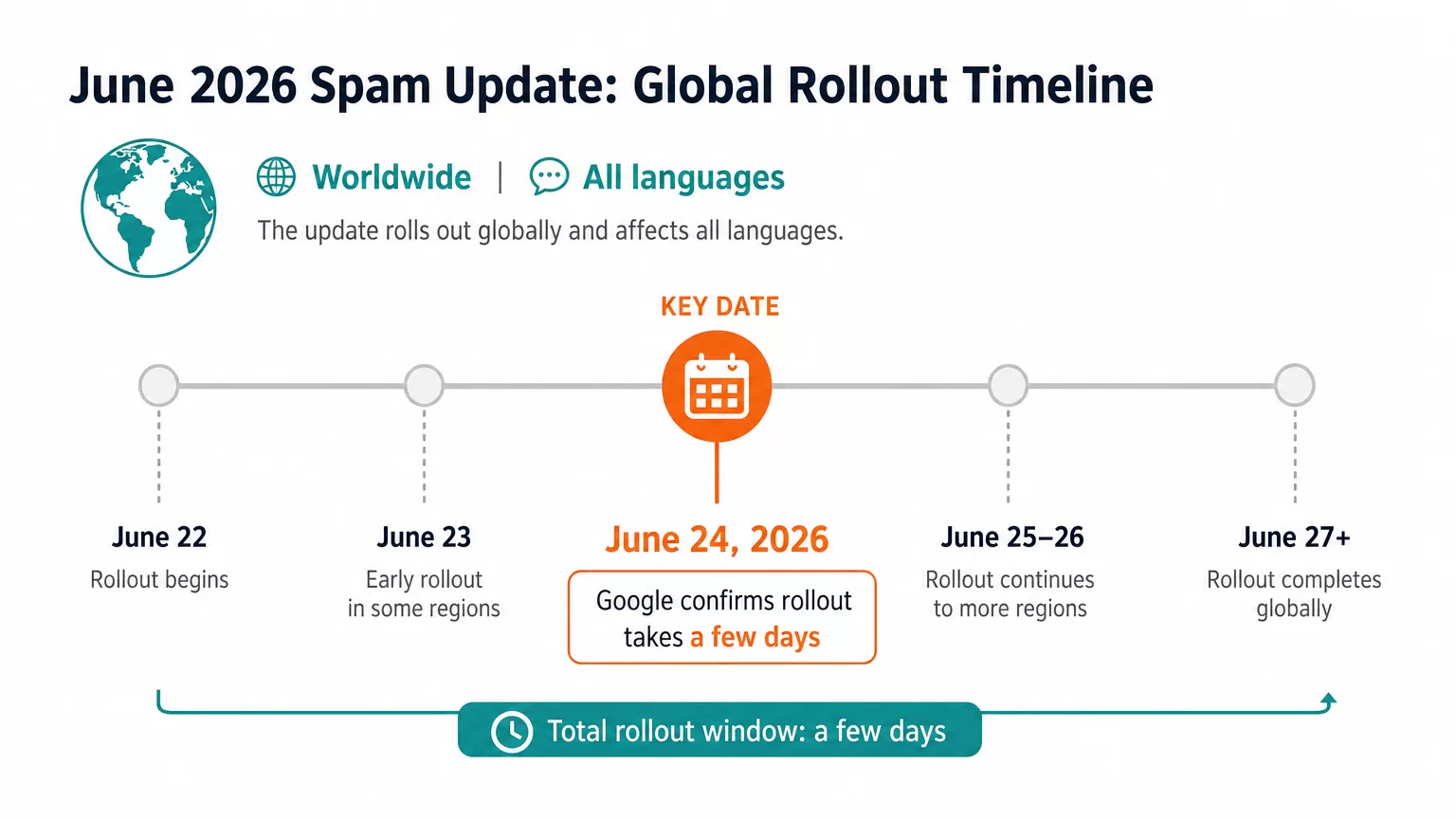
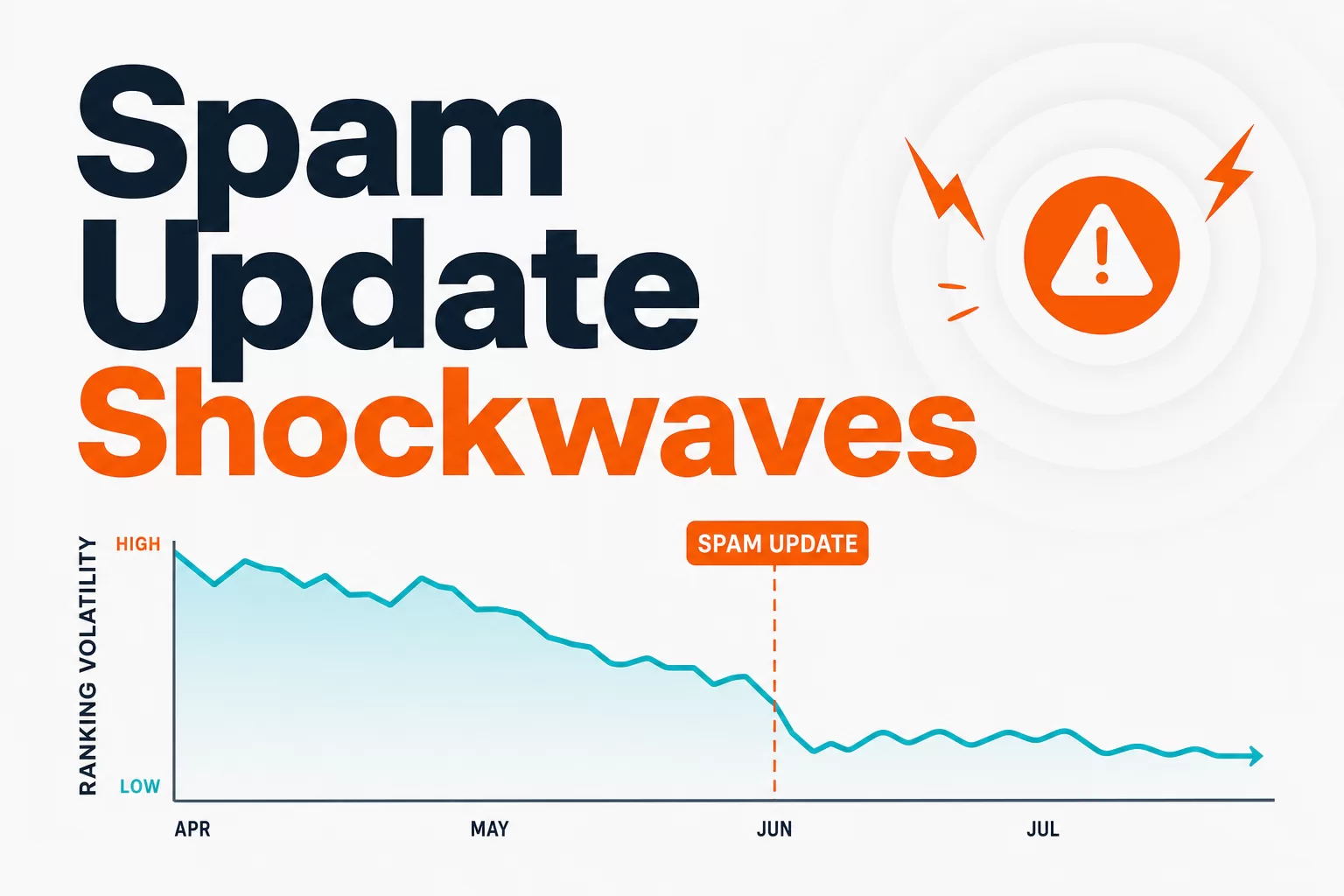
Google confirmed a June 2026 spam update that began rolling out on June 24 and may take a few days to fully complete. The update is global, language-agnostic, and applies to the entire indexed web, which means no market is automatically insulated from impact.
This is also the second spam update of 2026, a useful signal that spam enforcement remains a recurring operational priority rather than a one-time cleanup. In practical terms, Google is continuing to refine how its systems identify spam patterns, low-quality manipulation, and policy-violating behavior.
Just as important: no new spam policies were announced with the rollout. That suggests this is primarily a systems improvement update, not a policy rewrite. Existing spam policies remain the standard for evaluating risk.
Interpretation tip: if a site was already skating close to spam policy boundaries, this kind of update can expose those weaknesses quickly. If a site is compliant, the effect may be minimal or invisible.
Why spam updates are different from core updates
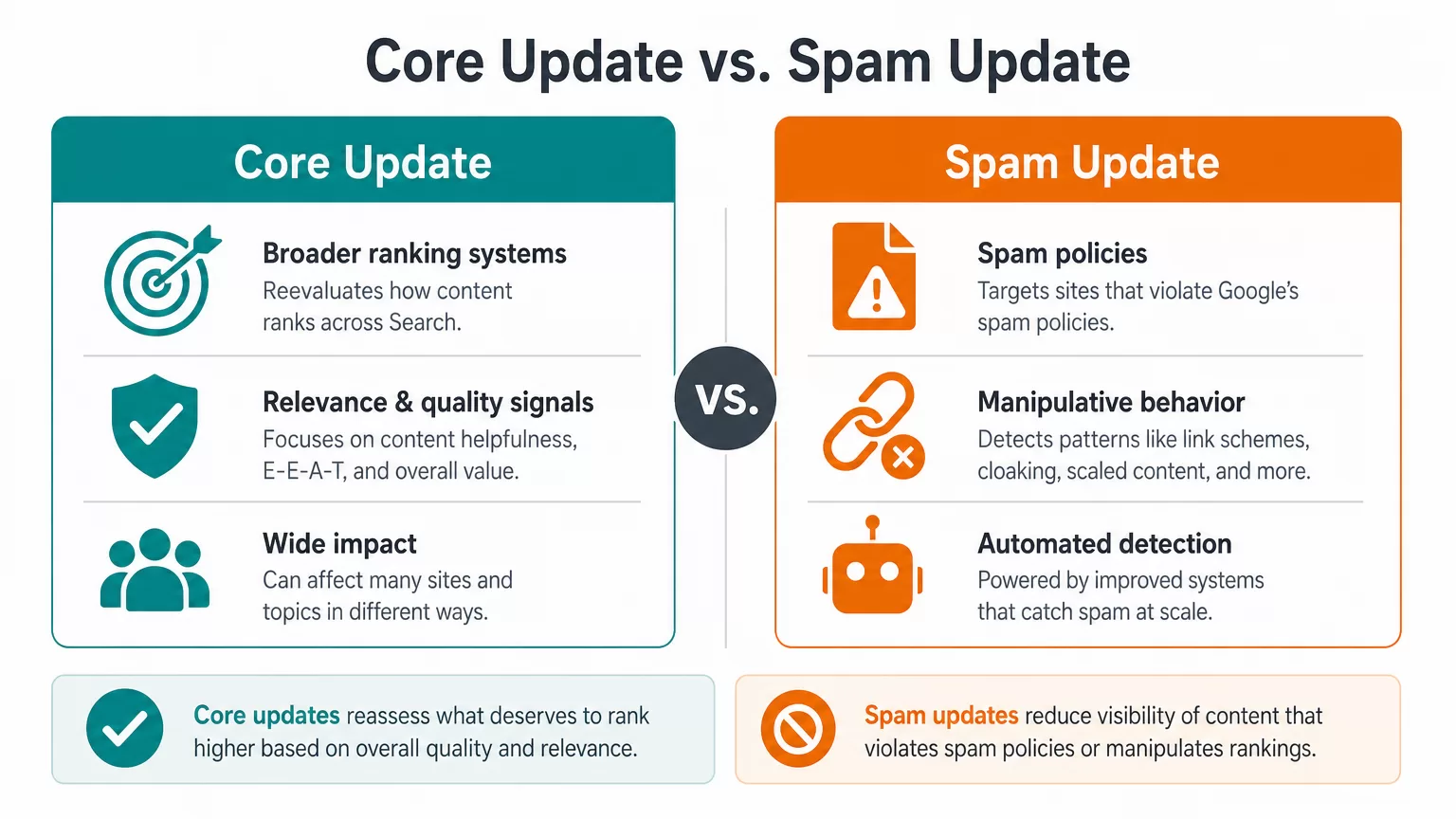
It’s easy to lump every Google update into one bucket, but that creates bad diagnoses. A core update usually reflects broader changes to ranking systems, relevance evaluation, and how Google interprets content quality or intent match. A spam update, by contrast, is narrower: it targets behaviors that violate spam policies or attempt to game search visibility.
That difference changes how you investigate performance drops. After a core update, you may need to assess content depth, topical authority, page intent, and competitive SERP shifts. After a spam update, the first question should be much more direct:
- Are there link schemes or manipulative link patterns?
- Is the site publishing scaled or low-value pages?
- Are there doorway-style templates, thin affiliate patterns, or other policy risks?
- Has the site relied on tactics that could trigger automated spam detection?
In other words, core updates often ask whether a page deserves to rank better. Spam updates ask whether the page should rank at all. That’s a very different kind of pressure.
For teams that want to separate movement caused by ranking systems from movement caused by policy enforcement, it helps to measure more than position changes alone. Our guide on Measure Search Performance Beyond Rankings can help frame that analysis with a stronger reporting model.
What Google’s documentation says about SpamBrain and recovery
Google’s spam update guidance repeatedly points back to SpamBrain, its AI-based spam-prevention system. The important takeaway is not just that Google has a spam filter; it’s that the filter is continuously improving. These updates are meant to sharpen detection of evolving spam patterns, not simply apply a static rule set.
That has two implications for site owners:
- Detection gets better over time. Tactics that slipped through before may be discounted later.
- Recovery is not instant. If a site changes to comply with spam policies, Google says reassessment may take months.
This is where many recovery expectations go wrong. Cleanup is necessary, but cleanup does not guarantee a fast rebound. The system may need time to re-evaluate trust signals, and some forms of lost benefit may not come back quickly.
Especially for link spam: if Google discounts spammy links, the ranking benefit they once created is removed. Cleaning up the links does not restore that benefit on demand.
That’s a critical mindset shift for SEO recovery. For sites dealing with technical issues, policy exposure, or link-related suppression, a structured audit is usually the right first step. If that’s your situation, Technical SEO Services can support the diagnostic work needed before any recovery plan is finalized.
How to diagnose ranking and traffic changes
When volatility starts, the worst move is to treat every dip as proof of damage. The June 2026 spam update may explain movement, but it’s still important to separate update-related fluctuation from seasonality, tracking noise, and unrelated technical problems.
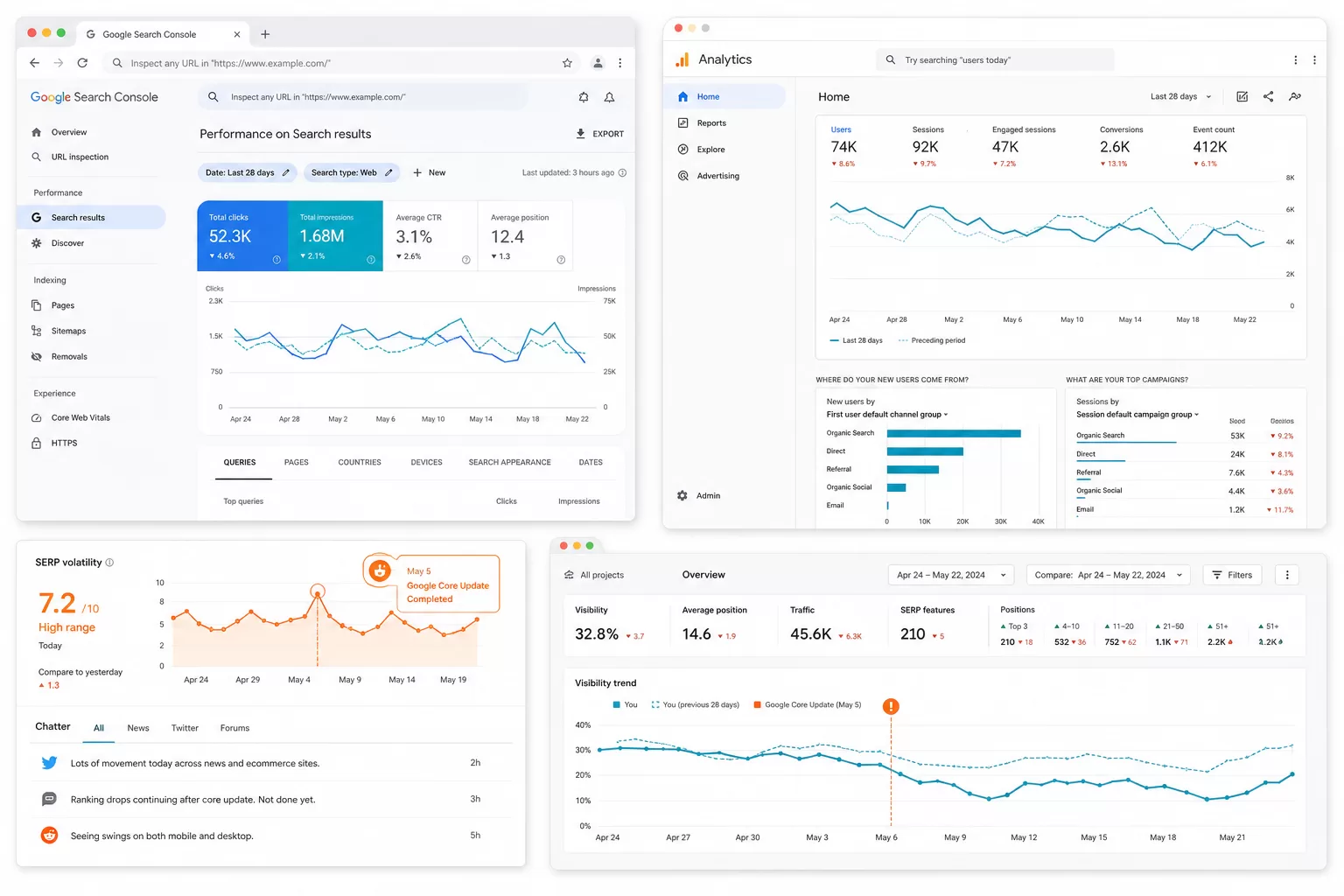
Here’s what to monitor first in Search Console and adjacent reporting:
- Performance by page to identify which URLs lost clicks or impressions.
- Queries to see whether the drop is broad or limited to specific intent clusters.
- Country and device segments to spot patterns that may reveal localized issues.
- Indexing and crawl status to rule out technical visibility problems.
- Manual actions and security issues to make sure you’re not missing a separate enforcement problem.
Just as important, annotate your reporting around June 24. That date should mark the start of a new analysis window so later movement isn’t misattributed to the wrong event. Because rollout may take a few days, it’s normal for different reporting tools to show instability at different times.
Short-term ranking volatility can be noisy. A page may bounce for a day or two, then settle. That doesn’t mean the update is over, and it doesn’t mean the site has fully absorbed the impact. It means the release is still unfolding.
Practical rule: avoid major content or link changes based on a single day of data. Wait for enough signal to distinguish a rollout effect from a structural issue.
What site owners should do next
The right response to a spam update is disciplined, not dramatic. If your site appears stable, keep monitoring. If you see meaningful losses, investigate policy exposure before changing strategy.
Start with this sequence:
- Map the timing of traffic and ranking changes against the June 24 rollout window.
- Review affected pages for spam-policy risk signals, especially thin content and manipulative linking.
- Compare winners and losers to see whether the issue is sitewide or clustered in a specific section.
- Check technical health so you don’t mistake crawl or indexing issues for spam enforcement.
- Document everything before making changes, so you can evaluate whether recovery actually follows.
If your site has a history of aggressive link acquisition, scaled content production, or other borderline tactics, recovery may be slower than expected. If you’ve already cleaned things up, be patient. Google’s own guidance suggests that reassessment can take months.
For teams building a broader recovery roadmap, it helps to pair rank tracking with business-level metrics such as conversions, landing-page engagement, and branded demand. That’s the kind of measurement discipline that keeps update analysis grounded in reality rather than panic.
Final takeaway: the June 2026 spam update is less about new rules and more about stronger enforcement. If your site follows policy, the best response may be careful observation. If it doesn’t, the fix is compliance first, then patience.
In SEO, not every fluctuation is a crisis. But every meaningful fluctuation deserves a methodical diagnosis. That’s especially true when Google is tightening spam detection through systems like SpamBrain and giving site owners a clear reminder: recovery is possible, but it is rarely immediate.