Google is getting better at understanding meaning, not just matching strings of text. That shift is why a page can earn impressions for queries it never explicitly targeted — and why modern SEO now depends on topic coverage, not keyword repetition.
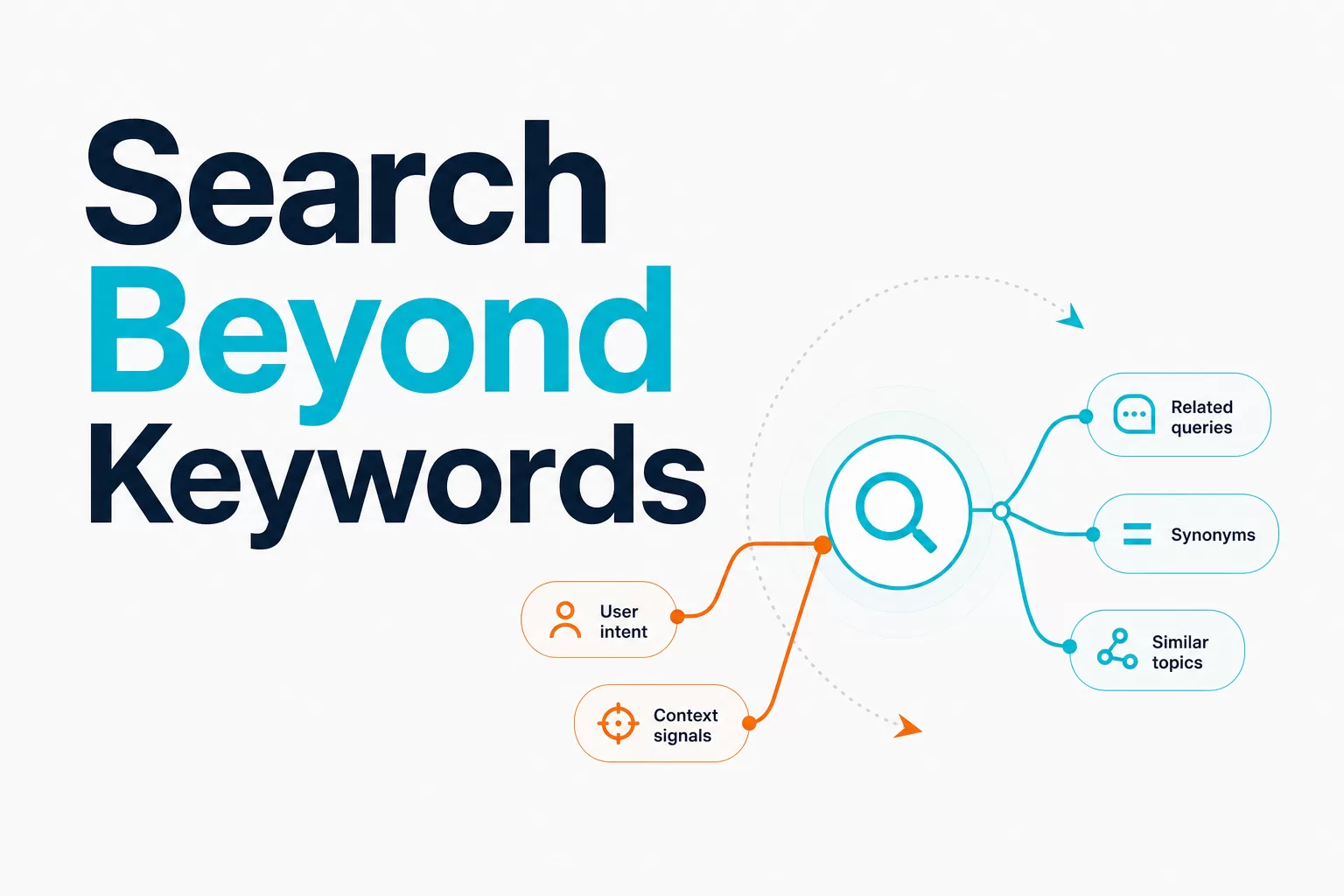
In practice, this is where Google query expansion matters. It helps search engines broaden a searcher’s original wording using synonyms, related concepts, and intent signals so results are more useful. For marketers, that means one well-built page can surface across a wider set of searches than its exact-match keyword would suggest.
That visibility opportunity is even more important in the era of AI Overviews. The same semantic relationships that help Google expand a query can also influence whether your content is considered relevant enough to be cited, summarized, or surfaced in AI-assisted results. The win is not stuffing more keywords into a page. The win is building a page that fully covers the topic ecosystem around the searcher’s intent.
Key takeaway: If your content only targets one phrase, you are likely leaving impressions on the table. If it covers the topic thoroughly, Google can connect it to more queries naturally.
What query expansion is and why it matters
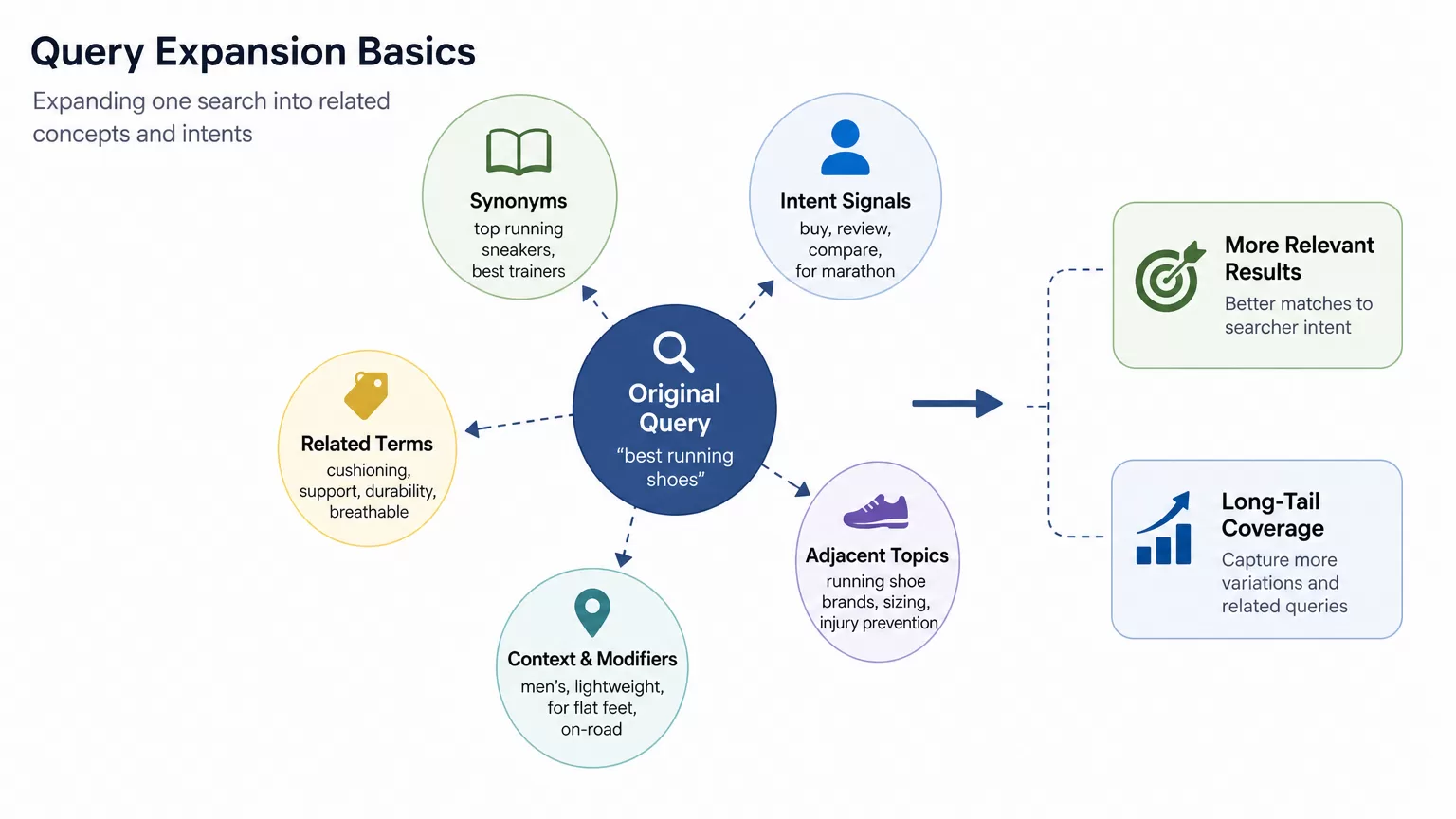
Query expansion is Google’s way of interpreting a search beyond the exact words typed into the box. The system can broaden a query using synonyms, related entities, intent clues, and contextual associations. That helps Google avoid narrow matches and reduces the chance of returning weak or zero-results experiences for long-tail searches.
For example, a page about backyard chicken care might rank for a query about the average lifespan of a chicken even if it never uses the word “lifespan.” Why? Because the page likely contains semantically related information about age, health, breed, and care conditions. Google can connect those concepts even when the wording differs.
This matters because it changes how we measure organic visibility. A page may be driving impressions from queries that never appeared in the original keyword plan. If you only track exact-match terms, you miss the broader demand your content is actually capturing.
- Visibility is now semantic. Search engines reward pages that answer the underlying question, not just the literal phrase.
- Long-tail searches benefit most. The more specific the query, the more likely Google is to broaden it using context.
- Topical completeness wins. Pages that cover adjacent subtopics are easier for Google to connect to related searches.
If your team is building a broader semantic strategy, this is also where Answer Engine Optimization (AEO) becomes relevant. Query expansion and answer retrieval both depend on clear, structured, intent-aligned content.
Query expansion vs query fan-outs
It is easy to lump query expansion and AI-era retrieval into one bucket, but they happen at different stages of the search process.
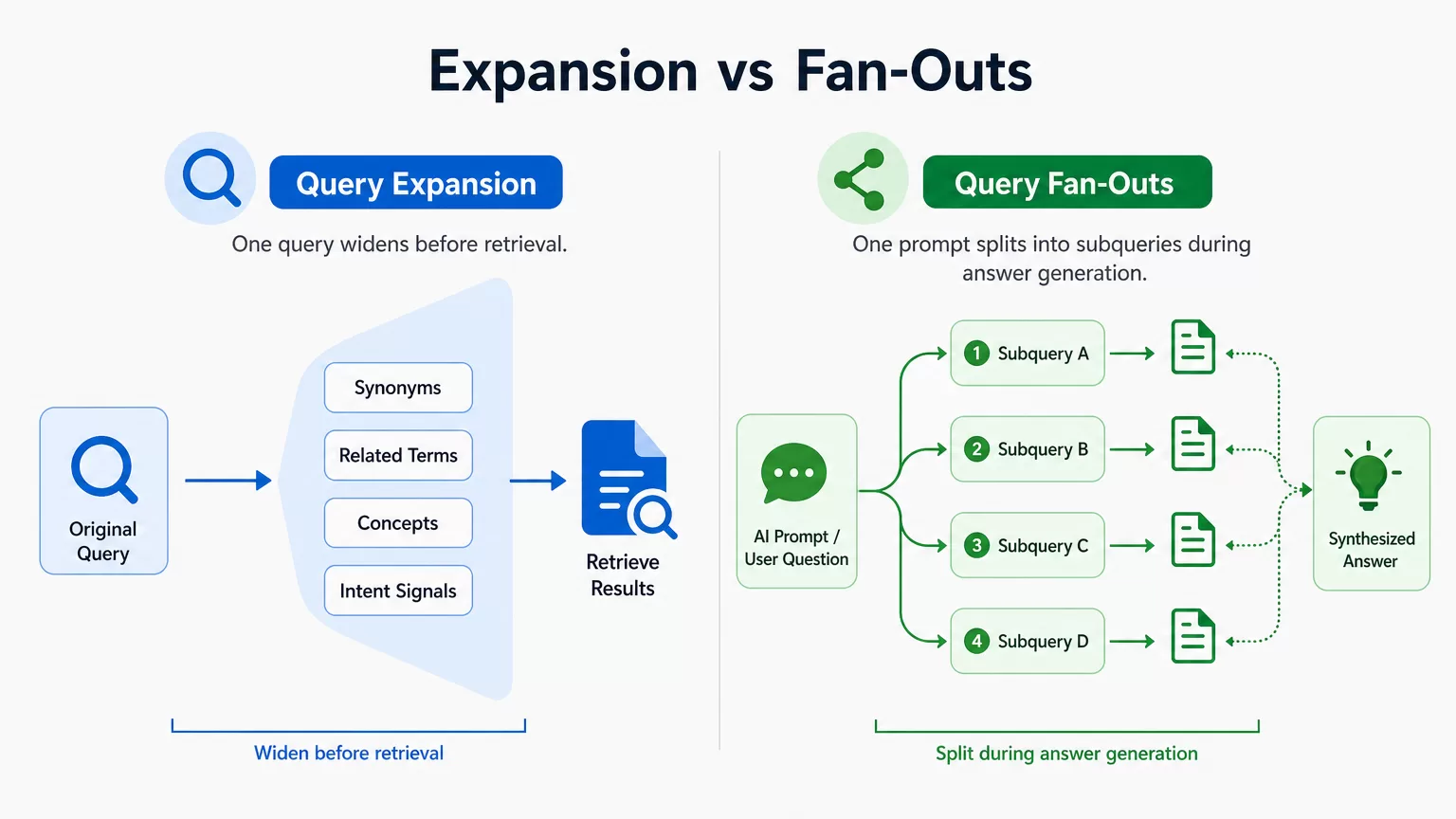
Query expansion happens before results are generated. Google interprets the original query, broadens it semantically, and then retrieves documents that appear relevant to the expanded interpretation.
Query fan-outs happen during AI response generation. A system may split one prompt into multiple subqueries, search for supporting information, and then synthesize an answer from those results. In other words, expansion broadens the search intent; fan-outs break the prompt into smaller retrieval tasks.
Think of it this way: query expansion helps Google understand what the user means, while fan-outs help an AI system gather the evidence it needs to answer.
Both processes rely on semantic relationships, which is why the same content strategy supports both traditional rankings and AI Overviews. If your page is built around a narrow keyword string, it may underperform in both environments. If it is built around a topic with strong supporting detail, it has a better chance of being selected, cited, or summarized.
This is also where Generative Engine Optimization (GEO) fits naturally. Content that is easy for systems to retrieve, interpret, and trust is more likely to participate in AI-generated answers.
Why this distinction matters for marketers
- Traditional SEO: optimize for the query Google expands.
- AI visibility: optimize for the subtopics AI systems fan out to verify.
- Content planning: build one page that can support multiple related intents without becoming bloated or repetitive.
How to find expansion opportunities in GSC
Google Search Console is the best place to see query expansion in action. The goal is to identify pages that are already surfacing for unexpected or broader queries, then decide whether those queries deserve a dedicated section, a supporting article, or a content refresh.
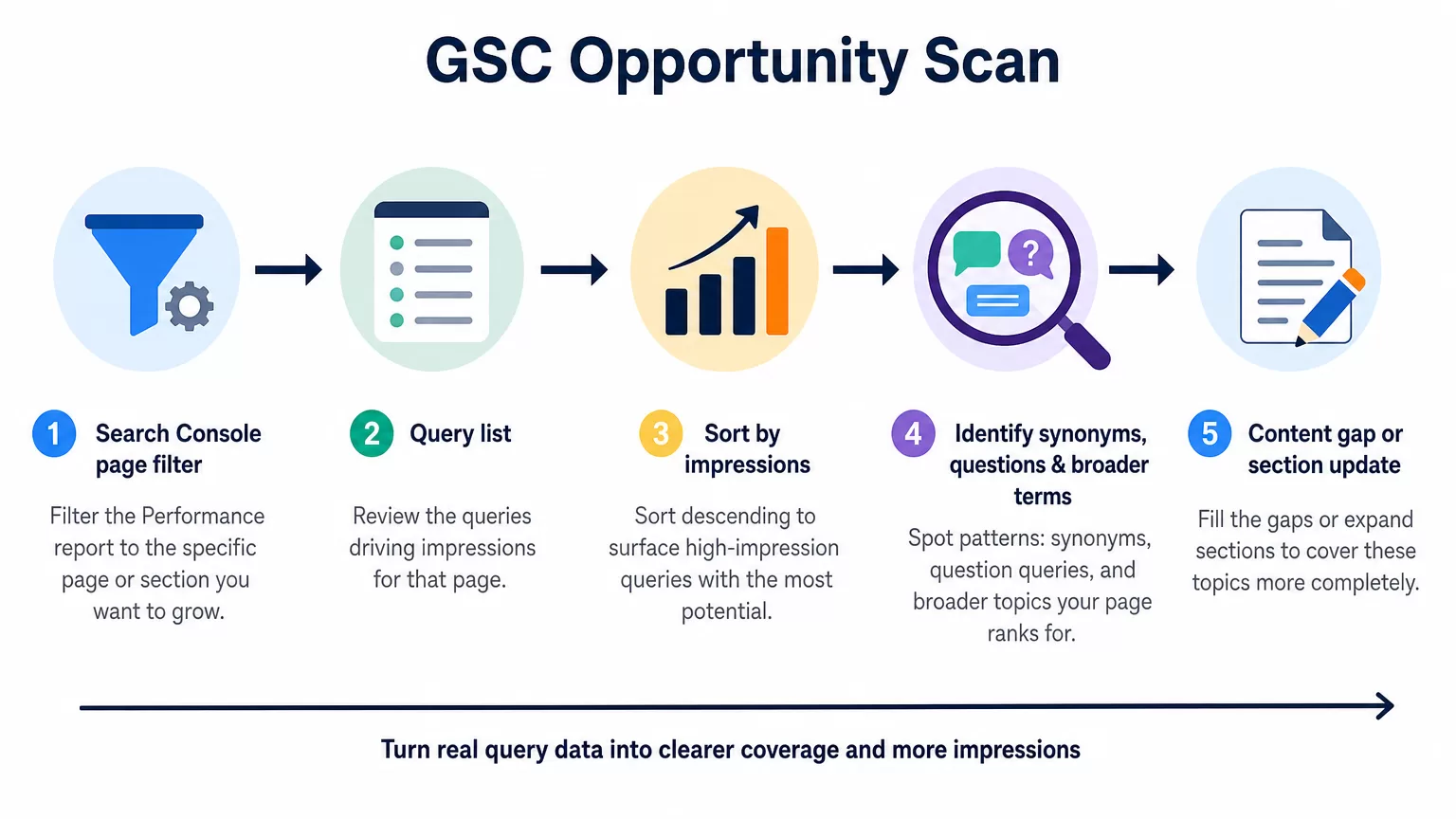
Use this workflow:
- Open Performance > Search results.
- Filter by a specific page.
- Review the full query list for that URL.
- Sort by impressions to surface the terms Google is showing most often.
- Look for synonyms, question-based searches, broader concepts, and adjacent informational needs.
What you are looking for is not just volume. You are looking for semantic drift — the places where Google is associating your page with a slightly different, but related, user intent. Those are often the strongest expansion opportunities.
For example, if a product education page about “project management software” starts appearing for “how to track team workload,” that may signal a useful content gap. The page is already relevant enough to earn impressions, but it may need a clearer section on workload planning to strengthen that association.
Important caution: not every surfaced query is a win. If a page is attracting unrelated terms, the issue may be a mismatch between the content promise and what users actually see on-page.
That is why Search Console should be paired with SERP review and, when needed, broader keyword research. Tools like Keyword Research & Analysis can help you validate whether an expanded query deserves a content update or a separate asset.
What to prioritize first
- High-impression queries that are close to your page’s core topic.
- Question-form queries that suggest informational intent.
- Broader terms that indicate Google sees your content as part of a larger topic cluster.
- Synonym variants that confirm semantic relevance without exact-match wording.
How to build content for broader semantic coverage
Once you know which queries are expanding, the next step is to build content that deserves that visibility. The answer is not keyword stuffing. The answer is topic coverage.
That means identifying the adjacent questions, subtopics, and supporting details that searchers expect to see around the main topic. If a page is already ranking for an expanded query, adding a dedicated section can strengthen relevance, increase impressions, and improve the page’s chances of appearing in AI Overviews.
Think in layers:
- Primary intent: the core topic the page is meant to address.
- Secondary questions: related questions people ask before or after the main query.
- Supporting concepts: definitions, comparisons, examples, and edge cases.
- Entity relationships: the people, tools, processes, or attributes connected to the topic.
This is where content gap analysis becomes practical. Review the SERP, look at related questions, and compare your page against the topics competitors cover that you do not. If the missing information is clearly relevant, add it to the page or build a supporting asset that links back to the main URL.
A strong semantic page usually includes:
- Clear definitions of the main concept and related terms.
- Direct answers to likely follow-up questions.
- Examples that show how the concept works in practice.
- Internal links to deeper resources that reinforce topical authority.
The goal is to make the page useful enough that Google can confidently connect it to a wider set of searches. When that happens, you are not chasing every keyword variation manually. You are building a page that naturally earns those variations through relevance.
Best practice: expand the page when the new query fits the same intent. Create a separate page only when the intent truly changes.
Common mistakes and how to avoid them
Query expansion can create a false sense of opportunity. Just because a page appears for more queries does not mean every query should be pursued in the same way.
1. Treating expansion like a license to stuff keywords
Adding repeated phrases will not improve semantic relevance if the page does not genuinely answer the searcher’s question. Google is looking for meaning, not mechanical repetition.
2. Ignoring unrelated impressions
If Search Console shows a page surfacing for terms that do not match the page’s purpose, audit the content and the SERP. The issue may be a mismatch in intent, not a missed optimization opportunity.
3. Creating thin pages for every variation
Not every expanded query needs its own URL. In many cases, a better approach is to strengthen the existing page with a new section that covers the related subtopic more completely.
4. Focusing only on exact-match keywords
Exact-match tracking still has value, but it should be paired with query analysis at the page level. Otherwise, you miss the broader search demand your content is already capturing.
5. Forgetting AI visibility
Pages built only for classic blue-link rankings may struggle in AI-assisted search experiences. Semantic depth, concise answers, and clear structure improve your odds of being used in AI Overviews and other generative surfaces.
The modern SEO workflow is straightforward: analyze Search Console, identify query expansion patterns, map content gaps, and strengthen the page where the intent aligns. That is how you win more impressions without chasing keywords for their own sake.
Bottom line: query expansion rewards pages that cover a topic thoroughly. If your content answers the real question behind the query, Google can do the rest.