Security headers are no longer just a developer concern. In a modern technical SEO audit, they belong on the same checklist as indexation, canonicals, and crawlability.
That may sound like a stretch if you only think about SEO in terms of keywords and links. But search visibility is also a function of site integrity. When a site is compromised, framed by third parties, injected with malicious code, or made untrustworthy in the browser, rankings can suffer indirectly through broken UX, reduced trust, and operational damage.
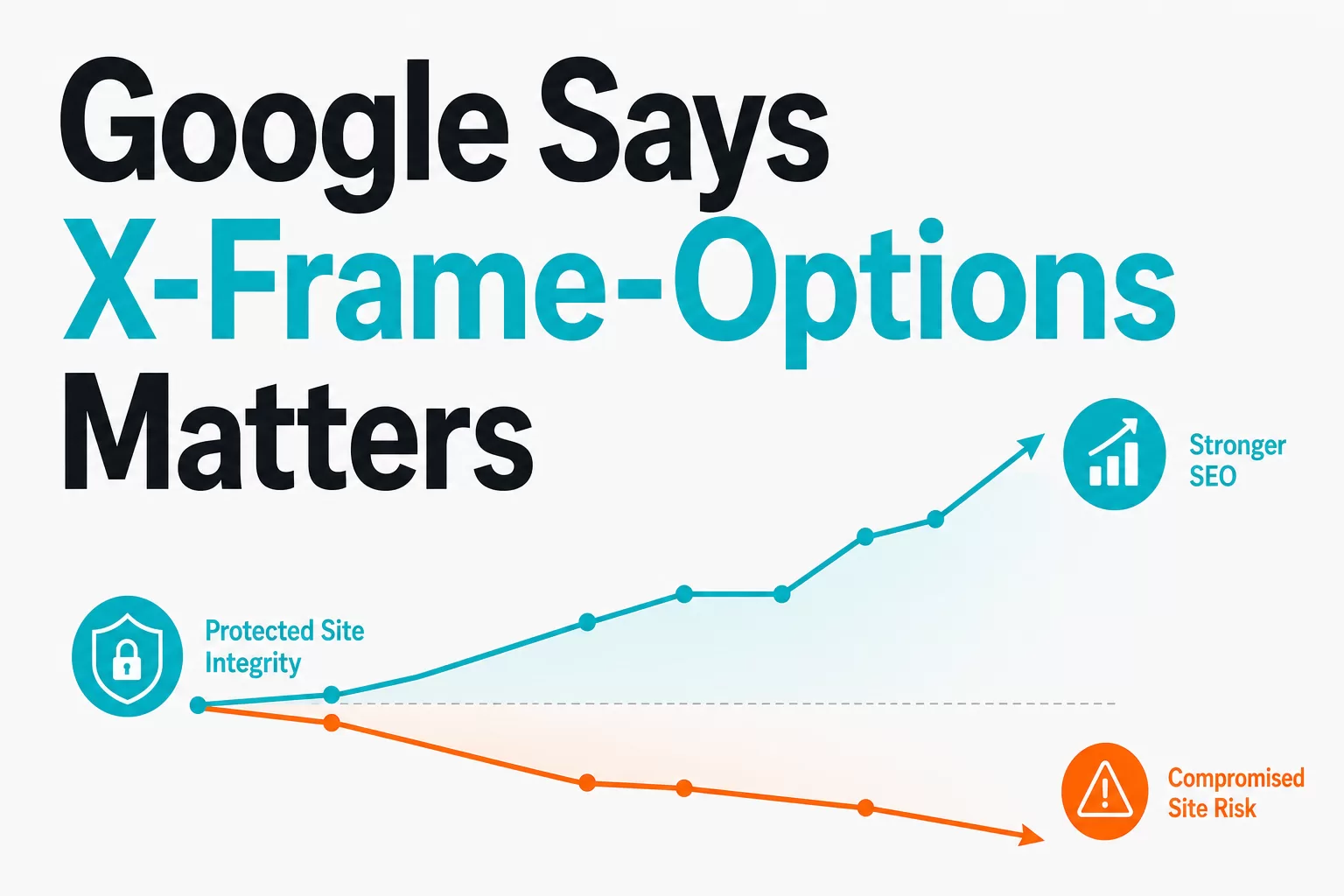
Among the full header stack, X-Frame-Options and the newer Content-Security-Policy frame-ancestors directive deserve special attention. They are not ranking factors in the simplistic sense, but they are part of the defensive layer that helps preserve the conditions SEO depends on.
SEO is not only about earning visibility. It is also about preventing visibility loss caused by security failures, content abuse, and trust erosion.
For teams managing large sites, CMS platforms, or agency portfolios, security headers should be treated as a standard audit item. If you already work with Technical SEO Services, this is one of the clearest examples of where infrastructure hygiene and search performance overlap.
Why security headers belong in SEO audits
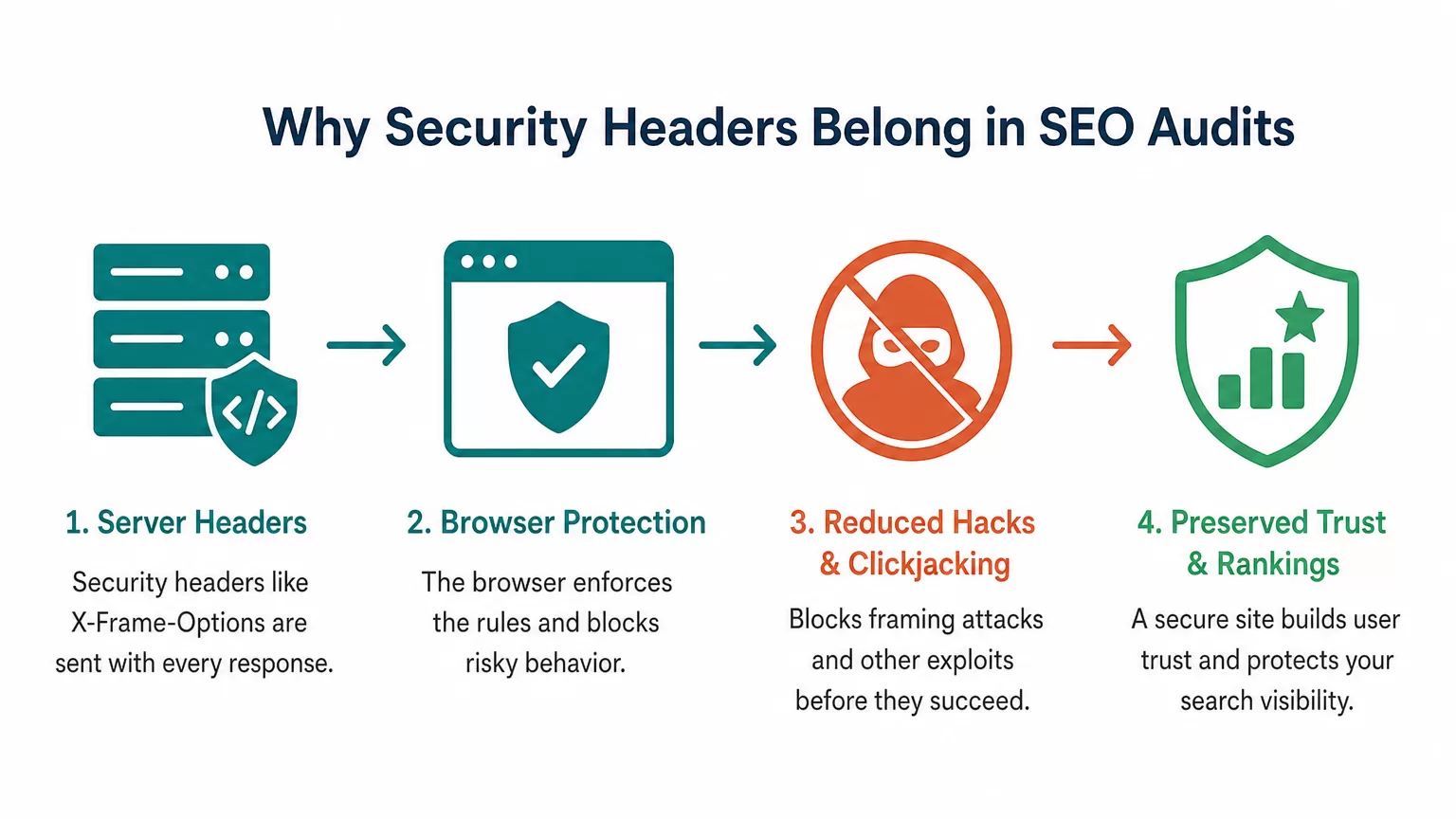
Security headers are HTTP instructions that tell browsers how to handle content safely. They help reduce exposure to threats like clickjacking, XSS, malicious script injection, and data theft. That is a security story first, but it is also an SEO story because compromised sites rarely stay stable in search for long.
A technical SEO audit should not stop at title tags, internal links, or page speed. It should also ask a harder question: can this site be trusted to stay intact? If the answer is uncertain, then the site’s search value is at risk even if every page is technically crawlable.
- Broken trust can reduce clicks and conversions.
- Injected spam can pollute indexable pages and internal linking.
- Browser warnings can suppress engagement and repeat visits.
- Compromised templates can create sitewide quality issues.
That is why security headers belong in audits alongside plugin reviews, CMS checks, and server configuration. They are not there to “boost” rankings directly. They are there to help prevent the kinds of failures that quietly erode organic performance over time.
The headers that matter most
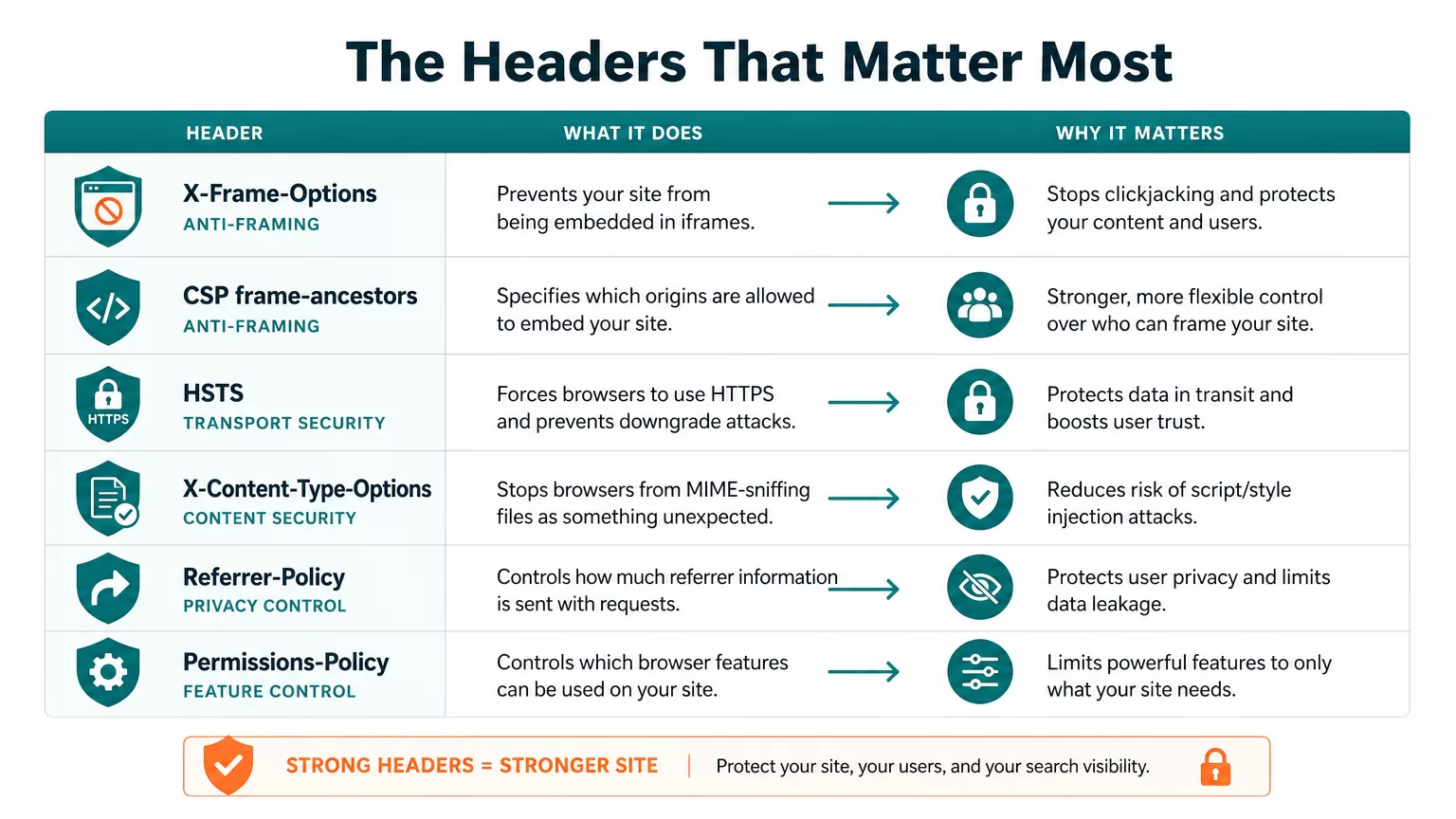
Not every security header carries the same SEO relevance. Some are foundational, some are highly recommended, and some are more situational. For SEO teams, the goal is not to memorize every possible directive. It is to know which ones materially reduce risk to search visibility.
X-Frame-Options
X-Frame-Options is the most directly SEO-relevant header in this discussion. Its job is to prevent other sites from loading your pages inside an iframe. That matters because unauthorized framing can be used to present your content in a way that competes with your source page, confuses users, or creates a pathway for abuse.
In practical SEO terms, this is about content protection and source integrity. If a page can be embedded and repackaged without permission, the original publisher loses control over how that content is experienced. That does not automatically create a ranking penalty, but it can weaken the signals that support long-term visibility.
Content-Security-Policy frame-ancestors
The modern alternative is Content-Security-Policy with the frame-ancestors directive. It serves a similar anti-framing purpose, but with more flexibility and broader strategic value because CSP can also govern script behavior and other resource loading rules.
For many teams, the smartest approach is to treat CSP frame-ancestors as part of a broader policy stack rather than a replacement in isolation. If you are auditing a site, check whether the platform uses X-Frame-Options, CSP, or both, and confirm that the policy matches the site’s legitimate embedding needs.
HSTS, X-Content-Type-Options, Referrer-Policy, and Permissions-Policy
Other headers help protect the site environment that SEO depends on:
- HSTS forces secure connections and reduces downgrade risk.
- X-Content-Type-Options helps prevent MIME sniffing issues.
- Referrer-Policy controls how much referral data is exposed.
- Permissions-Policy limits access to browser features such as camera or geolocation.
These headers may not influence rankings directly, but they help maintain a cleaner, safer, and more predictable site experience. That stability matters when you are trying to preserve crawl efficiency, user trust, and conversion quality.
Think of security headers as insurance for organic performance. They rarely create a ranking lift on their own, but they can help prevent costly losses when something goes wrong.
Direct vs indirect SEO impact
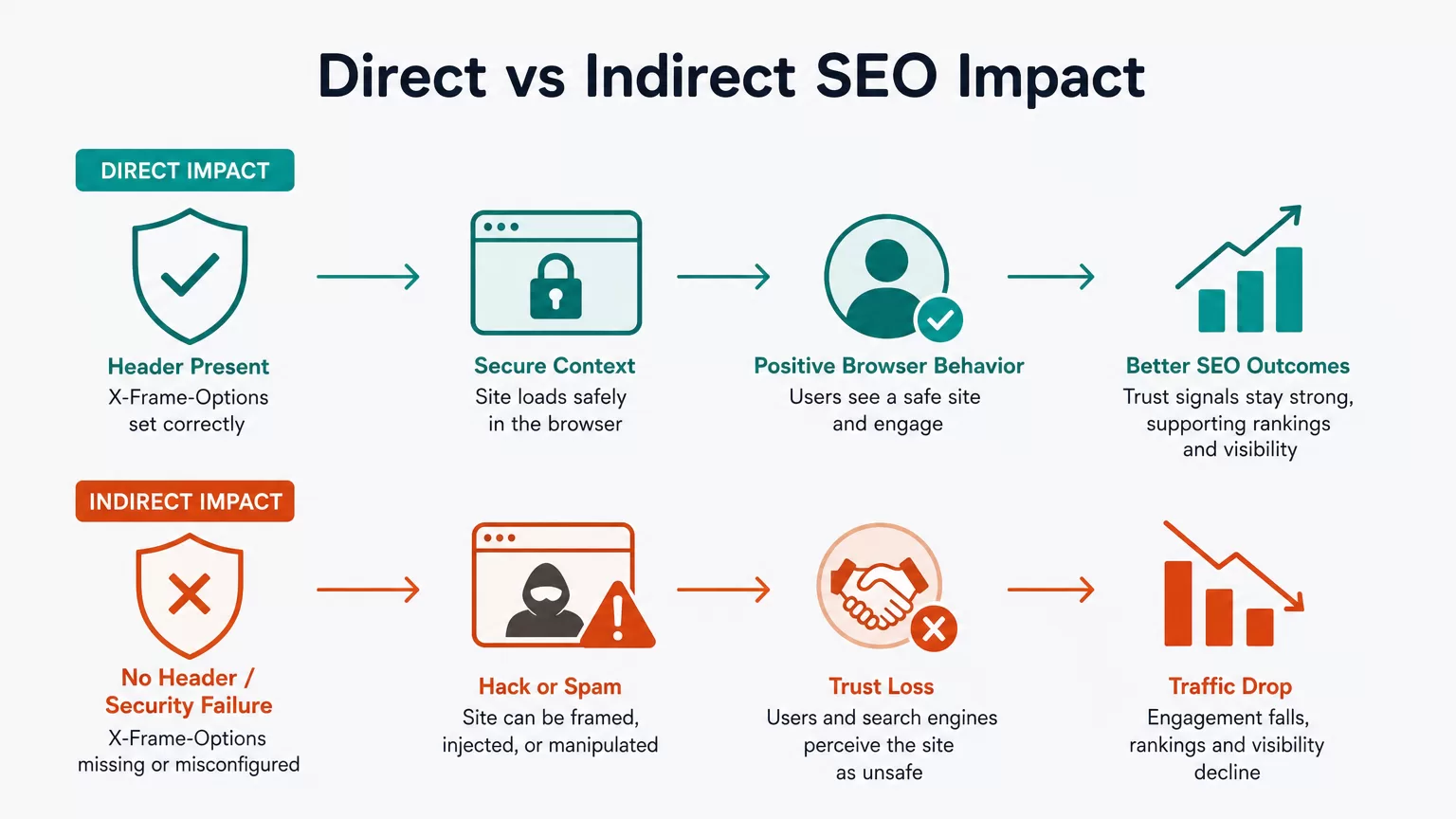
This is the distinction that matters most. Security headers are not magic ranking signals. A site does not climb search results simply because it added X-Frame-Options or HSTS.
But the indirect impact is real. Search performance depends on more than crawlability. It also depends on whether the site remains trustworthy, usable, and intact. If security breaks down, the fallout can spread quickly:
- Hacked pages can be deindexed or demoted.
- Injected content can create relevance noise and quality problems.
- Malware warnings can reduce traffic and brand trust.
- Slower recovery after an incident can disrupt indexing and engagement.
That is why we should separate ranking factor from ranking protection. Security headers mostly live in the second category. They help preserve the technical and reputational conditions that allow organic visibility to hold steady.
This is also where measurement matters. If a site experiences a security event, watch for changes in Search Console coverage, crawl anomalies, engagement metrics, and page-level performance. For a broader framework on this, see Measure Search Performance Beyond Rankings.
Indirect SEO risk often shows up first in behavior signals such as lower click-through rates, shorter sessions, and weaker conversion performance. By the time rankings move, the damage may already have spread across the site.
Implementation notes for WordPress and CMS platforms
Security header implementation is not one-size-fits-all. Hosted CMS platforms, custom stacks, and WordPress installations often handle headers differently, which means the audit workflow should be platform-aware.
WordPress sites
WordPress often requires more hands-on configuration. Some security or caching plugins can set headers, but that does not guarantee the right policy is active sitewide. In other cases, headers may need to be added at the server level through Apache, Nginx, or a hosting control panel.
- Check whether a plugin is adding headers or only suggesting them.
- Verify that headers apply to templates, subdomains, and key page types.
- Confirm that caching layers are not stripping or duplicating values.
- Test after theme, plugin, or hosting changes.
Hosted CMS platforms
Some hosted systems set certain headers automatically, which is helpful but not always sufficient. The risk is assuming a default exists when it only covers part of the stack. Audit the live response headers, not just the documentation.
Hosted platforms can also restrict the level of control you have over CSP or frame policies. In those cases, the SEO team should work with the platform owner or development team to confirm what can be configured natively and what must be handled elsewhere.
Custom and enterprise environments
In custom environments, the biggest challenge is governance. Security headers may be configured correctly in one service but omitted in another. If your site uses multiple apps, subdomains, or edge layers, document where the headers are enforced and who owns them.
Implementation is not the finish line. The real audit question is whether the header policy is consistent across the pages that matter most for organic performance.
Audit checklist and prioritization
A practical SEO audit should treat security headers as a prioritized checklist, not a vague recommendation. Start with the headers that most directly protect content integrity, then move to the ones that reduce operational and privacy risk.
Priority 1: Core protection
- X-Frame-Options or CSP frame-ancestors to prevent unauthorized framing.
- HSTS to enforce secure connections.
- X-Content-Type-Options to reduce MIME sniffing risk.
Priority 2: Broader policy control
- Content-Security-Policy for script and resource governance.
- Referrer-Policy to manage referral exposure.
- Permissions-Policy where feature restrictions are relevant.
Priority 3: Validation and monitoring
- Inspect live response headers on key templates.
- Confirm no conflicting plugin or CDN behavior.
- Re-test after deployments, migrations, and theme updates.
- Monitor Search Console and analytics for unusual drops after security changes.
For SEO teams, the most useful mindset is simple: protect the asset first, then optimize it. A secure site is easier to trust, easier to maintain, and less likely to suffer the kind of technical damage that creates ranking instability.
Security headers will not replace content quality, internal linking, or crawl optimization. But they do strengthen the foundation those tactics rely on. In that sense, they are no longer optional extras in a modern technical SEO audit. They are part of the job.