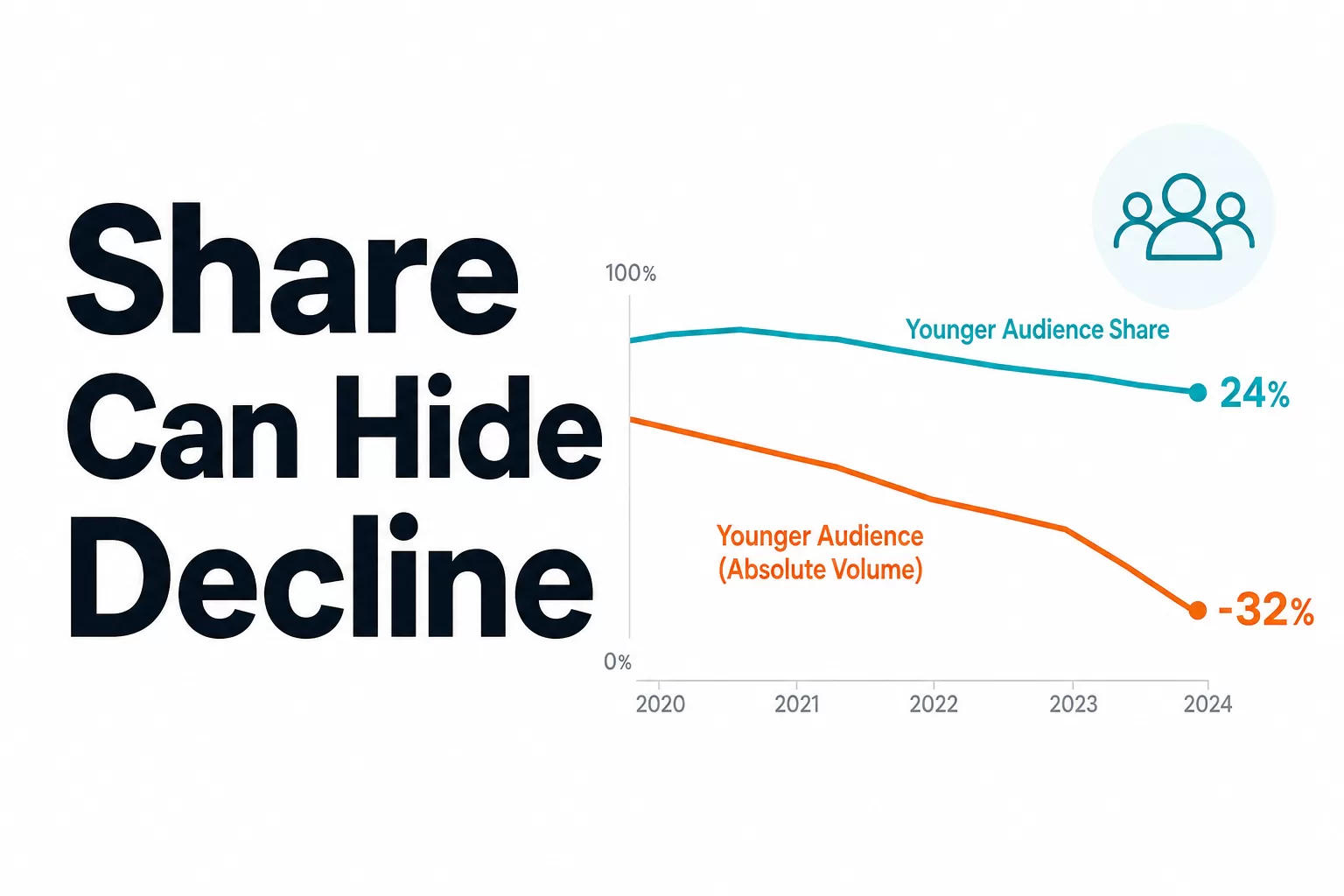
Younger audience decline is one of those problems that can look manageable in a chart and alarming in the business. A publisher may see only a small drop in the 18–34 share of its audience and assume the issue is modest. But if the total audience is shrinking at the same time, that same small percentage-point change can conceal a much larger loss in absolute readers.
That is the core measurement trap: share is a ratio, not a volume metric. When you rely on audience share alone, you can miss structural decline in younger readership, especially if older audiences are also falling. For publishers, the real question is not just whether the mix looks stable. It is whether younger readers are still present in meaningful numbers, returning with frequency, and progressing through the funnel from discovery to loyalty.
Key warning: A stable-looking audience mix can still sit on top of a fast-moving erosion problem. Composition is not the same as scale.
Why share can mislead
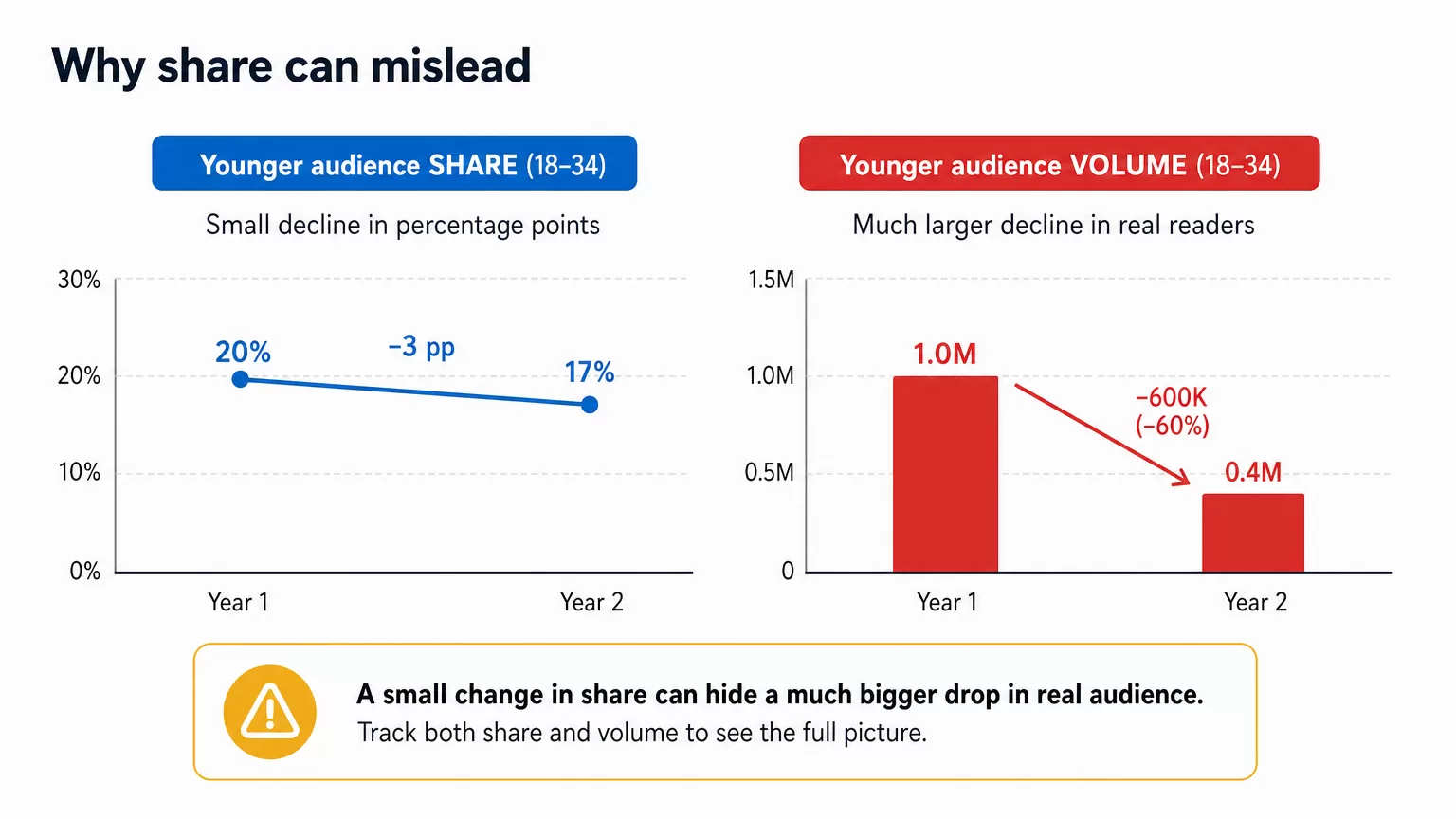
Audience share is useful, but only when it is paired with absolute counts. If younger readers decline by 20% and older readers decline by 10%, the younger cohort may barely move in share terms even though it lost more people in real terms. That is why publishers should avoid treating a small share change as evidence of a small business problem.
This matters because many editorial and growth teams still report audience health as a single demographic percentage. That approach can hide three different realities:
- Composition changes — the audience mix shifts, but total traffic is steady.
- Scale changes — total traffic drops, even if the mix looks similar.
- Composition plus scale changes — the most dangerous case, where younger readers shrink in both share and absolute volume.
When publishers confuse composition with scale, they may end up optimizing for the wrong outcome. A demographic share target can look healthy while the actual younger-reader base erodes. That is why cohort analysis should sit alongside standard traffic reporting in every serious media analytics workflow.
For teams building a more durable content system, this is also where measuring search performance beyond rankings becomes relevant. Rankings can tell you where content appears; cohort analysis tells you whether the audience you need is actually arriving and returning.
The shrinking pie problem
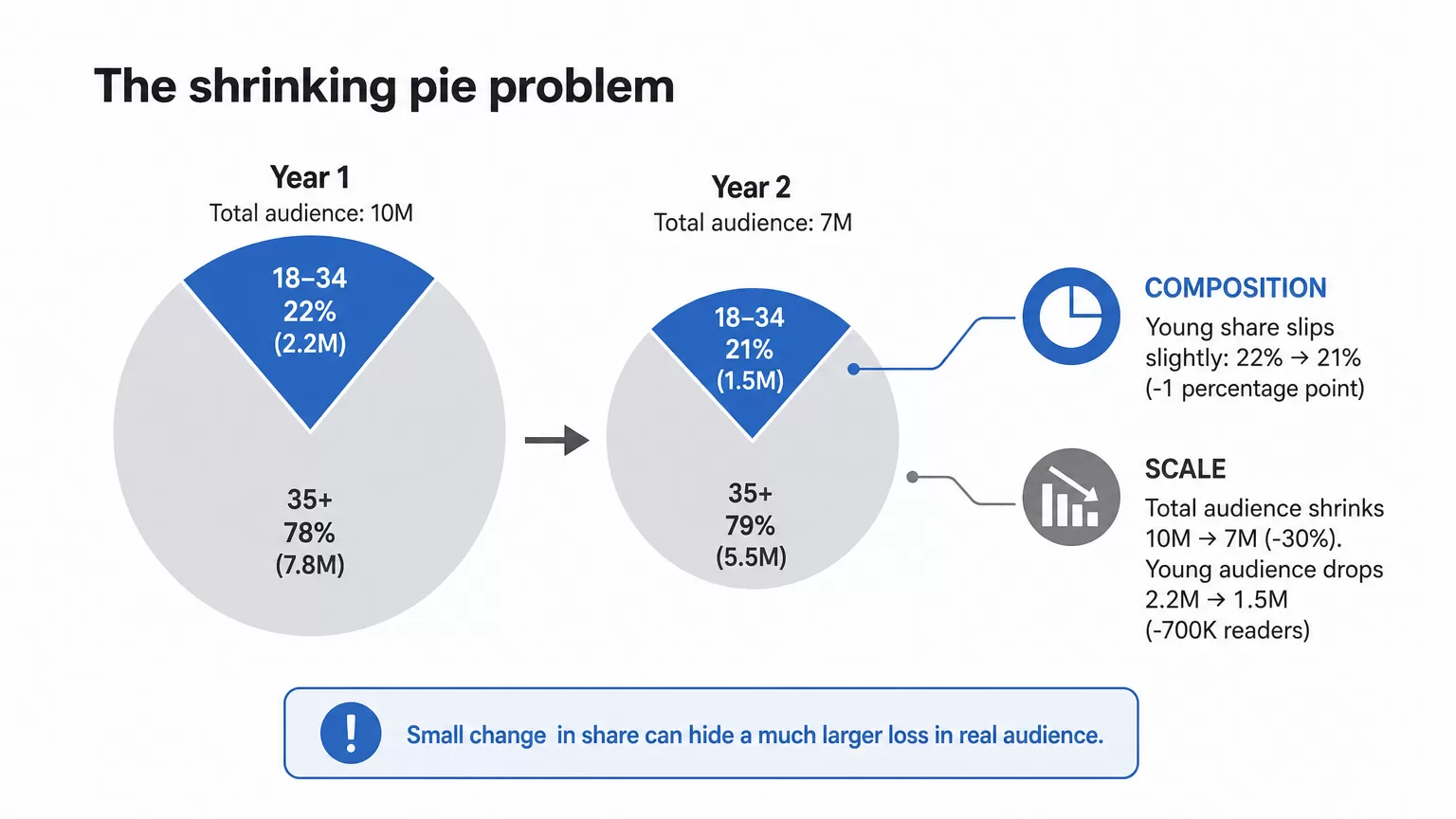
The simplest way to understand younger audience decline is to picture a shrinking pie. If the total audience base contracts, a cohort can appear relatively stable even while its actual slice gets much smaller. That is why share-based reporting can understate structural decline.
In practical terms, this means publishers should separate two questions:
- What percentage of my audience is younger?
- How many younger readers do I actually have?
Those are not interchangeable. A publisher can remain near a population benchmark in percentage terms and still lose a meaningful share of future audience value. And if younger readers are declining faster than older readers, the business problem is not just general audience contraction. It is a cohort-specific erosion problem.
That distinction also changes how we interpret platform competition. It is tempting to say younger audiences simply moved to social platforms or video-first ecosystems. But website-only data cannot prove a clean migration story. The more defensible conclusion is narrower: younger audiences at publishers are declining in absolute terms, even if the destination of those users is not fully visible in web analytics.
Practical takeaway: If total audience is falling, share can stay deceptively calm. The pie is shrinking, and the slice is shrinking with it.
Benchmarking younger readers
Benchmarking is where audience analysis becomes operational. Instead of asking whether younger readers are “good” or “bad,” publishers should compare themselves against the right peer set and ask where they sit on the spectrum of younger-audience strength.
A useful benchmarking model starts with three levels:
- Internal benchmark: How has younger readership changed over 12, 24, and 36 months?
- Peer benchmark: How does that trend compare with similar publishers in size, format, and proposition?
- Market benchmark: How does the audience mix compare with broader population expectations?
That third layer matters, but it should not be the only one. A publisher can be close to a population norm and still be underperforming relative to peers. In other words, representativeness is not the same as resilience.
For publishers in entertainment, culture, and lifestyle categories, the audience challenge is often tied to SEO Services for Entertainment & Media performance across discovery surfaces. Younger readers are often highly intent-driven, but they are also fast-moving and selective. If a publisher’s content strategy does not match that behavior, benchmark gaps will widen quickly.
When building an audience benchmarking framework, watch for these signals:
- younger share declining faster than older share;
- younger absolute visits falling even when share looks stable;
- repeat visits weakening more than first-time visits;
- younger cohorts underperforming on return rate, pages per session, or newsletter sign-up.
Diagnostic quadrants
The most useful way to interpret younger-reader erosion is with a diagnostic framework that separates position from capability. Think of it as a two-part scan:
- Position scan: Where does the publisher sit versus peers on younger share and engagement?
- Capability scan: Where do younger readers drop out of the funnel — awareness, engagement, loyalty, or advocacy?
That creates four broad quadrants:
- Distribution problem: content may be relevant, but reach is too weak.
- Engagement problem: readers arrive, but they do not stay or return.
- Relevance problem: the publisher is not meeting younger users’ needs or interests.
- Relevant and engaging: the aspirational quadrant, where content, distribution, and retention all align.
This is far more actionable than saying “young people are not reading news.” It tells teams where to intervene. If the issue is distribution, the answer may be packaging, channel mix, or search visibility. If the issue is engagement, the answer may be format, depth, page experience, or internal linking. If the issue is relevance, the answer may be topic selection, tone, or audience promise.
In SEO terms, this is where content strategy and audience retention intersect. The goal is not just to win clicks, but to build repeatable value for a specific cohort. That requires a clearer view of search intent, content quality, and the pathways that turn a one-time visit into habit.
What publishers should do next
Publishers trying to understand younger-reader erosion should move from broad concern to structured diagnosis. The right response is not panic; it is measurement discipline.
Start with a cohort dashboard that tracks younger readers in absolute terms, not just share. Then layer in peer benchmarking, engagement diagnostics, and funnel-stage analysis. That combination will show whether the problem is reach, resonance, or retention.
Here is a practical action list:
- Track share and volume together. Never report one without the other.
- Segment by cohort. Compare 18–34s with older groups across acquisition and retention.
- Benchmark against peers. Use a relevant set, not a generic industry average.
- Audit the funnel. Identify where younger readers drop out from discovery to repeat use.
- Test relevance signals. Review topic mix, headlines, formats, and distribution channels.
- Measure beyond web-only behavior. App, social, and video ecosystems may capture part of the audience movement.
Most importantly, publishers should treat younger audience decline as a product and strategy issue, not just a traffic issue. The objective is not to preserve a percentage point. It is to rebuild a durable relationship with a cohort that will shape future audience value.
If your team needs a stronger operating model for this work, start by connecting audience benchmarking to your broader content and SEO workflows. That is where structural decline becomes visible — and where recovery becomes possible.
Bottom line: Share can hide decline. Absolute volume, cohort benchmarking, and funnel diagnostics reveal it.