Why lean teams need a weekly SEO system
Lean marketing teams rarely struggle because they lack SEO ideas. They struggle because SEO competes with everything else: paid media, landing pages, email, social, webinars, sales requests, and site changes that feel urgent in the moment. Without a fixed cadence, SEO becomes the channel that gets reviewed, discussed, and postponed.
A weekly SEO workflow solves that problem by making SEO a decision-making habit instead of a vague backlog. The goal is not to “do more SEO.” The goal is to identify one or two high-impact actions each week that improve organic visibility, traffic quality, or conversion potential.
For lean teams, the win is not a bigger SEO plan. It is a tighter system that turns data into shipped work.
This matters even more when the team is small. In-house marketers often have business context but limited execution bandwidth. Agencies may have strategy but face approval delays, CMS restrictions, and context switching. In both cases, the answer is the same: a time-boxed SEO process with clear criteria for what deserves attention next.
If your team already uses tools like Search Console and GA4, the missing piece is usually not data. It is prioritization. That is why the most effective weekly process is designed around four outcomes:
- Find what is already working
- Fix what is blocking performance
- Improve pages closest to revenue
- Turn search data into next week’s actions
That is also why a focused workflow can be more effective than sprawling audits. If you need deeper technical support, a structured engagement like Technical SEO Services can help remove bottlenecks that keep recurring in weekly reviews.
The 120-minute workflow
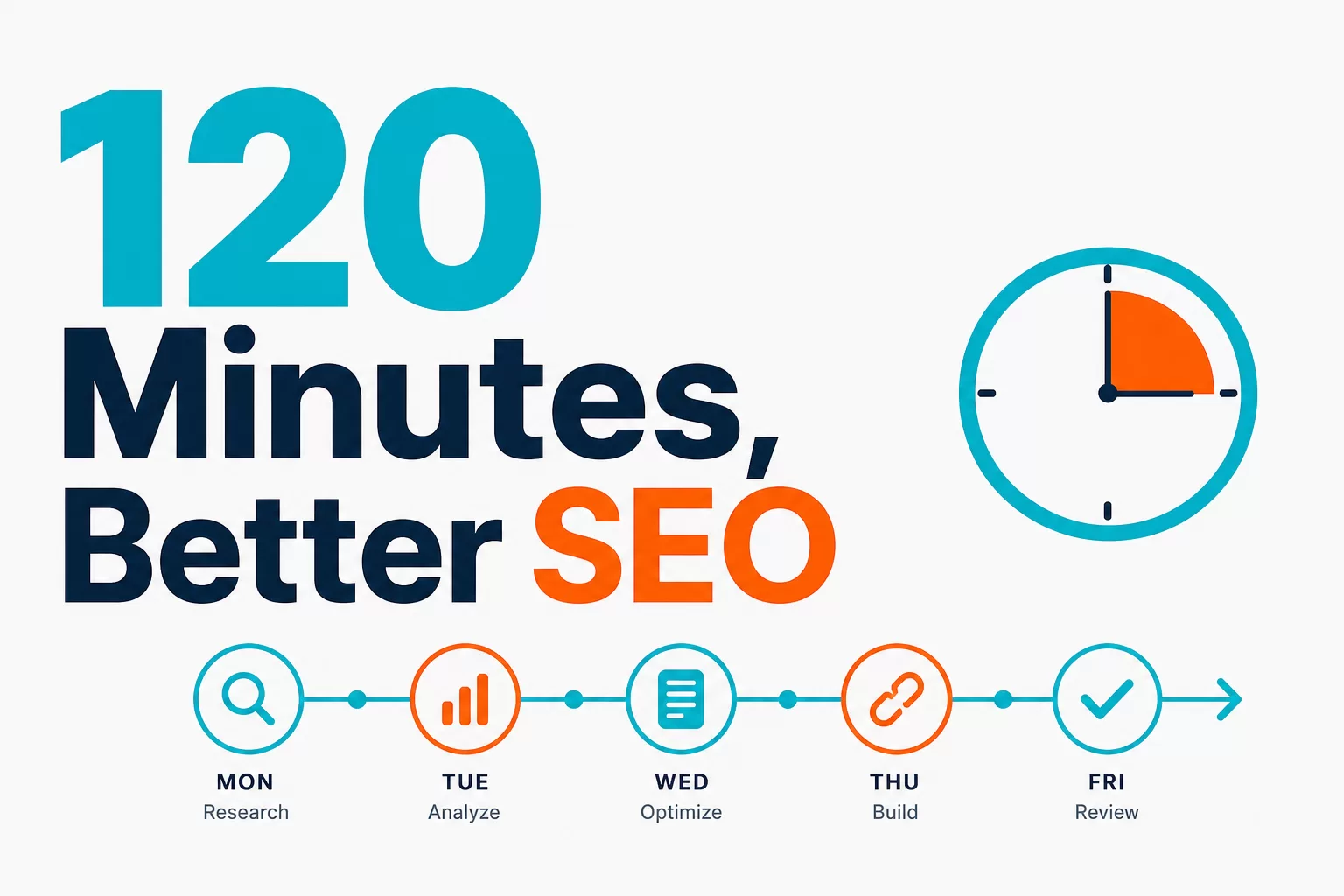
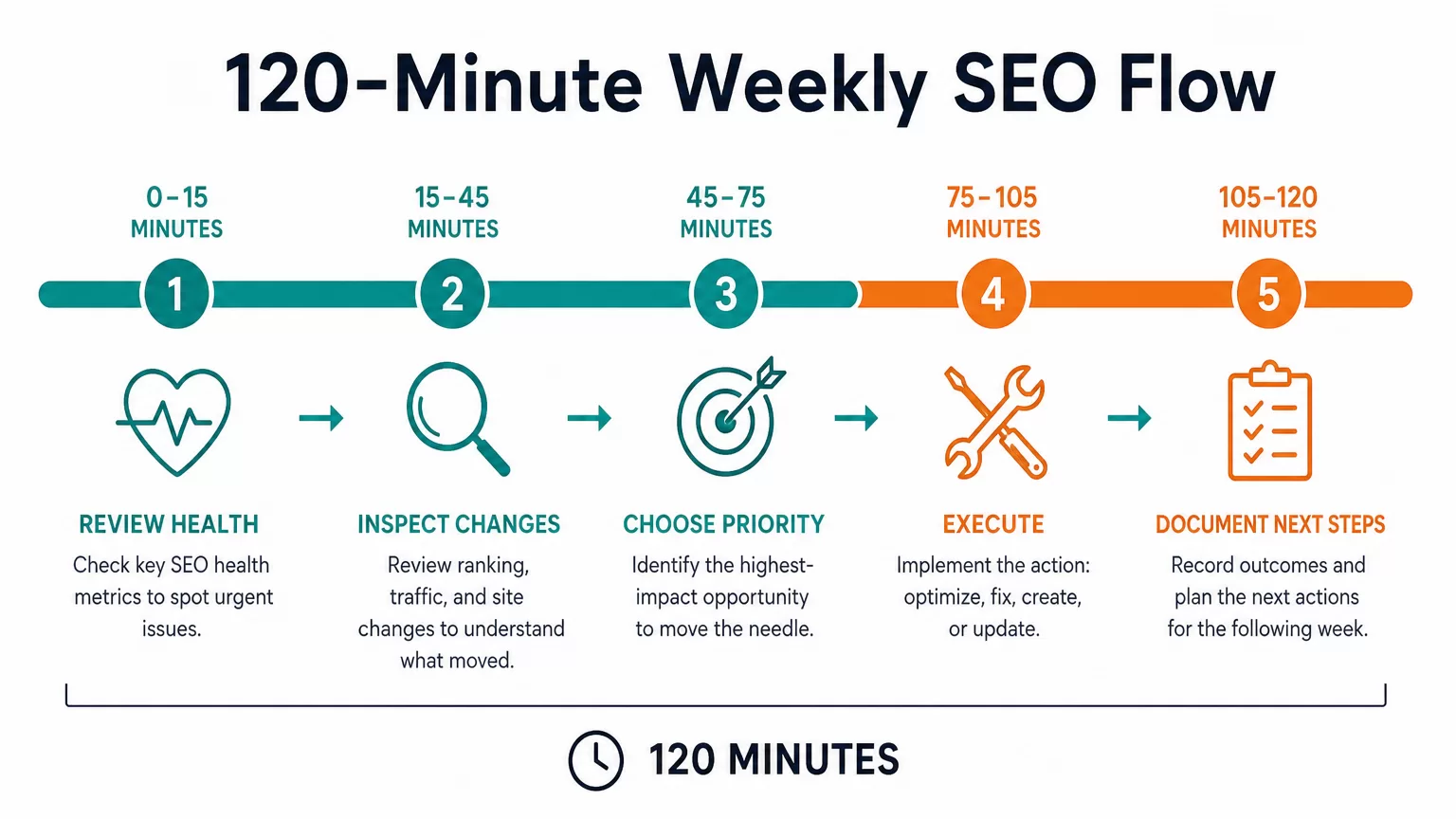
The simplest way to run SEO in a lean environment is to reserve 120 minutes per week for one repeatable operating session. That time limit is not arbitrary. It forces decisions. It prevents the meeting from turning into a reporting marathon and keeps the team focused on action.
Here is a practical breakdown:
- 0–15 minutes: check organic health and identify whether action is needed
- 15–45 minutes: review pages, queries, and trends that changed meaningfully
- 45–75 minutes: decide the highest-leverage fix or improvement
- 75–105 minutes: assign, draft, or implement the change
- 105–120 minutes: document the output and set next week’s starting point
The most important rule is this: the session should end with a change, not just a chart. If the week produces only a dashboard summary, the workflow has failed.
What to check in the first 15 minutes
The first 15 minutes should answer one question: Is organic visibility moving in a direction that requires action? Keep the review narrow. The point is not to inspect every metric. It is to spot meaningful movement quickly.
Start with these signals:
- Google Search Console: impressions, clicks, CTR, and query/page changes
- GA4 organic conversions: leads, purchases, sign-ups, or other business actions from organic traffic
- Top landing pages: identify which pages gained or lost the most value
- Branded vs. non-branded movement: separate brand demand from true SEO growth
- Indexing or crawl warnings: surface technical issues before they spread
One useful discipline is to write down only four notes: biggest win, biggest concern, one page to inspect, and one action to take. Anything beyond that usually drifts into reporting theater.
Reporting becomes a trap when it explains performance without changing it.
How to decide what to fix next
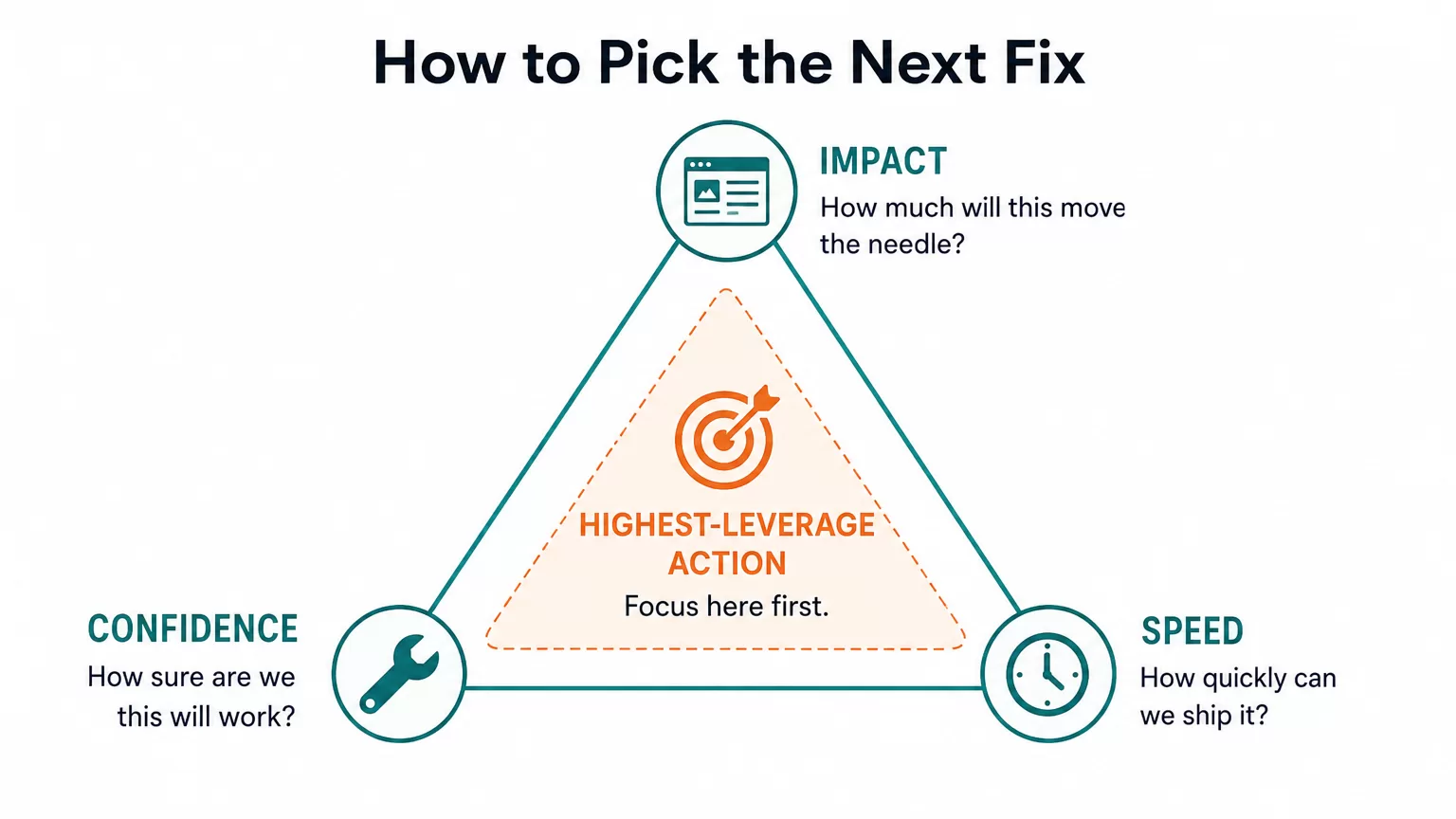
Once you have a short list of opportunities, use a simple prioritization filter. Lean teams do best when they choose work based on impact, confidence, and speed.
- Impact: Will this change affect a page, query, or template that already has traction?
- Confidence: Do the data and page context clearly suggest a fix?
- Speed: Can the change be made this week without heavy dependencies?
This is where many teams make an avoidable mistake. They treat SEO like enterprise SEO: exhaustive audits, endless keyword lists, and a long queue of “important” tasks. For a lean team, that usually creates motion without progress. A better question is: what is the highest-leverage SEO action we can actually finish this week?
Good candidates often include:
- Updating a page that already ranks on page two
- Improving title tags or on-page copy for a high-impression query
- Refreshing a revenue-adjacent landing page
- Fixing internal links to a page with strong conversion intent
- Resolving indexing or template issues that suppress multiple URLs
In other words, prioritize pages closest to revenue before chasing low-probability opportunities. That is how lean teams preserve momentum.
Common mistakes
Most weekly SEO systems fail for predictable reasons. The biggest one is letting reporting consume the entire block. If your team spends 90 minutes discussing charts and 10 minutes assigning work, the process is upside down.
Here are the most common mistakes to avoid:
- Tracking too many metrics: more dashboards usually mean less clarity
- Optimizing for rankings only: visibility matters, but revenue impact matters more
- Chasing every keyword: lean teams need leverage, not volume
- Ignoring technical blockers: crawlability, indexing, and template issues can quietly limit gains
- Failing to assign ownership: a good insight without a clear owner is just commentary
- Skipping documentation: if the team does not record what was changed, next week starts from zero
Another mistake is copying enterprise behavior. Large teams can afford broad audits, layered approvals, and long optimization cycles. Smaller teams usually cannot. They need a weekly rhythm that fits real constraints and still produces measurable progress.
Lean SEO is not about doing less strategically. It is about removing everything that does not lead to a decision or a shipped improvement.
Weekly output template
To keep the workflow repeatable, use a simple output template every week. The format should be short enough to complete in minutes, but structured enough to create continuity.
- Week of: [date]
- Biggest win: [what improved]
- Biggest concern: [what needs attention]
- Primary page/query: [the main opportunity]
- Action completed: [what was changed]
- Owner: [who is responsible]
- Expected outcome: [visibility, traffic quality, or conversion lift]
- Next check: [what will be reviewed next week]
This template does two things well. First, it prevents the weekly session from becoming a loose discussion. Second, it creates a lightweight audit trail that helps the team see whether actions are compounding over time.
If your team serves multiple clients or business units, this format also makes it easier to compare priorities without overcomplicating the reporting layer. For agencies, a repeatable operating model can be especially useful when paired with SEO Services for Digital Marketing Agencies, since client work often depends on fast prioritization and clear handoffs.
How to connect SEO to business impact
The final step is to connect the weekly workflow to business outcomes. That means moving beyond traffic alone and asking whether SEO is improving the metrics the business actually cares about.
Use this chain of logic:
- Organic visibility increases or stabilizes
- Qualified traffic reaches the right pages
- Engagement or conversion rate improves
- GA4 organic conversions show the business effect
This is where SEO reporting should become more disciplined. Instead of asking, “How did rankings change?” ask, “What changed in search behavior, and what did we do about it?” That shift keeps the team focused on outcomes instead of vanity metrics.
A practical way to frame it is to measure three layers:
- Visibility: impressions, rankings, query coverage
- Traffic quality: clicks, landing page engagement, intent match
- Revenue impact: leads, purchases, subscriptions, or assisted conversions
If you want a more complete view of performance, it also helps to Measure Search Performance Beyond Rankings so the team does not confuse movement in search positions with actual business progress.
The best weekly SEO workflow is not the one with the most analysis. It is the one that reliably turns search data into decisions, decisions into tasks, and tasks into measurable outcomes. For lean teams, that is the difference between staying busy and making progress.
When SEO is time-boxed, prioritized, and tied to business impact, even a small team can build real momentum.