Most content teams do not have a content problem. They have a maintenance problem.
Pages go stale. Voice drifts. New articles miss important subtopics. Internal links decay. And as AI search surfaces more synthesized answers, content also needs to be understandable and cite-worthy for machines, not just readable for humans.
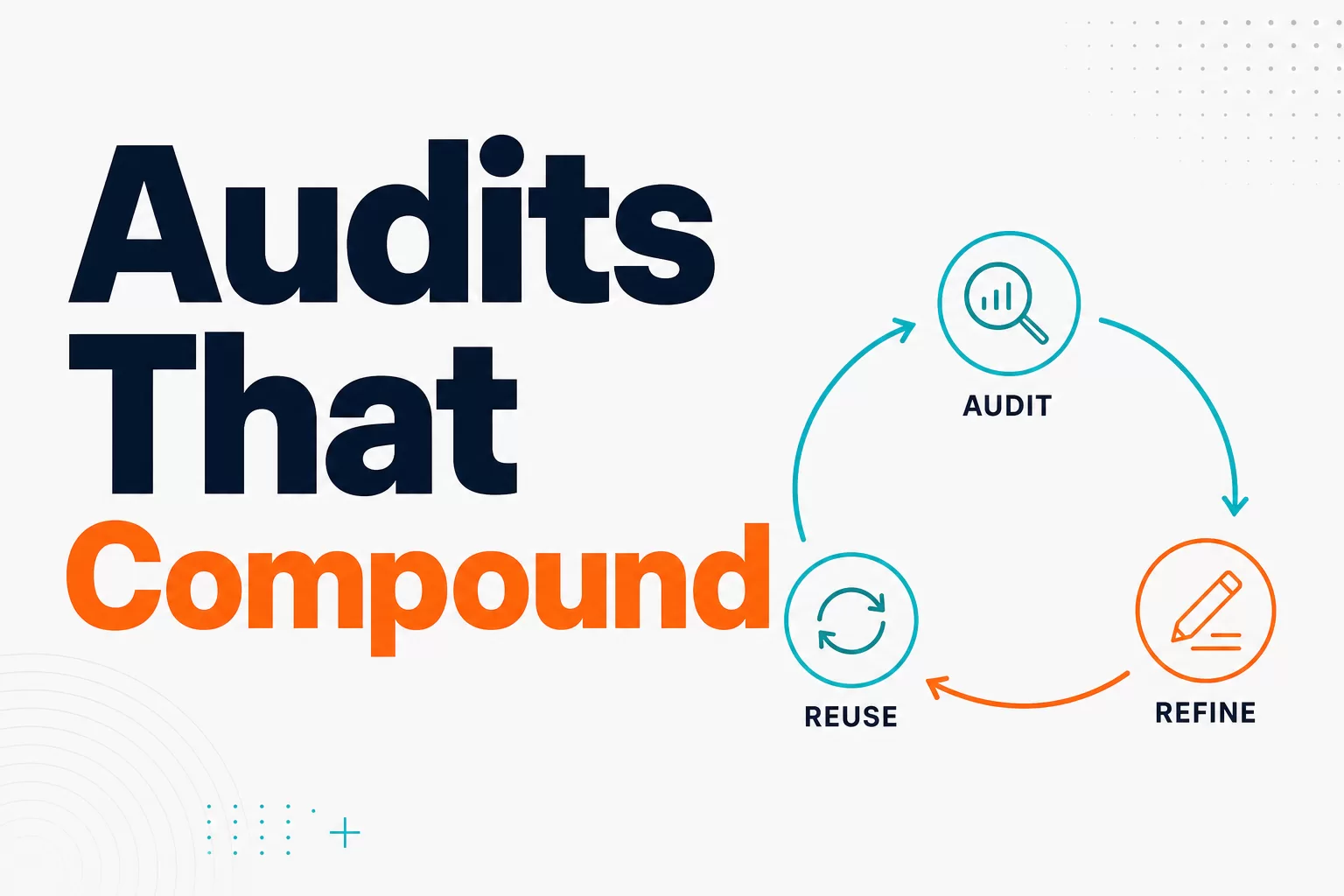
That is why the real opportunity in a Claude content audit is not a one-time review. It is turning audits into repeatable workflows that improve every time you run them.
Think of content audits less like a checklist and more like a system: a reusable skill that compounds editorial quality, search performance, and AI visibility over time.
For SEO teams, that shift matters. Instead of reinventing prompts for every page, you can build a library of audit workflows for brand voice consistency, topical gap analysis, freshness, structure, and conversion quality. If you already manage content at scale, this is the difference between reactive cleanup and operational control. Teams that want to connect these audits to broader Content Marketing SEO work will usually see the biggest payoff, because the audit system becomes part of the publishing process rather than a separate task.
Why content audits should become reusable workflows
For hands-on help with this topic, explore SEO Services for Personal Branding.
One-off prompts are useful for experimentation, but they do not scale. The moment a prompt works well for one article, teams should ask a better question: What skill did we just discover, and how do we reuse it?
That mindset changes content operations in four important ways:
- Consistency improves because the same criteria are applied across pages.
- Review time drops because the prompt structure is already proven.
- Editorial judgment gets encoded instead of living in one person’s head.
- Each audit gets better as you refine the workflow after every run.
This is especially useful when your existing library is a goldmine of opportunities. Most teams do not need more ideas; they need a practical way to inspect what already exists and decide what to update, expand, or retire.
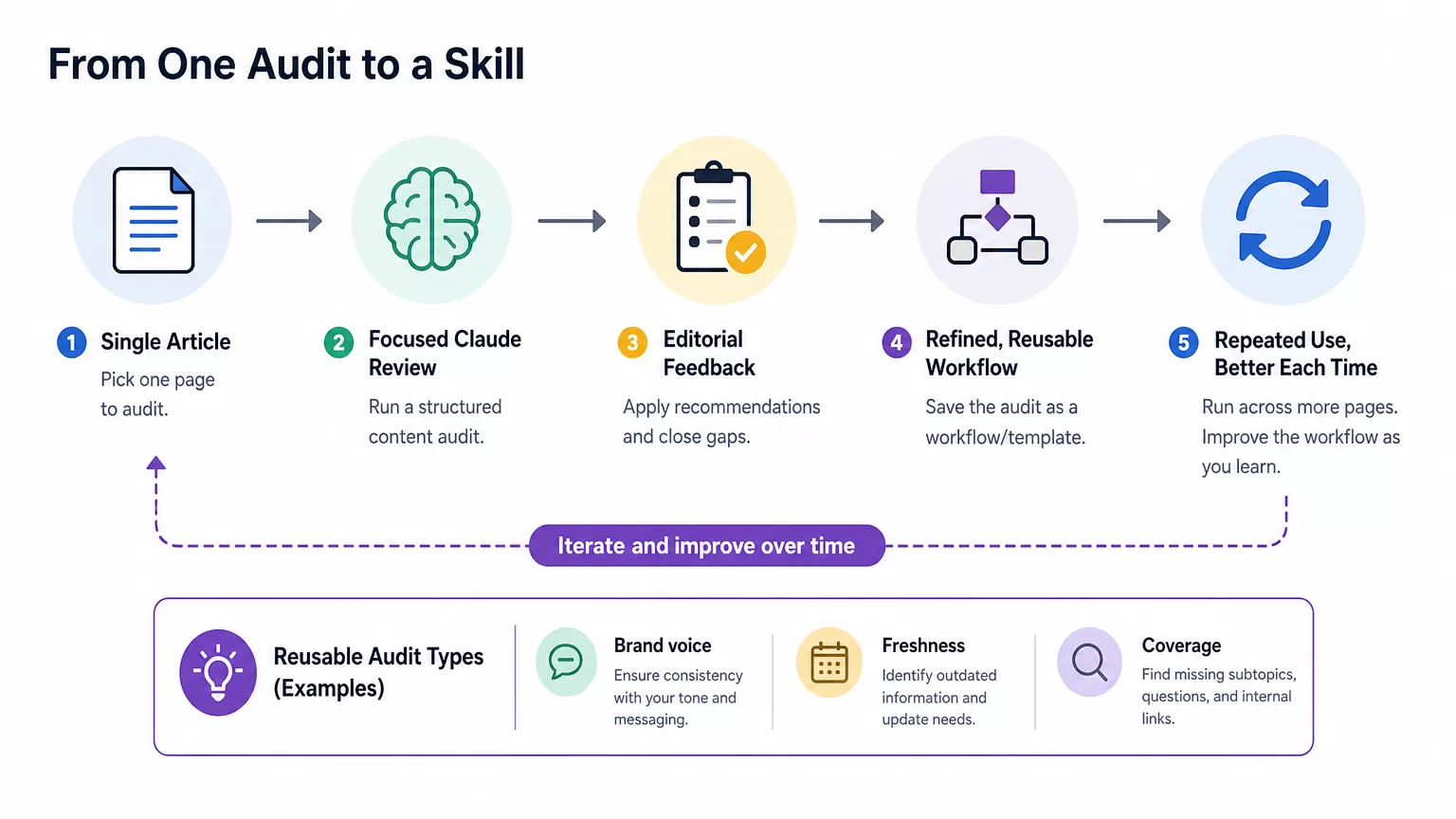
Start small. Audit a single article. Observe where Claude agrees, where it misses context, and where the output feels too generic. Then convert that process into a reusable skill. That incremental approach lowers friction and makes the system accessible even if you are not ready for full automation.
Build one audit well before you build six. The best workflow is the one your team will actually reuse.
6 Claude audit workflows to build
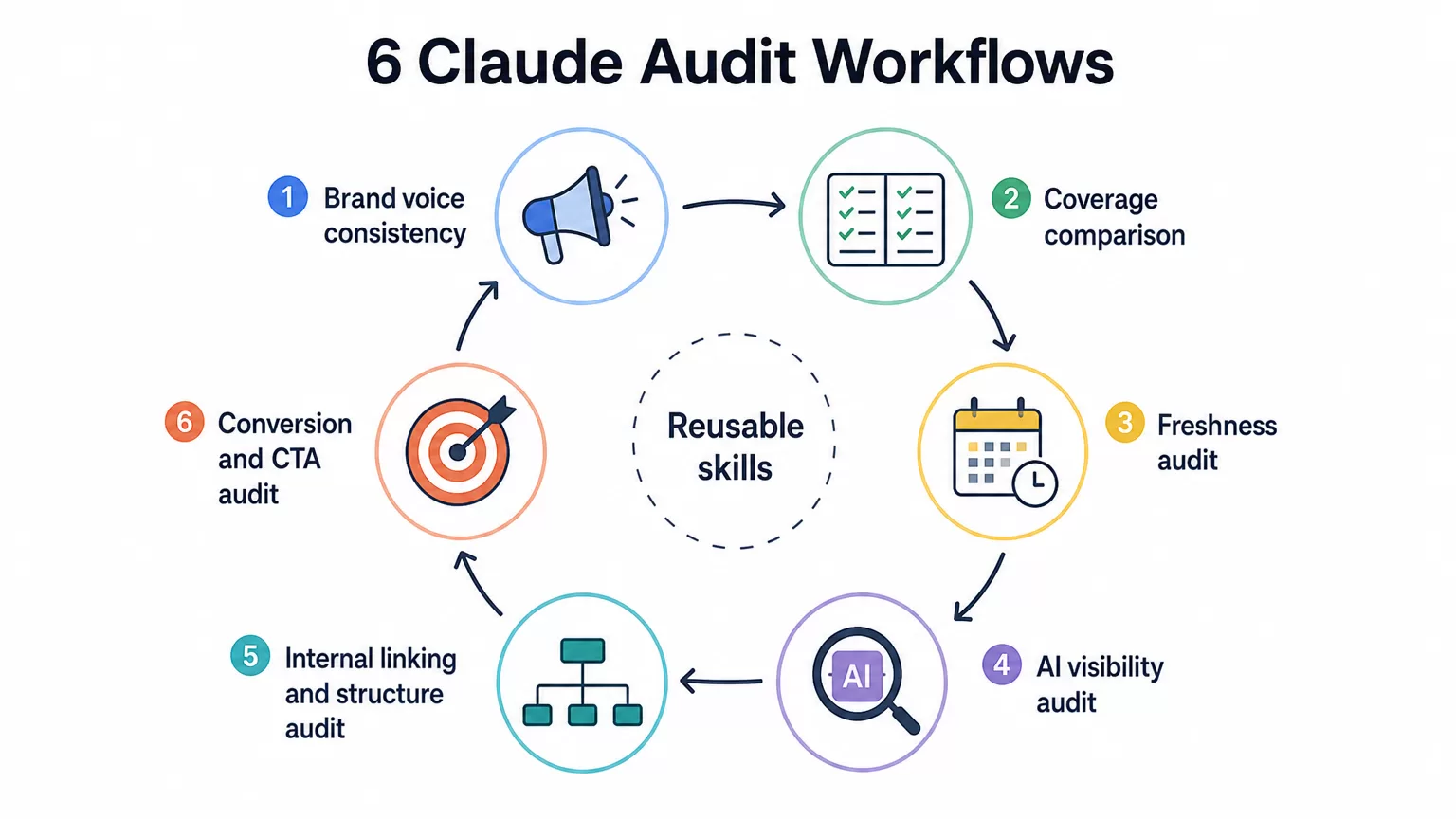
The most effective audit systems are modular. You do not need one giant prompt that tries to solve everything. You need a set of focused workflows that can be run independently and refined over time.
Below are six Claude workflows worth building into your content operations.
Brand voice consistency
Voice drift is one of the most common quality-control issues in growing content libraries. New writers, changing product positioning, updated offers, and shifting editorial standards all create subtle inconsistencies.
Instead of describing your voice with vague language like “conversational but authoritative,” build an AI-readable voice system from three to five high-quality articles that already represent the brand well. Ask Claude to identify:
- How the articles open
- Typical sentence and paragraph structure
- Preferred vocabulary and terms to avoid
- Personality patterns, framed as “We say X, but not Y”
- What the brand never does in tone or framing
The goal is not just a human style guide. It is a guide an LLM can interpret and apply consistently. That distinction matters. A machine can follow patterns more reliably than it can infer nuance from broad adjectives.
Useful voice systems are operational, not poetic. They describe patterns Claude can actually reproduce.
Coverage comparison
Coverage comparison is a structured way to run topical gap analysis. For a target keyword, have Claude review the top three to five ranking pages and compare them against your page. The output should identify:
- What competitors cover well
- What your article covers well
- What is missing, thin, or underdeveloped
- Which additions would improve completeness without bloating the page
This workflow is especially useful because it turns competitor analysis into a repeatable decision process. Claude can format the findings as a table, a prioritized list, or a draft-ready content brief. If it suggests additions you would never actually include, do not ignore that signal; note it, then encode your editorial judgment into the skill so the next run is more aligned.
That is where prompt engineering becomes operational rather than experimental. You are not just asking for better output. You are teaching the workflow what “better” means for your team.
Freshness audit
Freshness is more than checking whether a post has an old date. A strong freshness audit looks for outdated examples, obsolete recommendations, inaccurate facts, stale terminology, and shifts in search intent that make a page feel behind the market.
Use Claude to scan an article for signs of content decay and to prioritize what should be updated first. The best freshness workflows answer questions like:
- Which claims are time-sensitive?
- Which sections are still accurate but no longer useful?
- Which examples feel dated?
- What should be refreshed to match current search expectations?
For teams managing large archives, this is how content maintenance becomes systematic. You move from occasional cleanup to a repeatable maintenance cycle.
Freshness is not a publishing chore. It is a ranking safeguard and a trust signal.
AI visibility audit
As search experiences become more AI-mediated, content has to work harder for machine interpretation. That means clear structure, explicit entities, concise definitions, and language that can be confidently summarized or cited.
An AI visibility audit checks whether a page is likely to be understood, extracted, and represented accurately in AI-driven results. Ask Claude to review:
- Whether key concepts are defined clearly
- Whether headings reflect the page’s actual themes
- Whether important facts are easy to isolate
- Whether the page answers likely follow-up questions
If you are building for AI search, this workflow should sit alongside your standard SEO review. It is not enough for a page to rank. It also needs to be legible to systems that synthesize answers. For a deeper framework on this topic, see How to Optimize Content for AI Search Citations.
Internal linking and structure audit
Structure is one of the easiest quality issues to miss and one of the easiest to improve. A page can have strong information but still underperform if the hierarchy is unclear or the internal links fail to guide readers deeper into the site.
Use Claude to evaluate:
- Whether the H2s and H3s follow a logical progression
- Whether the content has enough scannable signposts
- Whether the page links to relevant supporting pages
- Whether there are opportunities to connect to related topics
This workflow is particularly valuable for large sites where internal linking is often inconsistent. A structured audit can surface pages that should support one another but currently live in isolation.
Conversion and CTA audit
Good content should do more than inform. It should move the reader toward a meaningful next step. A conversion audit checks whether the page’s call to action matches the user’s intent and whether the content earns that CTA naturally.
Ask Claude to review whether the content:
- Introduces the CTA at the right moment
- Uses language that matches the reader’s stage
- Offers a logical next step
- Avoids generic or abrupt selling
This is where quality control becomes business control. If the article is meant to educate, the CTA should feel like a continuation of the conversation, not a detour.
How to package audits into Claude skills
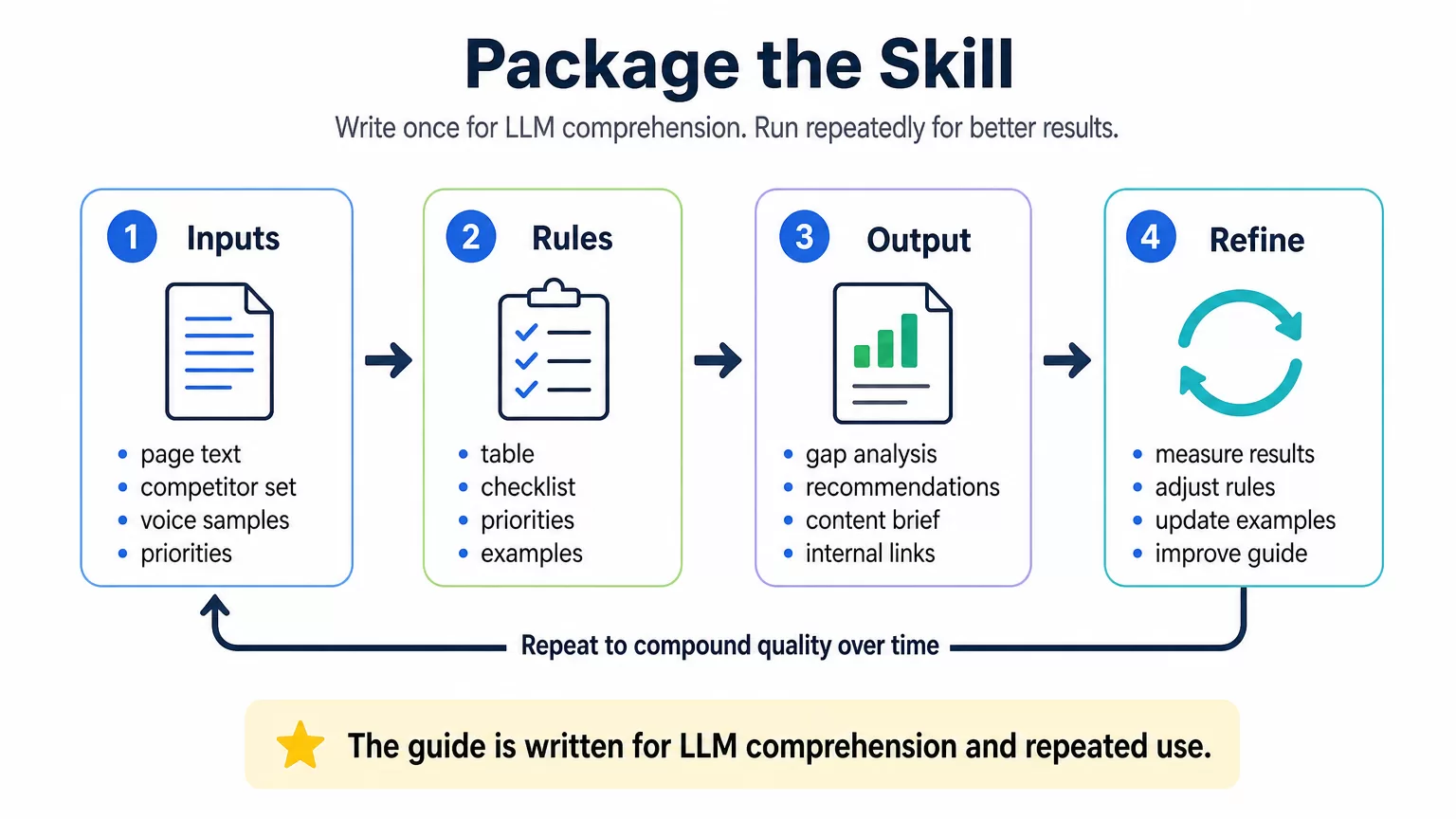
The strategic unlock is not simply using Claude to audit content. It is packaging the audit into a skill that can be reused, refined, and shared.
Think of a skill as a machine-readable procedure with a clear purpose, inputs, outputs, and evaluation rules. That means your audit should not live as a loose prompt in a chat thread. It should become a documented workflow.
Here is a practical way to build one:
- Start with one page. Choose a single article and run a focused audit.
- Define the input. Specify what Claude should review: the page text, a competitor set, or a voice sample.
- Define the output. Ask for a table, checklist, prioritized recommendations, or rewrite notes.
- Set judgment rules. Clarify what counts as a good recommendation and what should be ignored.
- Refine after each run. Note where the output missed the mark, then update the skill.
- Reuse it consistently. Apply the same workflow to the next page and compare results.
The key is iteration. The first version of the skill is not the final version. It is the baseline. Every mismatch between Claude’s output and your editorial expectations is useful because it helps you make the workflow more precise.
Do not build a prompt library. Build an operating system for content QA.
Also, remember that the best skills are written for LLM comprehension, not just human readability. A style guide can be elegant and still be difficult for a model to apply. A skill should be direct, specific, and testable.
Operational tips for scaling audits across teams
Once the workflows are working on one page, the next challenge is scale. That is where teams often lose momentum: the process gets too manual, too inconsistent, or too dependent on one person who knows how to prompt well.
To avoid that, treat audit workflows like shared infrastructure.
- Create a small audit library. Keep each workflow focused on one job: voice, coverage, freshness, AI visibility, structure, or CTA.
- Standardize inputs. Use the same file format, page selection rules, and competitor set where possible.
- Document what good looks like. Include examples of strong outputs and examples of recommendations the team would reject.
- Assign owners. Someone should maintain each workflow as editorial standards evolve.
- Review outputs in batches. Batch review improves consistency and makes pattern detection easier.
- Track what changes after each audit. If a workflow repeatedly surfaces the same issue, that is a signal to fix the underlying content system.
For SEO teams, this is where content quality control becomes sustainable. Instead of relying on ad hoc reviews, you build a repeatable process that supports publishing, refreshes, and strategic updates. The result is not just faster audits. It is better content governance.
And because four of these workflows can begin at the page level, teams can start immediately without waiting for a full content inventory or a complex data export. That makes the model practical for lean teams and large organizations alike.
The goal is not to automate judgment out of the process. The goal is to make judgment repeatable, visible, and easier to scale.
When Claude is used this way, content audits stop being a periodic burden and become a compounding advantage. Each audit sharpens the next one. Each skill improves the system. And each update helps your content library stay aligned with brand voice, topical coverage, freshness, and AI visibility.